Manuals for repairing Italian motorcycles Aprilia RS-series
See this section in russian language
Here you can find instructions for self-repair of Italian motorcycles "Aprilia RS125" of the third generation, which were produced from 1998 to 2005.
Description and history of Italian motorcycles Aprilia RS
| Content: | RS50 (Mk1 Mk2 Mk3 Tech data) RS125 (Mk1 Mk2 Mk3 Mk4 Tech data) RS250 (Mk1 Mk2 Tech data) |
The Aprilia RS is a motorcycle sporty of Aprilia, produced since 1992 in displacements of 50, 125 and 250 cm³ with two-stroke engine. The production was discontinued at the end of 2013, replaced from the Aprilia RS4.
With the «RS» series models — an abbreviation of the German term «Rennsport», which corresponds to the Italian «Corse» — Aprilia followed the trend of road motorcycles derived from competitions, which were very popular among young people in the first half of the 1990s. At that time, all major motorcycle manufacturers offered models of this type on their lists. Despite not particularly high purchase and maintenance costs, these motorcycles provided respectable performance.
The «RS» series was conceived primarily to replace the now outdated «AF1» in the product range, but secondarily also to capitalize on the numerous sporting successes achieved by the Noale-based company: in fact, already in 1991, Aprilia had managed to win second place in the World Motorcycle Championship, both in the 125 and 250 classes, and the 1992 season had brought it the first speed world title.
Following those victories, the «RS Extrema» series was introduced in the spring of 1992 and went into production in the 125 cm³ version starting from June 1992, followed by the «Replica Reggiani» version, which entered production in the fall of the same year.
Equipped with excellent cycling components, including a thin-shell die-cast aluminium frame with reinforcing ribs, floating disc brakes, inverted fork legs and many other technical refinements, the motorcycles are powered by powerful and sophisticated two-stroke engines. They are also meticulously crafted in terms of bodywork and graphics.
The «125» version also included the «Sport Pro» equipment intended for young riders intending to compete in the Italian Sport Production Championship, now called the Coppa Italia.
In 1994, the range was completed with the «250» version, equipped with a Suzuki-produced twin-cylinder engine. This model was also widely used for speed races reserved for motorcycles derived from the series. Its production ended in 2003 following the introduction of new European emissions standards.
Aprilia RS 50
The Aprilia RS 50 is the smallest sports model of the company. Like the 125, this model has changed its liveries over the years, imitating its bigger sister, and also some components.
First generation (1992-1996)
The «first series», produced from 1992 to 1996, is characterized by a 16-inch front wheel and mono-arm rear suspension; both transmission and rear braking system are positioned on the left side of the wheel.
The Aprilia RS 50 is the successor to the AF1 50 model. Initially, a Minarelli AM5 engine was used (extreme models), liquid-cooled and started by an electric starter. The silhouette undoubtedly resembled large sports motorcycles, which was a great advantage. For its time, the vehicle's silhouette was fashionable, and it also stood the test of time — it is still just as popular today. The moped was equipped with a steel frame, a single-arm rear swingarm with a progressive suspension linkage, three-arm rims and a Brembo braking system.
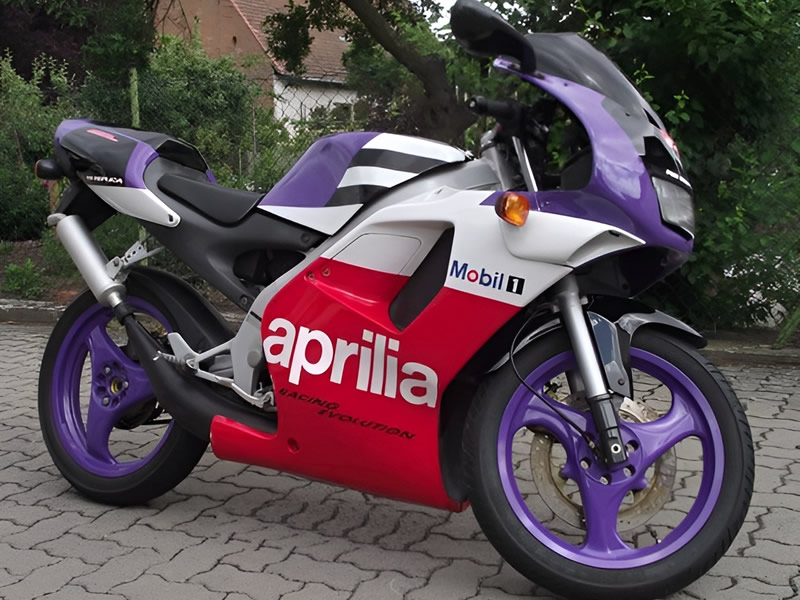
RS50 I, 1992 year, right view
There were several restylings over the years, including a modification of the front headlight and mirrors in 1995.
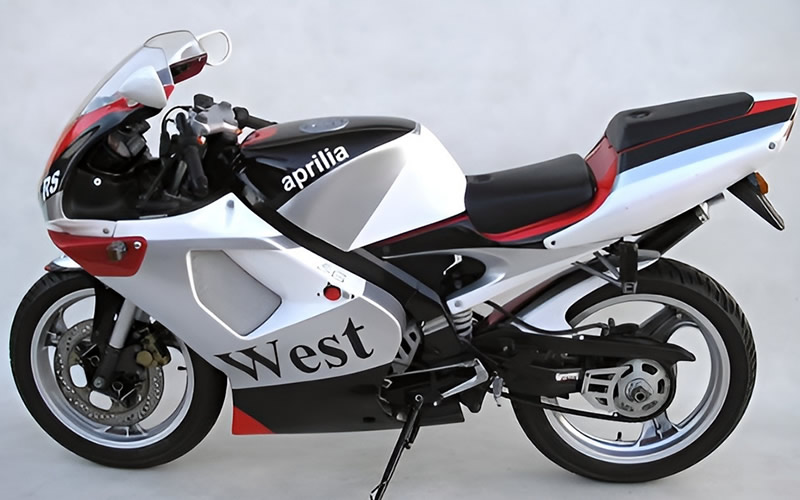
RS50 1993 year, left view
Second generation (1997-2005)
The «second generation», produced from 1997 to 2005, brought the front wheel to 17 inches, with larger channels of both wheels at the front (2.50" instead of 2.15") and the rear (3.00" instead of 2.75"), and the use of more traditional double-arm suspension, bringing the transmission and rear braking system to two separate sides of the motorcycle. Also, the frame was completely changed compared to the old series. The fairing became more bulky and voluminous, trying to replicate the 125/250 grand prix versions. The weight dropped from about 92–93 kg to 89 kg.
The second-generation Aprilia RS 50 has undergone a major styling change. The side fairings completely cover the engine. The passenger seat and the rear of the vehicle have been given a rounded shape. These two features are a reason for criticism, emphasizing the pseudo-sporty character of the small fifty. The moped has received a new cast aluminum frame, a regular two-arm rear swingarm with a single spring-damping element (monoshock) is used. The new model uses a Minarelli AM6 engine with a six-speed gearbox. The new braking system is very efficient, you need to pay attention to the front brake — it is very easy to block the front wheel.
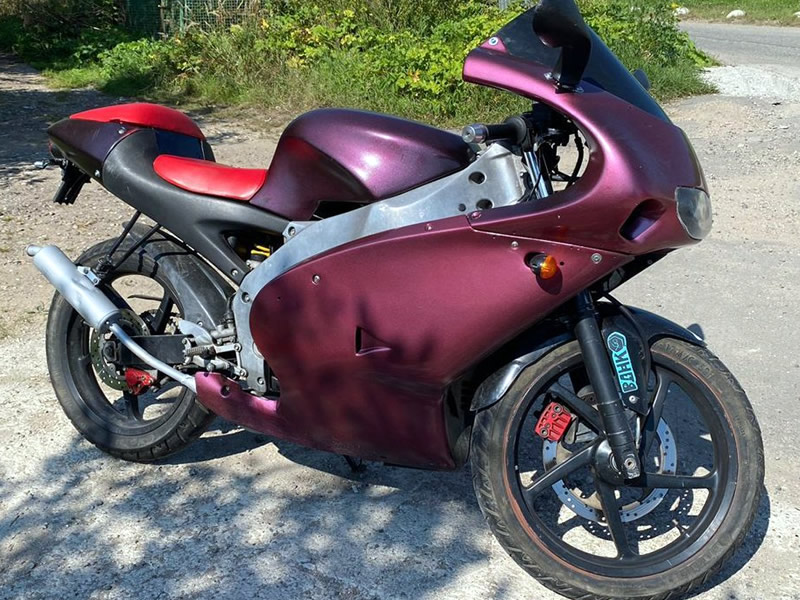
RS50 II, 2001 year, right view
In 2003, the moped was modified to meet the Euro 2 emission standard. The simple Dellorto SHA 14/12 carburettor was replaced with a more precise Dellorto PHBN 16, differing primarily in that it has a needle and an idle jet.
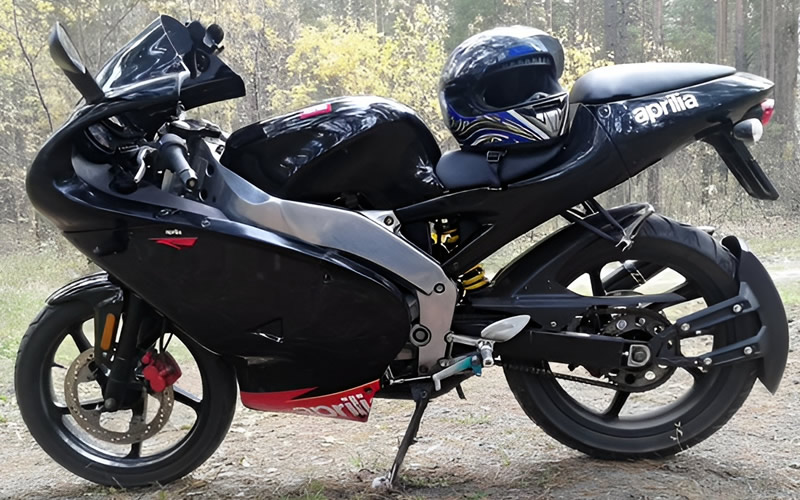
RS50 II, 2004 year, left view
Initially, the model competed with others, including Honda with the NSR 50 and Cagiva Mito 50. The RS 50 turned out to be a good compromise between quality and price. Over the years, most of the competitors disappeared and were subsequently replaced by other equally competitive and modern rivals such as the TZR 50 and GPR 50.
Third generation (2006-2013)
The «third generation», produced from 2006 to 2013, is closely derived from the Derbi GPR 50. Like its Spanish «cousin», it is equipped with first-class components, considering that it is and remains a moped. The differences are therefore only aesthetic. The dome, front mudguard and side fairings now adopt the same shapes as the fourth series of the RS 125, to continue the family feeling with the RSV 1000. Mechanically, we move on to wheels with a larger channel both at the front (2.75" instead of 2.50"), so that larger tires can be used (100 instead of 90 at the front), and the rear (3.50" instead of 3.00"), so that larger tires can be used there too (130 instead of 110 at the rear). Also, the new Derbi D50B engine block is adopted.
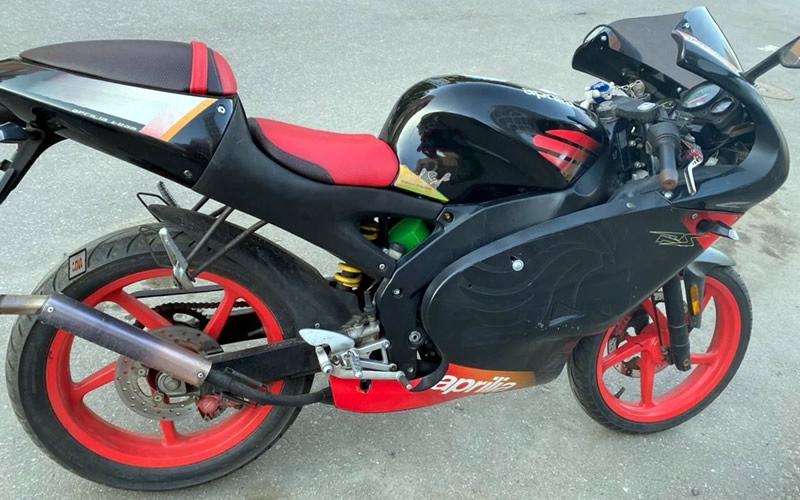
RS50 III, 2008 year, right view
The third generation is a great leap in design and technology. As a result of the incorporation of Aprilia into the Piaggio group in 2003, the new model was unified with another vehicle produced by the Piaggio group — the Derbi GPR 50. 90% of its components were used. Only minor stylistic changes are noticeable — mainly in the shape of the fairings, front lamp and counter. Aprilia has used many modern technical solutions in its smallest model, previously known from Superbike racing motorcycles, which is worth paying special attention to. This is a very light aluminum frame, aluminum rear swingarm, inverted front telescopes from Marzocchi, braking system from AJP — radially mounted front brake caliper and radial brake pump. LED turn signals, exhaust tip placed under the seat, digital-analog counter and aggressive styling with sharp lines add flavor. The drive unit is the Piaggio D50B1 engine meeting the EURO 2 emission standard, resulting from Piaggio's modernisation of the Derbi engine.
Technical features Aprilia RS 50 up to 2005
| Dimensions and weights | |
| Dimensions (length × width × height) | 1875 mm × 640 mm × 1090 mm (since 1996: 1920 mm × 720 mm × 1155 mm) |
| HeightsSeat: | 780 mm, from 1996: 810 mm |
| Minimum ground clearance: | from 1996: 170 mm Footrests: 355 mm |
| Wheelbase:1280 mm | Tank: 12.2 l, from 1996 13 l |
| Mechanics | |
| Engine type: Single cylinder 2-stroke Minarelli AM6 | Cooling: liquid |
| Displacement | 49.75 cm³ (Bore 40.3 × Stroke 39 mm) |
| Distribution: | reed valve |
| Power supply: | Dell'Orto SHA 14/12 carburetor, from 2001 PHBN 16 HS |
| Power:Couple: | Compression ratio: 12±0.5:1 |
| Clutch: | Multi-disc in oil bath |
| Gearbox: | 5-speed sequential (constant mesh) 1st 12/36 (3,000); 2nd 16/33 (2,062); 3rd 19/29 (1,526); 4th 22/27 (1,227); 5th 24/25 (1,042) from 1996 6 gears (always in mesh) 1st 12/36 (3,000); 2nd 16/33 (2,062); 3rd 19/29 (1,526); 4th 22/27 (1,227); 5th 24/25 (1,042); 6th 25/24 (0,960) |
| Ignition | electronics |
| Transmission | primary gear 20/71 (3,550);secondary chain |
| Start-up | electric CDI (fixed advance) |
| Cycling | |
| Chassis | double-beam aluminum |
| Suspensions | Front: 30 mm hydraulic fork Rear: monoshock with preload adjustment |
| Brakes | Front: 290 mm single disc, from 1996: 280 mm single disc Rear: 180 mm single disc |
| Tires | front 90/90 16 or alternatively 80/100 16 on rims with 2.15" channel; rear 110/80 17 or alternatively 100/80 on rims with 2.75" channel; from 1996 front 90/80 17 on rims with 2.5" channel; rear 110/80 17 on rims with 3" channel |
Technical features Aprilia RS 50 after 2006
| Dimensions and weights | |
| Dimensions (length × width × height) | 1965 × 720 × (maximum at the fairing) 1100 mm |
| Heights | Saddle: 810 mm |
| Wheelbase: 1310.5 mm | Unladen weight: 112 kg in running order, dry weight 89 kg | Tank: | 13 l |
| Mechanics | |
| Engine type: | Single cylinder 2-stroke Derbi D50B (Piaggio group) |
| Cooling: | liquid |
| Displacement | 49.9 cm³ (Bore 39.86 × Stroke 40.00 mm) |
| Distribution: reed valve | Power supply: Dell'Orto PHVA 17.5 carburetor |
| Power: | Couple: |
| Compression ratio: | 11.5:1 |
| Clutch: | Multi-disc in oil bath |
| Gearbox: | 6-speed sequential (constant mesh) 1st 11/34 (3.091); 2nd 15/30 (2.000); 3rd 18/27 (1.500); 4th 20/24 (1.200); 5th 22/23 (1.045); 6th 23/22 (0.956) |
| Ignition | CDI electronics (fixed advance) |
| Transmission | primary gear 21/78 (3,714); secondary chain 14/53 (3,785) |
| Start-up | electric |
| Cycling | |
| Chassis | double-beam aluminum frame with internally reinforced extruded profile |
| Suspensions | Front: "up-side-down" type telehydraulic fork (with upside-down stems) with 40 mm diameter stems and 120 mm travel Rear: Aluminium swingarm with reinforced double extruded arm and reinforcing truss, non-adjustable hydraulic monoshock, 110 mm wheel travel |
| Brakes | Front: stainless steel disc Ø300 mm Rear: stainless steel disc Ø180 mm |
| Tires | 100/80 17" tubeless front on 2.75" rims; 130/70 17" tubeless rear on 3.5" rims. |
Aprilia RS 125
The Aprilia RS 125 is one of the most successful models of Aprilia. It participates in various speed championships, both in the Italian Sport Production Championship and in the European Championship. In addition, Aprilia officially dedicated the corresponding single-brand championship to this model, as well as to its double-displacement sister.
This motorcycle is the evolution of the Aprilia Futura, the last descendant of the AF1 lineage born in the 80s with the Project 108 (the name of the project of the rear mono-arm, which also saw a legal dispute with Honda, which presented the VFR750R-RC30) and continued with different versions.
First generation (1992-1994)
As a result, with the advance of modernity, in 1992 the «first generation» was introduced, which would last until 1994. This series is called «Extrema», and it differs from the Aprilia AF1 due to the double-arm swingarm instead of the mono-arm, as well as the new frame and fairings derived from the 1991 Aprilia RSW 125. The engine remains the well-known Rotax 123, modified for the last time on the 1994 Extrema with a slightly more compressed head and an improved fusion crankcase, similar to that of the RX of the same year.
There are three models per year, easily distinguishable by the frame:
- In 1992, the frames were grey with a corrugated finish (painted), and the colour schemes were «plum» and Reggiani replica. However, it should actually be Gramigni replica, the rider who won the 125 title in 1992. This colour scheme arrived only after a few months — black rims on all models and number plates with only a white outline, there is an «Unlimited jeans» sponsor and technical sponsors at the bottom of the fairing;
- In 1993, the frames are still painted, but with a semi-opaque grey that tends to yellow on many specimens. It was sold in yellow/oil blue, purple/black, and Reggiani replica colour schemes (the rims are black, while Reggiani has purple rims, black number plates, replica stickers instead of «Unlimited jeans», no technical sponsors, and the word Reggiani on the plexiglass).
- From 1994, the frame is glossy for both the RS125R (the official designation of the «red fairing») and the RS125 Replica (which is Chesterfield). The fork changes in terms of both colours (black legs and slightly darker grey anodisation compared to the previous one) and caps, which have an external hexagon. In 1994, the head has greater compression, the fork hydraulics are revised, and there is the last series called Extrema. The speedometer becomes black background, and the brake calipers are gold/caramel colour. The SP version still has fork adjustments and has a differently shaped die-cast crankcase to ensure better mechanical qualities (it is not clear if this is also true for the standard version). The exhaust has an unremovable aluminium terminal, but covered with a genuine carbon tube. The front air intakes, to which the arrows are attached, become carbon look. Although not officially a Biaggi Replica, it is worth remembering that in 1994 it was the Roman rider with the 250 Chesterfield who won the world championship.
The Reggiani '93 sticker kit included the sport pro and replica writings, while the complete Chesterfield series exists in both replica and sport-pro versions with "double replica and sport-pro" stickers.
The sport-pro versions have a 28 carburetor, more precious and lighter Marchesini wheels (in '94 the rear channel becomes 4"), normally narrower tires, specific exhaust and cylinder, special ignition (the ECU has the writing aprilia racing) and kick start. The chassis of the normal Rs has the GS code, while the SP have the LA code. These "prefixes" of the homologation codes can be found on the expansion and exhaust silencer writings. The forks are adjustable (at the top of the right fork) like the mono-shock absorber. It seems that the front air intakes of the '94 are black and not carbon look. Also for the 1994 version, the SP calipers are black instead of gold/caramel. Without the described special components, the bike is a "re-assembled" one, whose historical value is that of a non-original/incomplete bike.
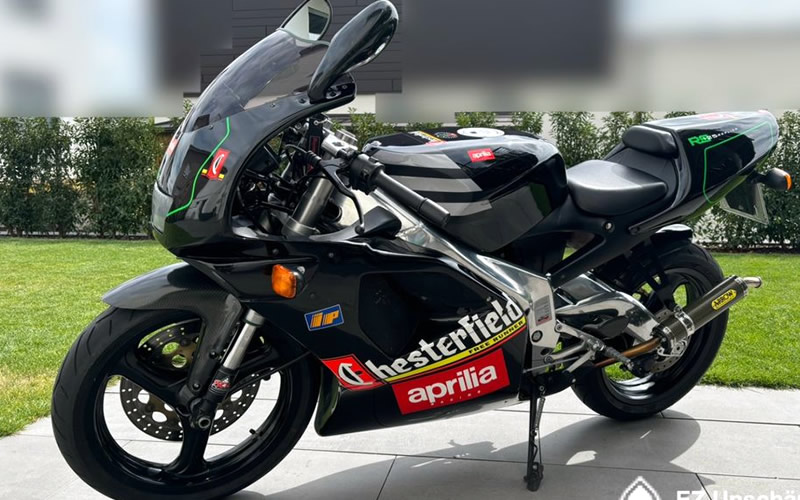
RS125 I, 1994 year, left view
In 1995, the second generation of the RS is born, which will still have the Extrema writing on the frame stickers and will include the "Biaggi replica" with a commemorative sticker of the victory in the 125 (with Kazuto Sakata and whose sponsor was not Chestefiled) and 250 world championships. The first "Chesterfield" Extrema came out in 1994 and is, together with the Reggiani (the first world champion rider with Noale's bikes in the 250), a milestone in the image of Italian sports motorcycling and Aprilia. Moreover, in 1994 Aprilia won both the 125 and 250 world championships.
Second generation (1995-1998)
The second generation replaced the previous one in 1995 and lasted until 1998. It is distinguished by the headlight, which is no longer inverted isosceles trapezoid, but of the semi-circle type, with the central and upper part slightly recessed. Additionally, it adopts the double side air intakes on the fairing, but simplified (integrated directly into the fairings) and expanded compared to the first series where they were protruding. Mechanical changes were also made, including the adoption of a new engine (Rotax 122 instead of Rotax 123) and an electrical system with variable advance ignition (SEM), with a new 180 W three-phase alternator replacing the previous 185 W two-phase alternator. The braking system is no longer only with Brembo calipers, but is now completely supplied by Grimeca, with calipers signed by Aprilia.
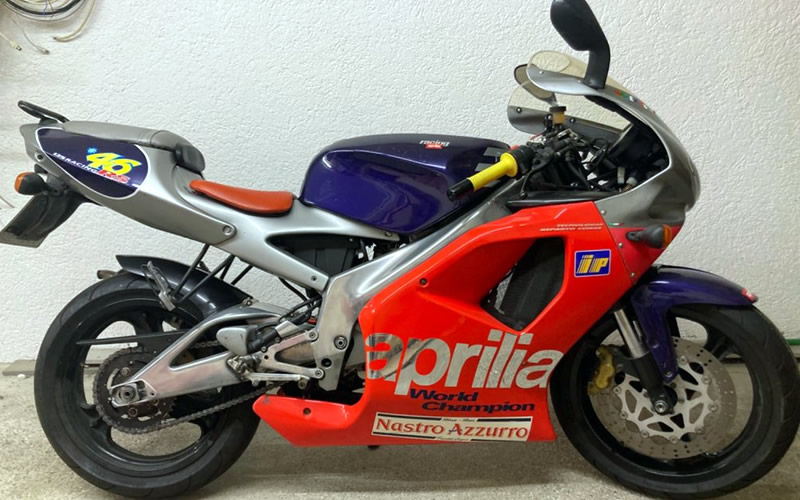
RS125 II, 1996 year, right view
This series continued to attract attention thanks to its true sports character, taking inspiration from the line of the new Aprilia RSW 125 from the motorcycle world championship. It was sold in various versions, such as the Silver version and the Valentino Rossi Replica.
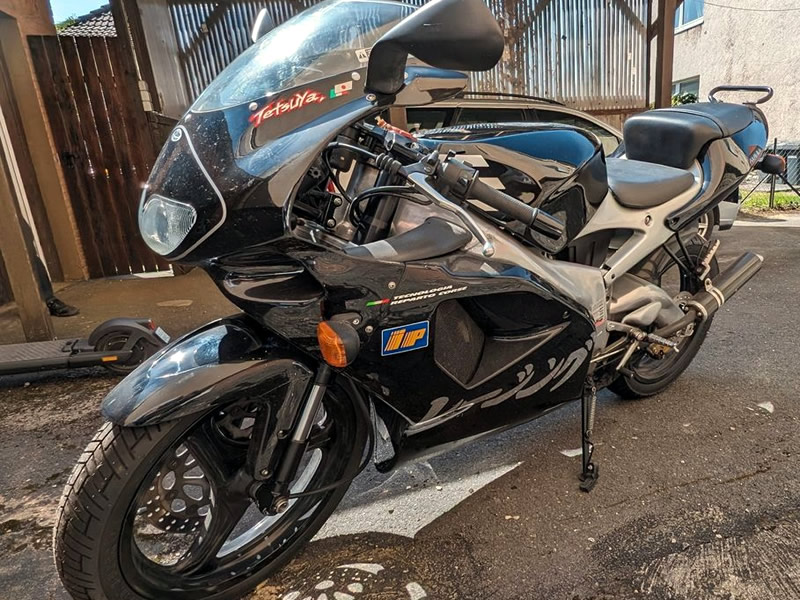
RS125 II, 1997 year, front view
Third generation (1998-2005)
The "third generation," introduced in 1998 and on the market until 2005, is inspired by the Moto GP model, featuring a fairly rounded aerodynamic setup with a downsized fairing. It includes the use of a single air intake on the right and more central position, narrower fairings without radiator slots, and a drop-shaped tail. Various color schemes and replicas of the motorcycle world championship were also produced for this model. Additionally, there was a change in the type of brake disc, which is now thicker by one millimeter (5 mm instead of 4 mm) but still with a diameter of 320 mm, paired with new five-spoke wheels instead of three, with respective 3" channels at the front and 4" at the rear.
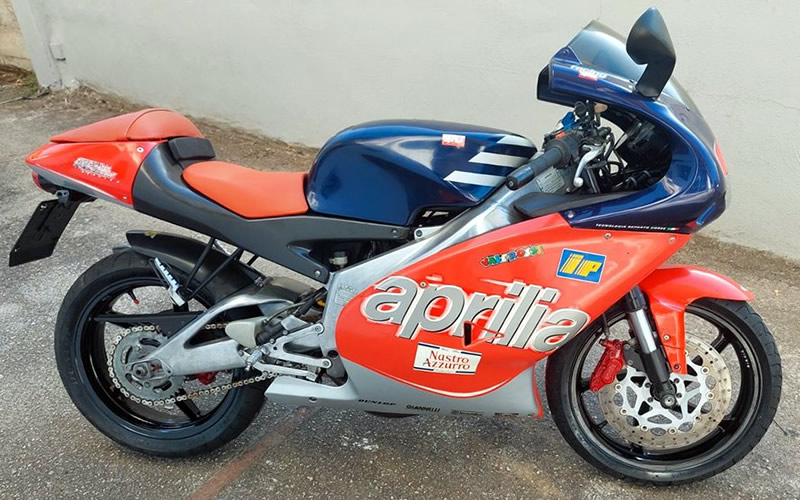
RS125 III, 1999 year, right view
To comply with European anti-pollution regulations and especially to allow sixteen-year-old novice riders to ride it, the Aprilia Rs 125, starting from 1995, was significantly power-limited from about 30 horsepower to 15 to fit within the A1 license limits.
These limitations consist of mechanisms that partially restrict the fuel mixture intake into the engine, restrictions in the exhaust expansion chamber, electronic limitations due to the absence of the valve actuator ECU, and the adoption of a fixed restrictor valve that no longer acts as a resonance regulator for the expansion chamber, but as an additional rev limiter and high-end torque limiter.
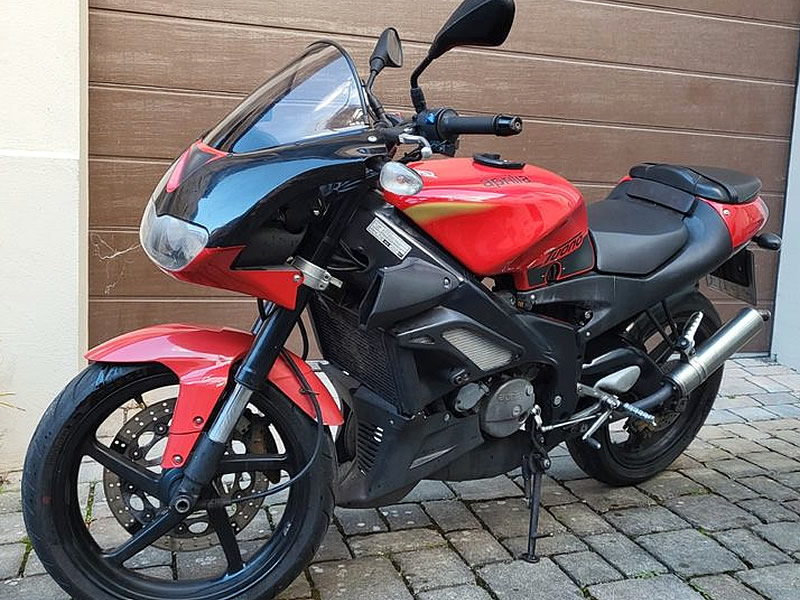
RS125 III, 2004 year, front view
To regain the bike's power for track use, starting from 1995, Aprilia released an easy-to-install kit (later named Full Power) that included a functional RAVE valve and a different expansion chamber. This kit could be used to restore the bike to its full power, as it was in previous years or outside of Italy.
Fourth generation (2006-2013)
Introduced in 2005, the "fourth generation" of the RS 125, as the "model of the year 2006," entered the market in 2006 and was produced until December 2013. It features completely revised fairings and mechanical components, such as brakes with radial calipers that make it resemble its larger sporty sibling, the RSV1000.
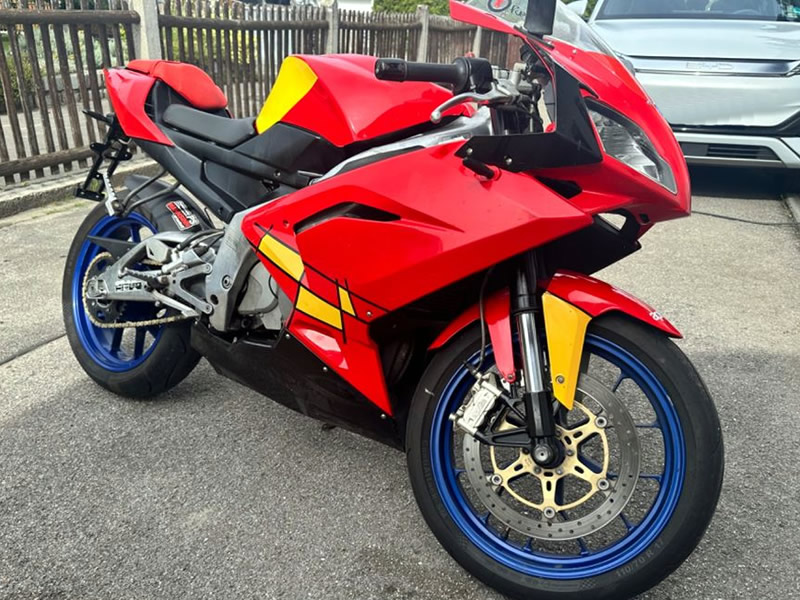
RS125 IV, 2007 year, front view
In 2007, a variant was released that, while aesthetically similar, adopted an electronic VHST 28 carburetor from Dell'Orto with a soap valve (in contrast to the previous cylindrical valve PHBH 28), a catalytic converter in the exhaust, a new Piaggio ECU, and a new 14,000 rpm tachometer instead of the previous 12,000 rpm. The ECU replaced both the old Nippon-Denso and the useful exhaust valve ECU, enclosing both in one unit and also presenting a variant for the bike's power increase. Additionally, a new indicator called EFI (Electronic Fuel Injection) was introduced for any malfunctions. All these changes were made to comply with Euro 3 regulations and to continue competing not only with the Mito but now also with the Derbi GPR 125 Racing and the Gilera SC 125 in the market.
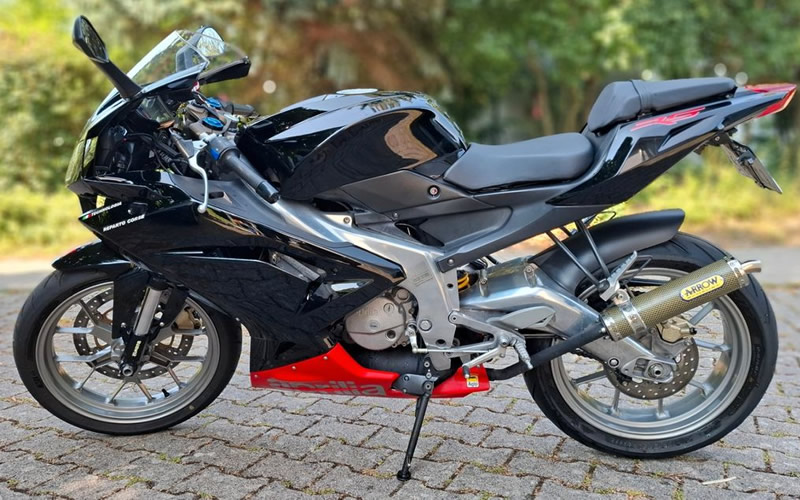
RS125 IV, 2010 year, left view
In 2008, three new color schemes were released: Spain's #1 (Replica Jorge Lorenzo #1), Nero Aprilia, and Rosso Fluo.
The Aprilia RS boasts sophisticated chassis components: an aluminum cast swingarm with asymmetric arms, one of which has a reinforcement brace, a shell frame with internal ribs directly derived from Noale's racing department, and in the latest models, a more refined front end with a disc brake featuring a 4-piston opposed radial caliper, ensuring more effective and modulated braking. It also includes lightweight alloy wheels and a lightened and visually appealing steering plate.
Technical features Aprilia RS 125 Extrema 1992
| Dimensions and weights | |
| Dimensions (length × width × height) | 1970 × 780 × 1100 mm |
| Heights | Seat: 800 mm Minimum ground clearance: 130 mm |
| Wheelbase: 1345 mm | Empty weight: 121 kg |
| Tank: | 14 l |
| Mechanics | |
| Engine type: Rotax 123, single cylinder 2-stroke | Cooling: liquid |
| Displacement | 124.8 cm³ (Bore 54.0 × Stroke 54.5 mm) |
| Distribution: reed valve | Power supply: Dell'Orto VHSB 34 LD mm carburetor |
| Power: | 32.34 HP at 11,500 rpm |
| Torque: | 2.02 kg·ma @ 11,500 rpm |
| Compression ratio: | |
| Clutch: Multi-disc in oil bath | Gearbox: 6-speed sequential constant mesh |
| Ignition | CDI electronics (with variable advance) |
| Transmission | in chain |
| Start-up | electric |
| Cycling | |
| Chassis | double-beam aluminum |
| Suspensions | Front: 40 mm upside-down hydraulic fork "MARZOCCHI" Rear: monoshock with preload adjustment "SACHS" |
| Brakes | Front: Single 320 mm Brembo disc Rear: Single 220 mm disc |
| Tires | 110/70 ZR 17 front; 150/60 ZR 17 rear |
Technical features Aprilia RS 125 2006
| Dimensions and weights | |
| Dimensions (length × width × height) | 1955 × 720 × 1100 mm |
| Wheelbase: 1345 mm | Empty mass: |
| Tank: | 14 litres (of which 3.5 litres reserve ) |
| Mechanics | |
| Engine type: Rotax 122, single cylinder two stroke | Cooling: liquid |
| Displacement | 124.8 cm³ (Bore 54.0 × Stroke 54.5 mm) |
| Distribution: | reed valve |
| Power supply: | Dell'Orto PBHB 28 carburetor from 2007 Dell'Orto VHST 28 electronic carburetor |
| Power: | 11 kW - 15 HP (detuned) 21 kW - 28.5 HP (full power) |
| Couple: | Compression ratio: 12.5 ± 0.5:1 |
| Clutch: | Multiple discs, in oil bath |
| Gearbox: | 6-speed sequential (constant mesh) 1st 10/30 (3,000); 2nd 14/29 (2,071); 3rd 17/27 (1,588); 4th 19/25 (1,316); 5th 21/24 (1,143); 6th 22/23 (1,045) |
| Ignition | CDI (variable timing advance) control unit |
| Transmission | primary Gear: 19/63 (3,316) final Chain: 17/40 (2,353) since 2010 16/40 |
| Start-up | Electric |
| Cycling | |
| Chassis | Double inclined beam in cast aluminium, with thin-walled shell structure and crossed reinforcement ribs |
| Suspensions | Front: Upside-down hydraulic fork, Ø40 mm, 120 mm wheel travel Rear: Cast aluminium swingarm with asymmetric arms and thin-walled shell structure, hydraulic monoshock with spring preload adjustment, 120 mm wheel travel |
| Brakes | Front: floating disc Ø320 mm, with radial caliper with four pistons with differentiated diameter Ø32 mm – Ø27 mm Rear: single disc Ø 220 mm, caliper with two pistons Ø30 mm; metal braided brake hoses |
| Tires | Tubeless radial, front 110/70 17”, rear 150/60 17” Rims: Aluminum alloy, front 3.00 x 17”, rear 4.00 x 17” |
Aprilia RS 250
The Aprilia RS 250 is an Italian motorcycle with a 249cc twin-cylinder engine derived from that of the Suzuki RGV Gamma 250, but slightly revised to achieve more power at high revs. The aluminum twin-spar frame dimensions, the front braking system with dual discs, adjustable inverted forks, and powerful engine made it one of the cult bikes of the 1990s.
Its introduction came almost simultaneously with the unexplained abandonment of the 250cc sector by Japanese manufacturers, who were present until the early 1990s with various models like the TZR, RGV Gamma, RGV R, and NSR. Aprilia was undeterred by the declining market for 250cc bikes and decided to invest in this category. The sales results and public appreciation for the bike's qualities proved them right.
First generation (1995-1997)
Aprilia found itself without direct competition in the sector, so the "first series" of the RS 250 (produced from 1995 to 1997) achieved unexpected success, also due to the very sporty characteristics of the bike. The only drawbacks reported by enthusiasts were the torque delivery, which although very linear, was lacking at low revs, the not very capacious fuel tank, and the issues caused by the exhaust control valves breaking, which could fall into the cylinder and cause significant damage to the engine.
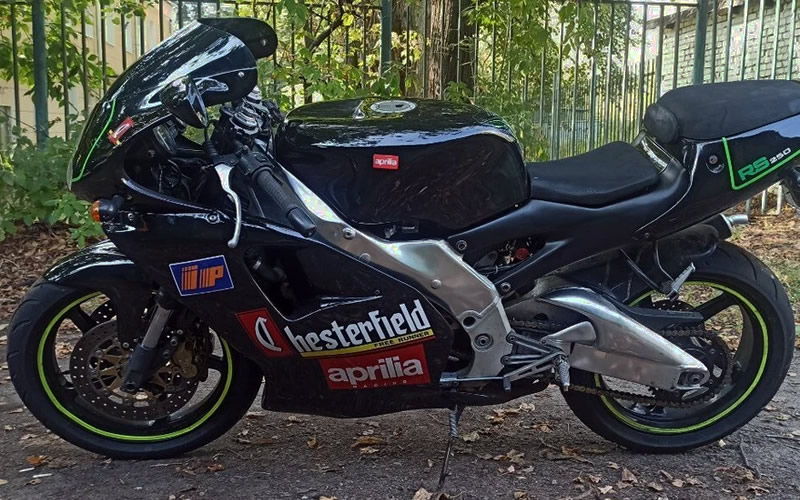
RS250 I, 1995 year, left view
Second generation (1998-2002)
The model was updated in various settings and components, with the so-called "second generation" from 1998, produced until 2002 in conjunction with the RS 50 and 125. The tail section took on a drop shape, the side slots for the radiator were eliminated, and the air intake was moved to the fairing, directly inspired by the Aprilia RSW bikes that raced in the GP 125 and 250. It was equipped with a larger capacity tank and a revised engine to provide more low-end torque without sacrificing high-end power, while also meeting increasingly restrictive emissions regulations. The front system (brake discs, calipers, and related pump) was also revised. The first available color scheme was the Valentino Rossi replica, inspired by the GP version, in purple, orange, and gray.
The bike retained its pure sporty nature, characterized by kick-start only, multiple adjustability capabilities for perfect everyday and track riding setups, very low weight that gave it high agility especially considering its power output.
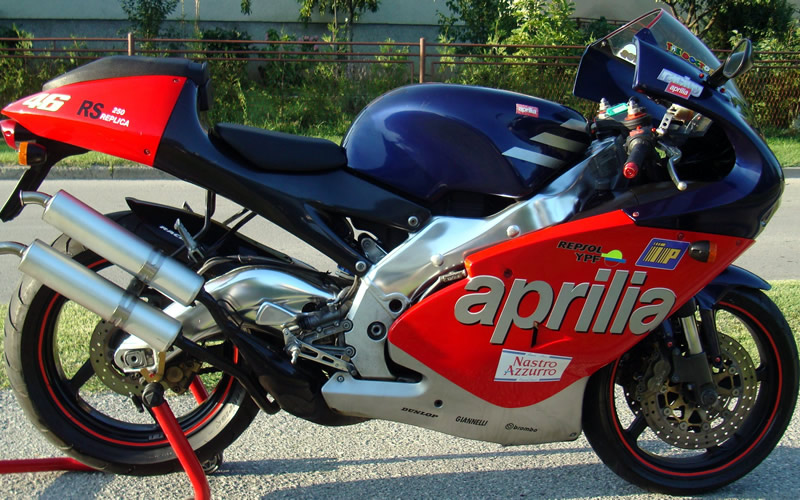
RS250 II, 2000 year, right view
The different years of the second series can be recognized (if original) by the color scheme of the fairings, usually reflecting the colors in which Aprilia riders competed in the previous year's motorcycle world championship.
Technical features Aprilia RS 250
| Dimensions and weights | |
| Dimensions (length × width × height) | 1980 × 690 × 1090 mm |
| Heights | Seat: 810 mm Minimum ground clearance: 135 mm |
| Wheelbase: | 1370 mm, from 19981360 mm |
| Unladen weight: | 149 kg dry, from 1998 onwards the kerb weight is 167 kg kg |
| Tank: | 16.5 l, from 1998 onwards it will be 19.5 l |
| Mechanics | |
| Engine type: 90° L-Twin 2-stroke | Cooling: liquid |
| Displacement | 249.25 cm³ (Bore 56 × Stroke 50.6 mm) |
| Distribution: | reed valve |
| Power supply: | 2Mikuni TM 34 SS carburetors |
| Power: | at the shaft 45 kw at 11,000 rpm |
| Torque: | 4.08 kgf·m / 10,750 rpm. |
| Compression ratio: | 12±0.7:1 |
| Clutch: | Multi-disc in oil bath |
| Gearbox: | 6-speed sequential constant mesh 1st 11/27 (2.454) 2nd 16/26 (1.625) 3rd 17/21 (1.235) 4th 22/23 (1.045) 5th 24/22 (0.916) 6th 25/21 (0.840) |
| Ignition | Digital CDI (3D variable advance) |
| Transmission | primary gear: 23/59 (2.565); final chain: 14/42 (3.000) |
| Start-up | by pedal |
| Cycling | |
| Chassis | double girder with cast elements and stamped aluminium sheet metal |
| Suspensions | Front: 40 mm "MARZOCCHI" multi-adjustable upside-down hydraulic fork (from '98 41mm "SHOWA") / Rear: multi-adjustable monoshock |
| Brakes | Front: 298 mm Brembo dual disc Rear: 220 mm single disc |
| Tires | 110/70 ZR 17 front on 3.00" channel rims; 150/60 ZR 17 rear or alternatively 160/60 ZR 17 on 4.50" channel rims since 1998 front 110/70 ZR 17 or 120/60 ZR 17 on rims with 3.50" channel; rear 150/60 ZR 17 or 160/60 ZR 17 |
| Declared performance | |
| Maximum speed | 205, since 1998 200 km/h |
| Acceleration | 0-400 meters: 12.6 s, from 1998 13.3 s; 0-100 km/h in 4.5 s, 5 s since 1998 |
| Consumption | extraurban 15.9; at 120 km/h 13.2; at the limit 7 |
- Information for owner
- Introduction to manual
- Maintenance
- Troubleshooting
- Engine and systems
- Engine repair
- Fuel system
- Cooling and lube system
- Running gear and frame
- Frame and hinged elements
- Front suspension and handlebar
- Rear suspension
- Brake system
- Wheels and tires
- Electric equipment
- Equipment and devices
- Starting and charging system