
Instructions for repair and maintenance of motorcycles Yamaha DragStar (V-Star)
See this section in russian language
This section contains workshop manual for the operation, repair and maintenance of Japanese cruiser motorcycles "Yamaha DragStar XVS1100", also called "V Star 1100", which were produced from 1998 to 2008.
Description and history of Japanese motorcycles Yamaha DragStar
| Content: | XVS125 XVS250 XVS400 XVS650 XVS950 XVS1100 XVS1300 |
DragStar XVS125 (2000-2004)
The Yamaha DragStar XVS125 is a cruiser-style motorcycle produced in 2000. It is equipped with a 124 cc air-cooled V-twin engine, which produces a maximum power of 13 hp at 10000 rpm and a maximum torque of 9 Nm at 8000 rpm. The transmission is a five-speed gearbox and the motorcycle has a maximum speed of around 100 km/h.
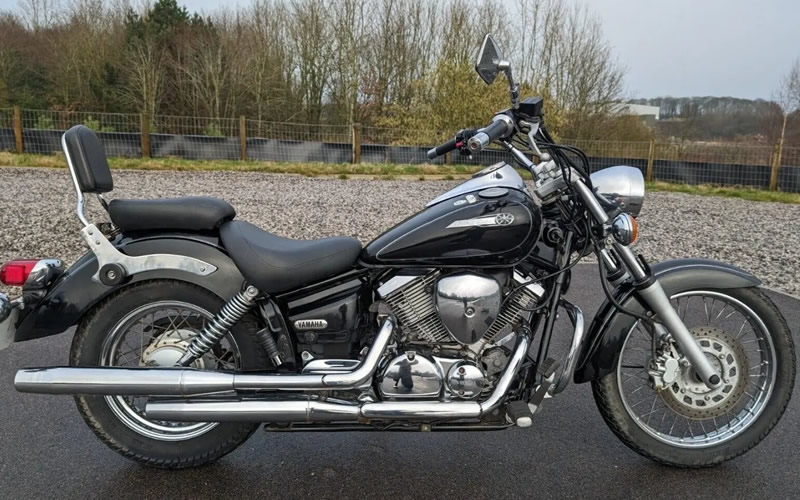
XVS 125, 2001 year, right view
The DragStar XVS125 has a double-cradle tubular steel frame, a telescopic fork at the front and a twin-shock rear suspension system. It has a 13-litre fuel tank and a kerb weight of 144 kg.
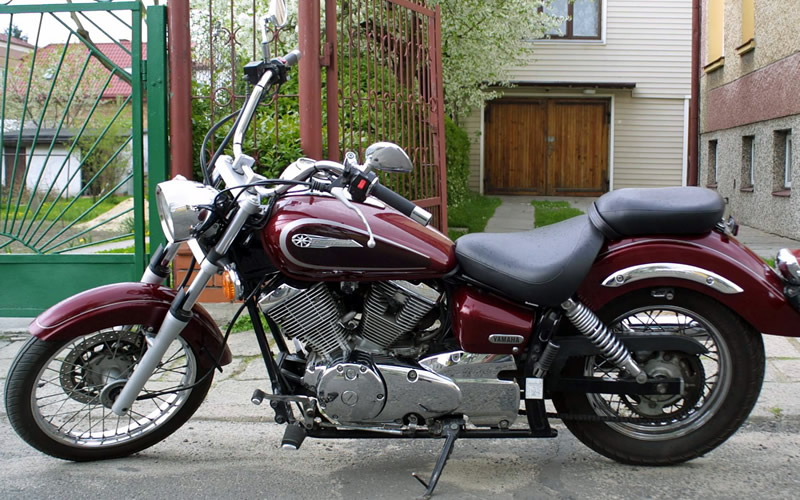
XVS 125, 2002 year, left view
The motorcycle is equipped with a front disc and rear drum brake system, with a front disc diameter of 282 mm. It also features an electric starter and a kick start system.
The Yamaha DragStar XVS125 is an ideal motorcycle for beginners and riders looking for an easy-to-ride and comfortable bike for urban commutes. Its low fuel consumption and timeless aesthetics make it a popular bike among cruiser enthusiasts.
Specifications XVS125
| Engine and transmission | |
| Displacement | 124 cc |
| Engine type | V2, four-stroke |
| Power output | 13 hp (9.4 kW) @ 10000 RPM |
| Torque | 9.4 Nm @ 8000 RPM |
| Compression | 11.0:1 |
| Bore x stroke | 41.0 x 47.0 mm |
| Valves per cylinder | 2 |
| Fuel control | Single Overhead Cams (SOHC) |
| Cooling system | Air |
| Transmission type | Chain (final drive) |
| Chassis | |
| Front suspension | Telescopic fork |
| Front wheel travel | 140 mm (5.5 inches) |
| Rear suspension | Swingarm Monocross |
| Rear wheel travel | 70 mm (2.8 inches) |
| Front tire | 80/90-M18 |
| Rear tire | 130/90-M15 |
| Front brakes | Single disc |
| Diameter | 282 mm |
| Rear brakes | Expanding brake (drum brake) |
| Diameter | 130 mm |
| Physical measures | |
| Dry weight | 144 kg |
| Seat height | 670 mm If adjustable, lowest setting. |
| Overall height | 1075 mm |
| Overall length | 2320 mm |
| Overall width | 910 mm |
| Ground clearance | 150 mm |
| Wheelbase | 1530 mm |
DragStar XVS250 (2001-2006)
When the XV250S Virago was phased out, it was succeeded by the Yamaha XVS250 Drag Star. The two models share many similarities, which is great news for current owners, as the long-standing Virago line has built a solid reputation over the years. The compact Yamaha XVS250 Drag Star upholds that legacy.
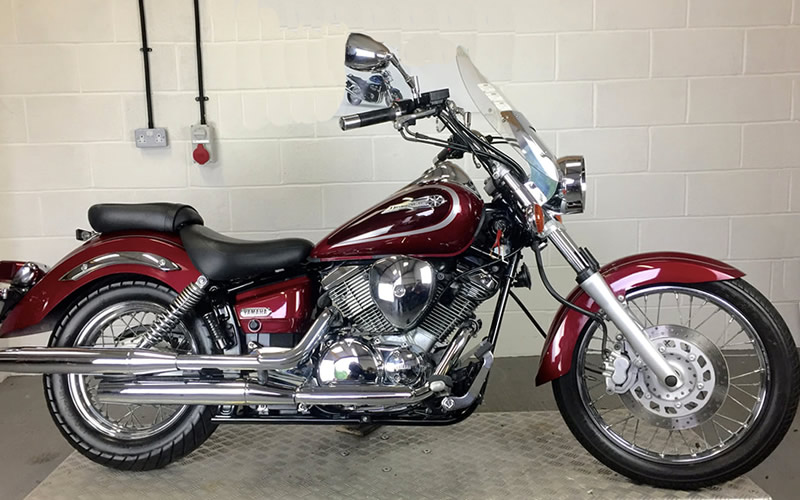
XVS 250, 2003 year, right view
Derived from the 250cc Virago and modified to meet updated emissions standards, this air-cooled, V-twin, four-stroke engine may not deliver peak power at higher RPMs, but it offers ample performance for navigating city streets with ease. Riding along winding roads is an enjoyable experience on the Yamaha XVS250 Drag Star.
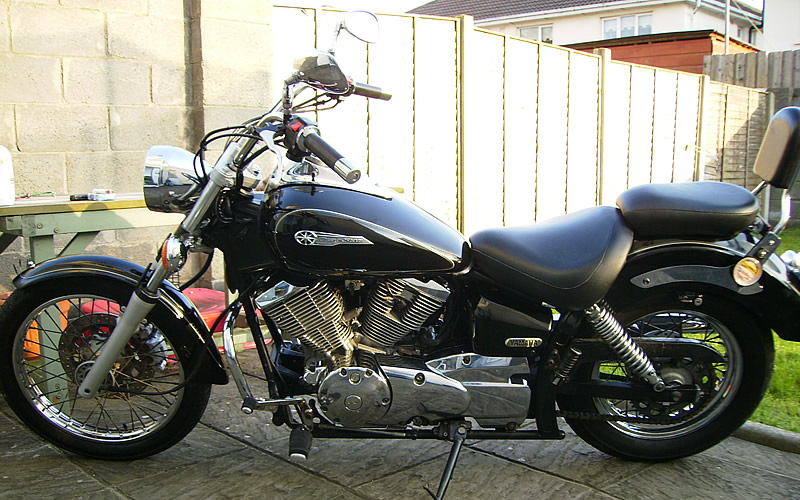
XVS 250, 2002 year, left view
Yamaha cruisers are known for their mechanical reliability and robust construction, and the XVS250 Drag Star is no exception to this rule.
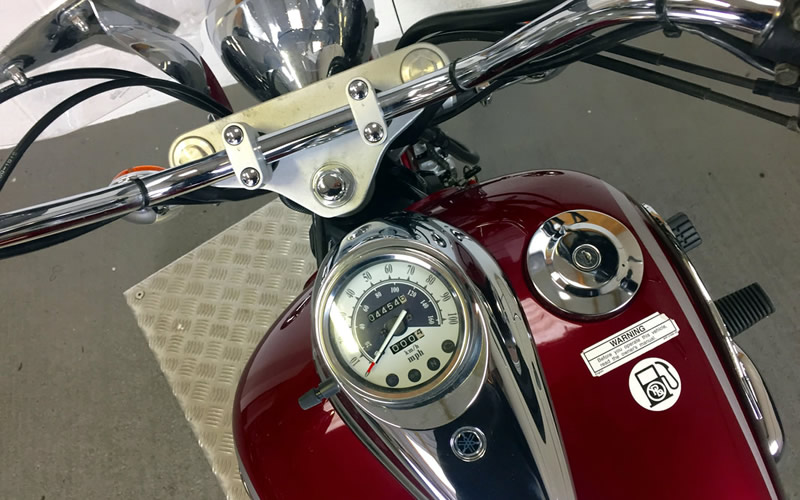
XVS 250, 2004 year, dashboard
Despite being a 250cc motorcycle, the Yamaha XVS250 Drag Star has a substantial presence, fitting seamlessly into any cruiser lineup. The instrument panel consists of a tank-mounted analog speedometer, complete with indicator lights and trip functions — simple yet stylish. However, the passenger accommodations on the Yamaha XVS250 Drag Star are limited, featuring only a small seat and a strap for support. With chrome exhaust pipes, wire-spoked wheels, and wide mirrors, the bike exudes classic cruiser aesthetics, and its low seat height makes it accessible for riders of all sizes.
Specifications XVS250
| Engine and transmission | |
| Engine size | 249 cc |
| Type of engine | V2, four-stroke |
| Output | 21 hp (15.3 kW) @ 8000 rpm |
| Torque | 21 Nm @ 6000 rpm |
| Top speed | 125 km/h |
| Bore x stroke | 49.0 x 66.0 mm |
| Valves per cylinder | 2 |
| Fuel system | Carburettor |
| Gearbox | 5-speed |
| Transmission type | Chain (final drive) |
| Chassis | |
| Front wheel travel | 140 mm |
| Rear wheel travel | 100 mm |
| Front tire | 80/100-P18 |
| Rear tire | 130/90-P15 |
| Front brakes | Single disc |
| Diameter | 252 mm |
| Rear brakes | Expanding brake |
| Diameter | 130 mm |
| Physical measures | |
| Dry weight | 147 kg |
| Seat height | 670 mm If adjustable, lowest setting. |
| Wheelbase | 1530 mm |
| Fuel capacity | 11.00 litres |
DragStar XVS400 (1996-2017)
The Yamaha XVS400 Drag Star cruiser model was released in 1996 as the successor to the Yamaha Virago 400. The main difference was the new duplex frame, which replaced the old backbone design, as well as the modified engine settings. The new engine, although it produced less power, provided better torque in the low and mid-range, which allowed the operating speed to be reduced by 1000 rpm. As a result, the maximum power was 33 hp, and the torque was 32 Nm, reaching their peak values at 6000 rpm.
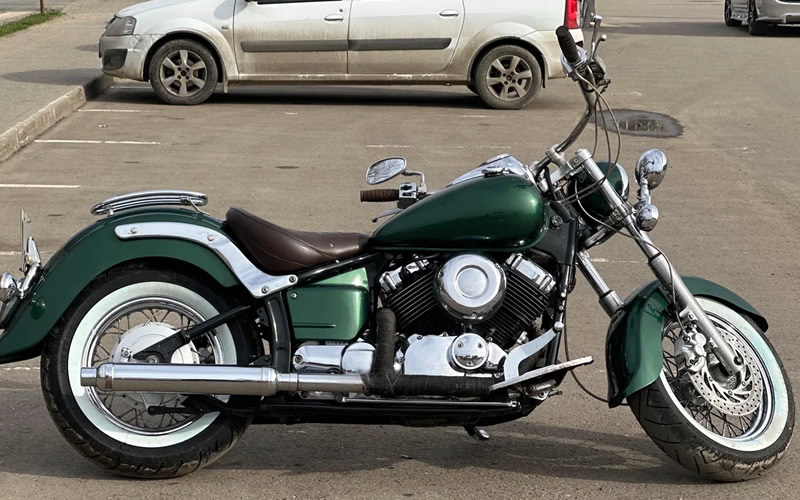
XVS 400, 1999 year, right view
This model was based on the older version of the Yamaha XVS650 Drag Star/V-Star, but differed in a smaller engine capacity and some updates. In addition, the Yamaha Drag Star 400 was developed exclusively for the Japanese market.
In 1998, the classic version was introduced – Yamaha Drag Star 400 Classic, which differed from the standard model by modified steering wheel, seat, fenders, headlight, as well as improved ergonomics and front wheel size. However, the technical characteristics remained the same.
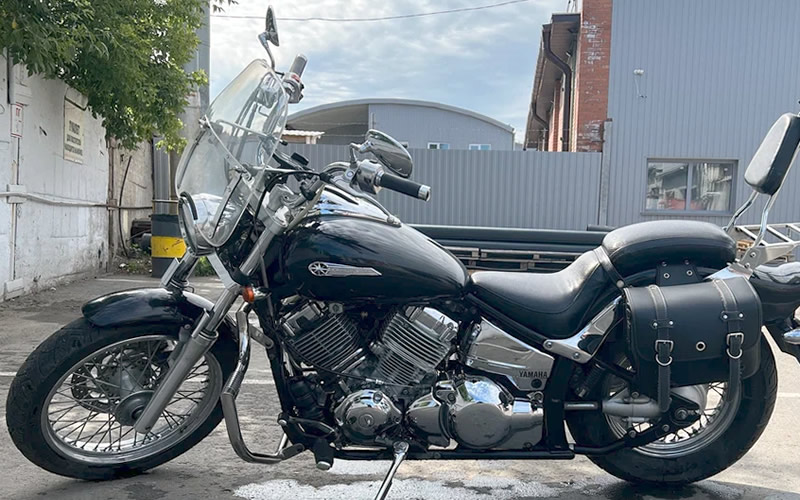
XVS 400, 2004 year, left view
In 2000, the model received an updated engine, which, although it did not change its characteristics, met new environmental standards. The instrument panel was also updated, now equipped with an electronic odometer and a fuel gauge.
In 2009, Yamaha introduced an updated version of the Drag Star 400, which became the 2010 model. It was equipped with electronic fuel injection and a catalytic converter, but the maximum power was reduced to 30 hp, and the torque to 31 Nm, which became available at 6250 rpm instead of the previous 6000.
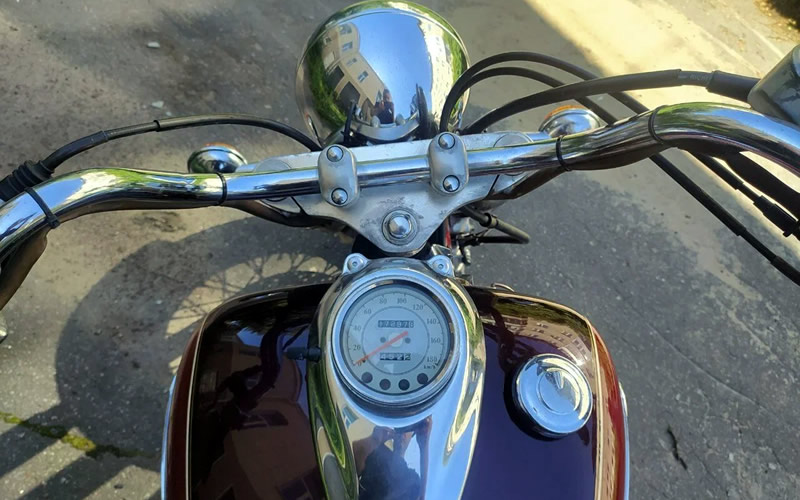
XVS 400, 1997 year, dashboard
2017 marked the end of production of this model, as new environmental standards made its further production impossible. However, the Yamaha Drag Star 400 continues to be actively sold at Japanese auctions, which makes it available for import to Russia. Today, the Drag Star 400 remains one of the most popular entry-level cruisers in the country.
Specifications XVS400
| Engine and transmission | |
| Displacement | 399 ccm |
| Power | 30 hp (22 kW) @ 7500 RPM |
| Torque | 31 Nm @ 6250 RPM |
| Gearbox | 5-speed |
| Clutch | Wet multiple plate coil springs |
| Fuel consumption | 2.6 litres/100 km |
| Frame, dampers, brakes and wheels | |
| Frame | Steel, double cradle |
| Front dampers | Telescopic |
| Rear dampers | Swing arm |
| Front tire | 130/90-16M |
| Rear tire | 170/80-15M |
| Front brakes | Single disc |
| Rear brakes | Expanding brake (drum brake) |
| Weight and dimensions | |
| Wet weight | 234 kg |
| Saddle height | 710 mm If adjustable, lowest setting. |
| Wheelbase | 1625 mm |
| Length | 2450 mm |
| Height | 1100 mm |
| Width | 1065 mm |
| Ground clearance | 140 mm |
| Fuel tank | 15.0 litres |
| Oil capacity | 3.20 litres |
DragStar XVS650 (1997-2007)
The 650 Dragstar is a motorcycle model, built by the Japanese firm Yamaha. Based on the engine of the 535 Virago, the DragStar 650's cylinders were rebored by an additional 5 mm (to 81 mm) and the stroke increased by 4 mm (to 63 mm), for a displacement of 649 cc. In the United States, the DragStar 650 was available in two models: the Custom with a seat height of 695 mm and the Classic version with a higher height of 708 mm. The Custom version weighs approximately 232 kg and the Classic is approximately 15 kg heavier at 247 kg.
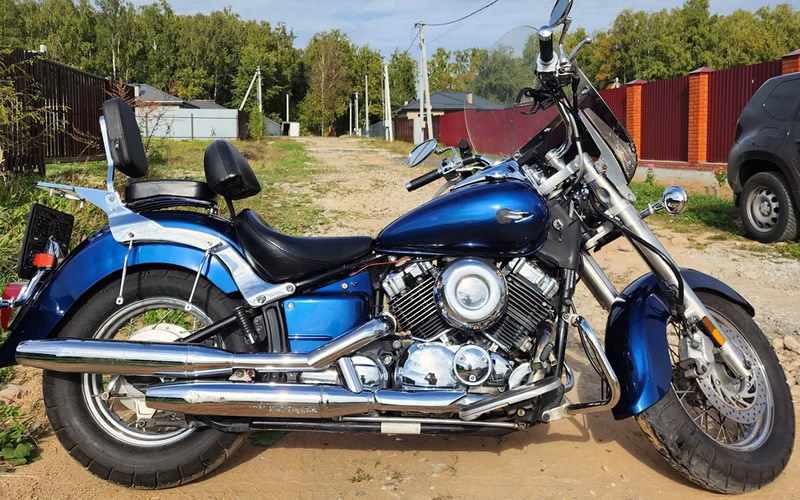
XVS 650, 2004 year, right view
The DragStar 650 was sold in the United States as the entry-level version of the V-Star line. This line was offered from 1998 to 2008 in two different versions: the Classic and the Silverado. Both versions were built around the same 649cc V-twin engine. The V-Star range offered the visual impact of larger V-twin motorcycles, combined with the fuel efficiency, reliability and handling of a mid-size motorcycle.
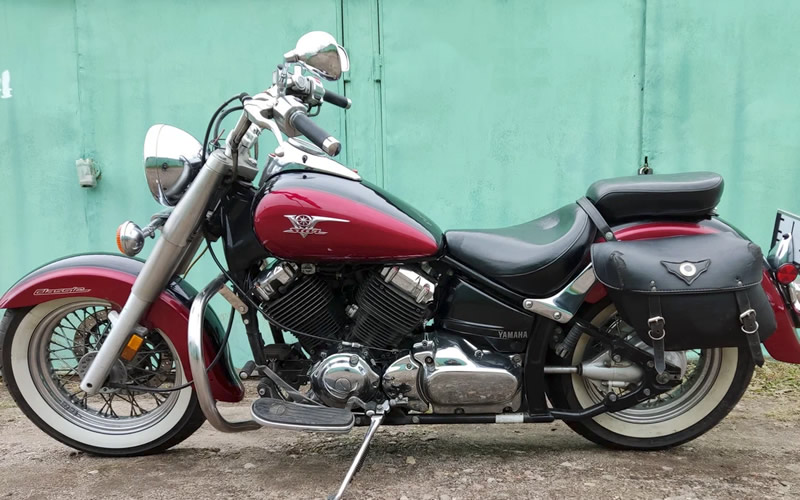
XVS 650, 2003 year, left view
Specifications XVS650
| Engine and transmission | |
| Displacement | 649 cc |
| Engine type | V2, four-stroke |
| Power output | 39.4 hp (28.8 kW) @ 6500 RPM |
| Torque | 50 Nm @ 5100 rpm |
| Compression | 9.0:1 |
| Bore x stroke | 81.0 x 63.0 mm |
| Fuel system | Carburettor. Mikuni BDS28/2 |
| Fuel control | Single Overhead Cams (SOHC) |
| Ignition | TCI |
| Lubrication system | Wet sump |
| Cooling system | Air |
| Gearbox | 5-speed |
| Transmission type | Shaft drive (cardan) (final drive) |
| Clutch | Wet, multiple disc |
| Chassis | |
| Front suspension | Telescopic fork |
| Front wheel travel | 140 mm |
| Rear suspension | Swingarm (Monocross) |
| Rear wheel travel | 105 mm |
| Front tire | 160/90-(16 |
| Rear tire | 170/80-M15 |
| Front brakes | Single disc |
| Diameter | 298 mm |
| Rear brakes | Expanding brake (drum brake) |
| Diameter | 200 mm |
| Physical measures | |
| Dry weight | 229 kg |
| Seat height | 710 mm If adjustable, lowest setting. |
| Overall height | 1105 mm |
| Overall length | 2450 mm |
| Overall width | 930 mm |
| Ground clearance | 145 mm |
| Wheelbase | 1625 mm |
| Fuel capacity | 16 litres |
DragStar XVS950 (2009-2017)
The Yamaha XVS 950 Midnight Star cruiser was first introduced in 2009 as a junior version of the Yamaha XVS 1100 Drag Star, which was updated to the XVS 1300 in 2008. In North America, this motorcycle is known as the Yamaha V-Star 950. It is aimed at beginner and intermediate riders, with full-size dimensions that give the impression of a more senior Yamaha XV1900 model, thereby avoiding the feeling of owning a budget version.
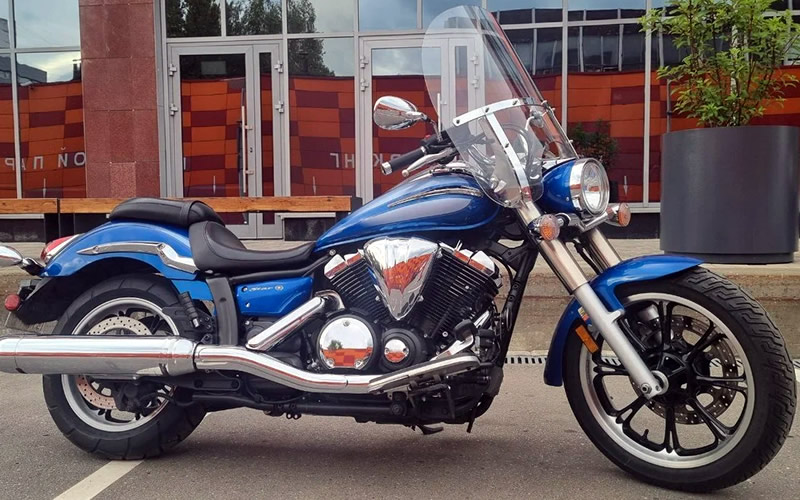
XVS 950, 2010 year, right view
The motorcycle is powered by a 942 cc, air-cooled V-2 engine that produces 54 hp and 77 Nm of torque. Peak performance is achieved between 3000 and 6000 rpm. This engine was also used in the Yamaha XV950 Bolt, released in 2013.
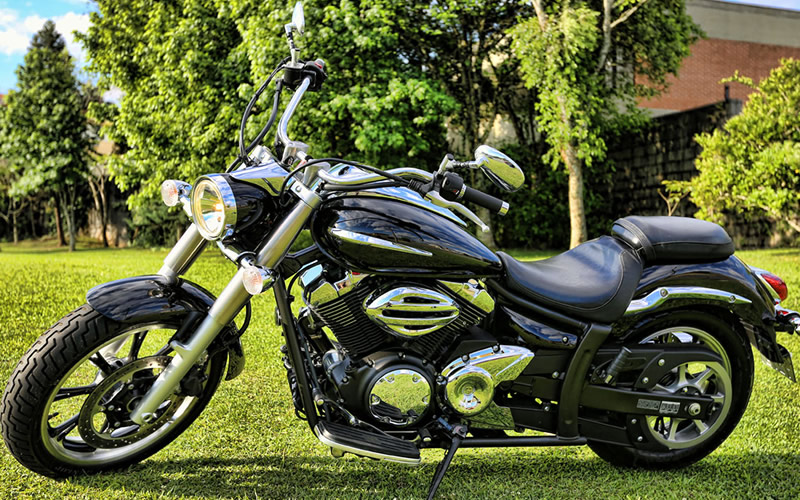
XVS 950, 2011 year, left view
When analyzing the Yamaha XVS 950, it becomes obvious that Yamaha wanted to create a cruiser aimed at the American market. This is reflected not only in the Harley-like design, but also in the engine characteristics. Firstly, the engine is not equipped with balance shafts. Secondly, to enhance vibration and the feeling of each pulse, the power strokes are located at 300° and 420°. Although such solutions may not be perceived as advantages in the European market, for sales in the USA they are necessary.
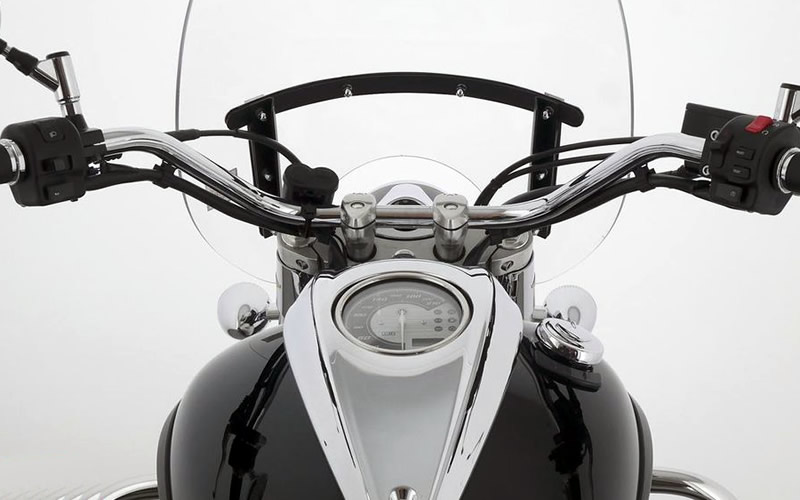
XVS 950, 2015 year, dashboard
Among the features of the Midnight Star 950 (V-Star 950) are a traditional steel duplex frame, simple suspension with a telescopic fork and monoshock absorber, disc brakes, fuel injection, a 5-speed transmission, belt drive, a fuel tank with a capacity of 17 liters and a curb weight of 278 kg.
Main modifications of the Yamaha Midnight Star 950 (V-Star 950):
- Yamaha XVS950A Midnight Star (also known as Yamaha V-Star 950) is a standard classic version.
- Yamaha XVS950A Drag Star Tourer (also known as Yamaha V-Star 950 Tourer) is a touring version with a windshield, passenger backrest and side panniers.
In 2017, the production of the Yamaha XVS950 (V-Star 950) model was completed.
Specifications XVS950
| Engine and transmission | |
| Displacement | 942 cc |
| Engine type | V2, four-stroke |
| Power | 53 hp (38.6 kW) @ 6000 rpm |
| Torque | 77 Nm @ 3000 rpm |
| Compression | 9.0:1 |
| Bore x stroke | 85.0 x 83.0 mm |
| Valves per cylinder | 2 |
| Fuel system | Injection |
| Fuel control | Single Overhead Cams (SOHC) |
| Ignition | TCI |
| Lubrication system | Wet sump |
| Cooling system | Air |
| Gearbox | 5-speed |
| Transmission type | Belt (final drive) |
| Clutch | Wet, multiple-disc |
| Chassis | |
| Frame type | Steel double cradle |
| Trail | 145 mm |
| Front suspension | Telescopic forks, ∅41 mm |
| Front wheel travel | 135 mm |
| Rear suspension | Swingarm |
| Rear wheel travel | 110 mm |
| Front tire | 130/70-M18 |
| Rear tire | 170/70-B16 |
| Front brakes | Single disc |
| Diameter | 320 mm |
| Rear brakes | Single disc |
| Diameter | 298 mm |
| Physical measures | |
| Weight | 278 kg |
| Seat height | 675 mm If adjustable, lowest setting. |
| Overall height | 1080 mm |
| Overall length | 2435 mm |
| Overall width | 1000 mm |
| Ground clearance | 145 mm |
| Fuel capacity | 17.0 litres |
| Oil capacity | 4.0 litres |
DragStar XVS1100 (1998-2008)
The Yamaha V-Star 1100, also referred to as the XVS1100 DragStar, was a cruiser motorcycle produced by Yamaha between 1998 and 2008. It was available in two distinct variants: the XVS1100 Custom and the XVS1100A Classic.
The XVS1100 Custom showcased a more contemporary design, while the XVS1100A Classic boasted rounded contours, a slightly elevated seat, and weighed 13 kg more than its Custom counterpart.
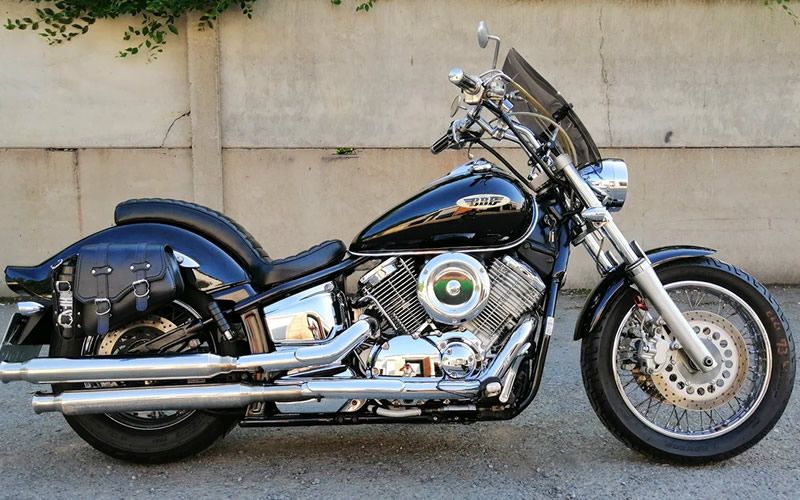
XVS 1100, 2002 year, right view
Both the V-Star 1100 and its smaller sibling, the V-Star 650, garnered positive feedback globally, with numerous aftermarket companies offering customization options for enthusiasts. Throughout its production run, the motorcycle underwent only minor updates.
The Classic version was launched in 2000 and differed from the Custom by incorporating floorboards, cast magnesium wheels, sturdier brake and shift levers, and longer fenders.
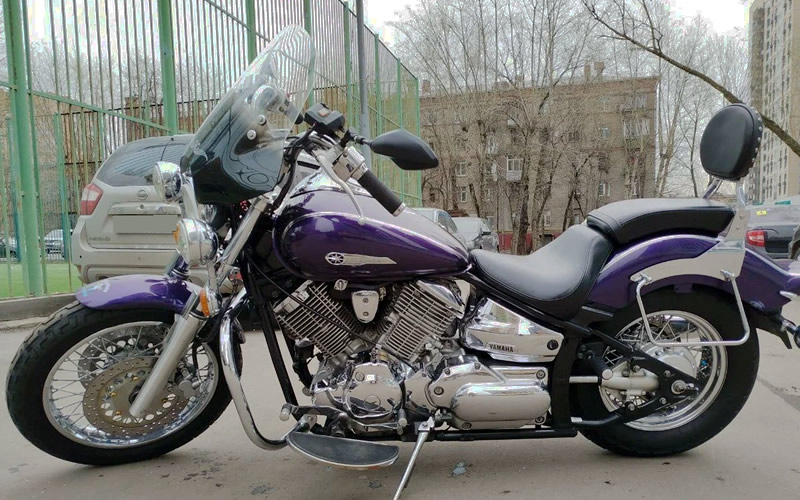
XVS 1100, 1999 year, left view
Additionally, Yamaha introduced the Silverado model, which included features like a windscreen, a sissy bar, and soft side bags.
For suspension, the Classic variant featured a telescopic fork at the front with 140 mm of wheel travel, while the rear was equipped with a single shock absorber, ensuring a smooth and comfortable ride.
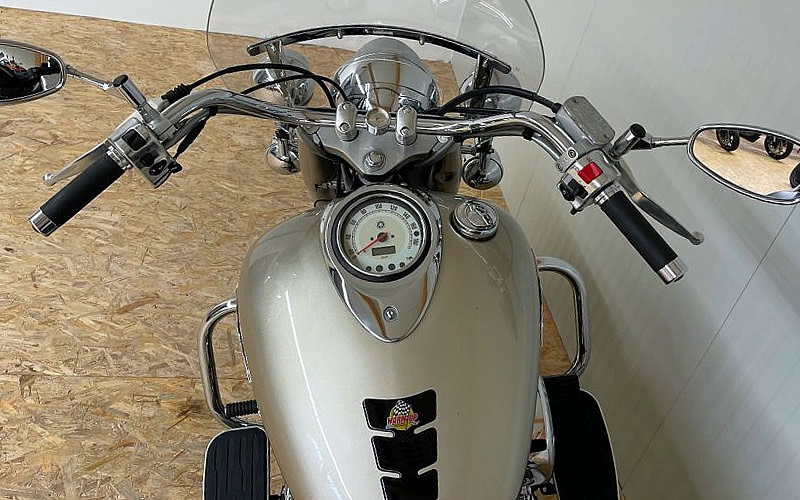
XVS 1100, 2005 year, dashboard
Braking was handled by two-piston calipers paired with two 298 mm discs at the front and a single-piston caliper with a 282 mm disc at the rear, delivering dependable stopping power.
The 2000 Yamaha V-Star 1100 Classic was powered by a 1063 cc air-cooled V-twin engine, paired with a five-speed manual transmission and shaft drive. It produced 62 hp at 5750 rpm and generated 85 Nm of torque at 2500 rpm.
Specifications XVS1100
| Engine and transmission | |
| Displacement | 1063 cc |
| Power | 60 hp (44 kW) @ 5750 rpm |
| Torque | 82 Nm @ 2500 rpm |
| Gearbox | 5-speed |
| Clutch | Wet multiple plate coil springs |
| Fuel consumption | 3.1 litres/100 km |
| Frame, dampers, brakes and wheels | |
| Frame | Double cradle |
| Front tire | 110/90-M18 |
| Rear tire | 170/80-M15 |
| Front brakes | Double disc |
| Rear brakes | Single disc |
| Weight and dimensions | |
| Dry weight | 262 kg |
| Wet weight | 278 kg |
| Saddle height | 690 mm If adjustable, lowest setting. |
| Wheelbase | 1640 mm |
| Length | 2405 mm |
| Height | 1100 mm |
| Width | 895 mm |
| Fuel tank | 17.0 litres |
| Oil capacity | 3.6 litres |
V-Star XVS1300 (2007-2017)
In 2007, Yamaha introduced the V-Star 1300, a cruiser motorcycle that remained in production until 2017. This model, also known as the XVS1300A Midnight Star and XVS13AW, was part of Yamaha's V-Star lineup, which featured a diverse range of cruiser-style motorcycles with varying engine sizes and designs.
The V-Star series encompassed a selection of cruisers, each tailored to different rider preferences. The V-Star 1300 was available in two configurations: a standard version and a touring variant.
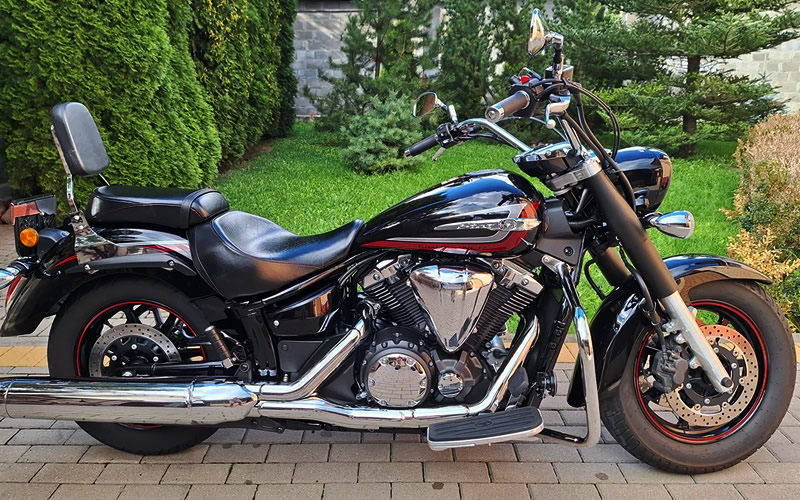
XVS 1300, 2013 year, right view
From the factory, the Yamaha V-Star 1300 came equipped with a host of classic features, such as a stylish two-into-one chrome exhaust system, a relaxed pull-back handlebar, a comfortable two-piece dual seat positioned low for an inviting riding experience, elegantly valanced fenders, and eye-catching seven-spoke cast aluminum wheels.
In addition to the standard model, Yamaha offered a touring edition that included a range of accessories designed for long-distance travel. This version featured a passenger backrest for enhanced comfort, a tall windscreen to shield against wind and weather, and sturdy leather-wrapped saddlebags for extra storage capacity.
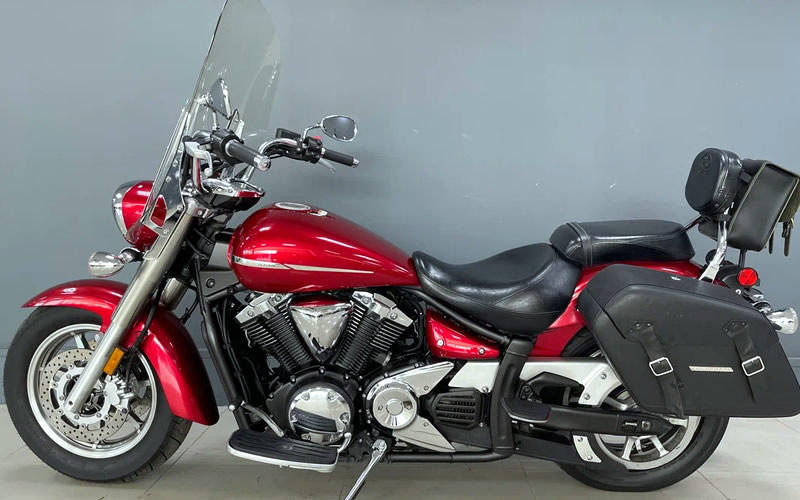
XVS 1300, 2009 year, left view
Powering the Yamaha V-Star 1300 was a robust 1311 cc four-stroke liquid-cooled V-twin engine, identical to that found in its predecessors. This engine utilized a fuel injection system, producing approximately 70 hp and 111 Nm of torque at 4000 rpm.
The braking and suspension systems were inherited from earlier models, featuring a rear setup with a 282 mm disc paired with a single-piston caliper, while the front utilized dual-piston calipers with two 298 mm discs for reliable stopping power.
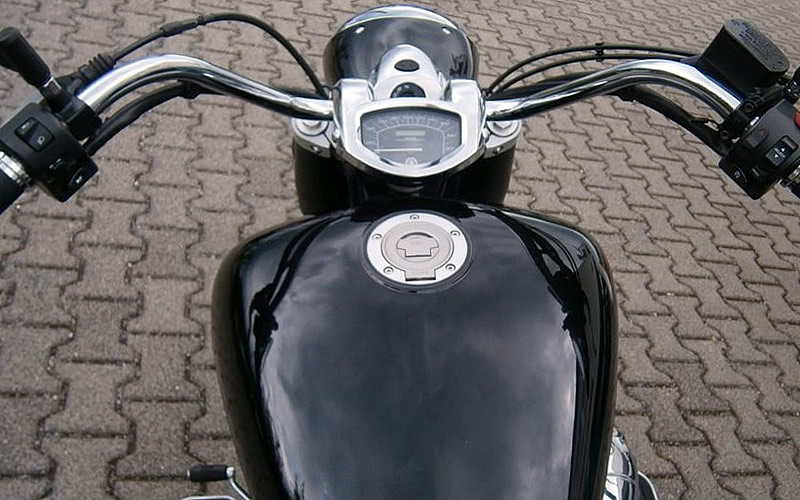
XVS 1300, 2016 year, dashboard
For suspension, the V-Star 1300 was equipped with a 41 mm telescopic fork at the front and a rear shock absorber with adjustable spring preload, ensuring excellent handling and ride quality.
Specifications XVS1300
| Engine and transmission | |
| Displacement | 1311 cc |
| Engine type | V2, four-stroke |
| Power output | 70 hp (51 kW) |
| Torque | 111 Nm @ 4000 rpm |
| Compression | 9.5:1 |
| Bore x stroke | 100.0 x 83.0 mm |
| Fuel system | Injection |
| Fuel control | Single Overhead Cams (SOHC) |
| Ignition | TCI: Transistor Controlled Ignition |
| Lubrication system | Wet sump |
| Cooling system | Liquid |
| Gearbox | 5-speed |
| Transmission type | Belt (final drive) |
| Fuel consumption | 5.6 litres/100 km |
| Chassis | |
| Frame type | Double Cradle |
| Front suspension | Telescopic fork |
| Front wheel travel | 135 mm |
| Rear suspension | Single shock |
| Rear wheel travel | 109 mm |
| Front tire | 130/90-M16 |
| Rear tire | 170/70-B16 |
| Front brakes | Double disc |
| Diameter | 298 mm |
| Rear brakes | Single disc |
| Diameter | 298 mm |
| Physical measures | |
| Dry weight | 290 kg |
| Weight incl. oil, gas, etc | 303 kg |
| Seat height | 714 mm If adjustable, lowest setting. |
| Overall height | 1115 mm |
| Overall length | 2489 mm |
| Overall width | 980 mm |
| Wheelbase | 1689 mm |
| Fuel capacity | 18.5 litres |
- Information for owner
- Introduction to manual
- Control devices
- Driving motorcycle
- Maintenance
- Troubleshooting
- Engine and systems
- Engine repair
- Lubrication system
- Carburetor repair
- Starting and charging system
- Transmission
- Running gear and frame
- Front suspension and handlebar
- Rear suspension
- Brake system
- Wheels and tires
- Electric equipment
- Equipment and devices
- Starting and charging system
- Electrical circuits