
Triumph:
Repair manuals for English motorcycles Triumph Street Triple
See this section in russian language
The instructions presented here are intended for repairing the English city motorcycle "Triumph Street Triple R/RS" of the fourth generation, produced from 2017 to 2024.
Description and history of motorcycles Triumph Street Triple
| Content: | Mk1 (2007-2011) Mk2 (2011-2012) Mk3 (2013-2017) Mk4 (2017-) |
The Triumph Street Triple, a standard motorcycle produced by Triumph Motorcycles since 2007, is intricately designed based on the Speed Triple 1050. It features a re-engineered inline three-cylinder 675 cc engine, derived from the Daytona 675 sport bike that debuted in 2006.
In 2007, the motorcycle press buzzed with spy photos and speculative design sketches, with one publication even capturing a road test of the finished Street Triple. Subsequent articles revealed leaked design images, and on March 6, 2007, a report surfaced showcasing the completed bike to dealers, accompanied by a spy video of a test ride.
First generation (2007-2011)
The Triumph Street Triple was officially introduced in 2007, stepping in to fill the void left by the 600 Speed Four. It adopts the design language of modern Triumph naked bikes, which was first established with the Speed Triple in 2005. This includes high-mounted twin mufflers and dual circular headlights, complemented by a dashboard unit positioned atop the front end. A notable distinction of the Street Triple is its conventional swingarm, contrasting with the single-sided swingarm found on the Speed Triple. Many components are shared with the Triumph Daytona 675, particularly evident in the frame and swingarm. The 675cc three-cylinder engine, borrowed from the Daytona 675, has been re-tuned for a more street-friendly performance, making it suitable for daily riding while delivering an impressive output of 79 kW (106 bhp) at 11750 rpm. Triumph opted for a new naming convention for this model, avoiding a straightforward displacement addition to the Speed Triple name, thereby marking its distinct place in Triumph's history.
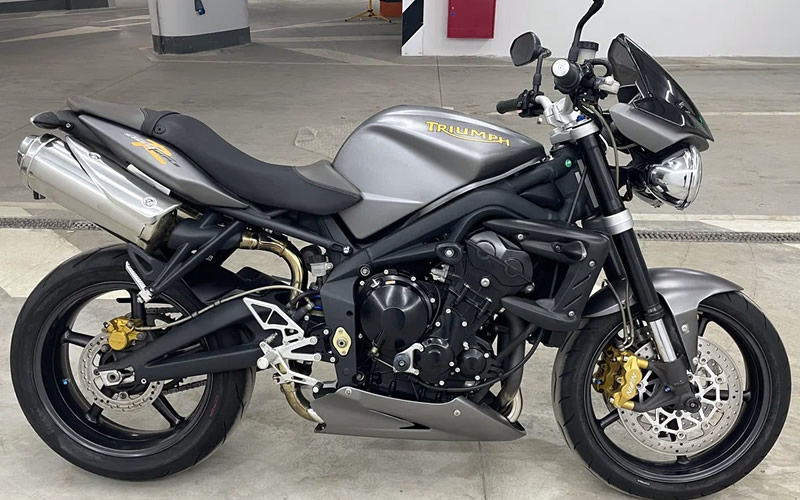
Street Triple, 2009 year, right view
In 2008, Triumph unveiled the Street Triple R, which shares the same engine and chassis as the standard model but boasts fully adjustable suspension at both the front and rear, inherited from the Daytona. This revised rear suspension results in a slightly elevated seat height compared to the standard version and a sharper rake angle. The front brake system is also taken from the Triumph 675 Daytona, featuring a fully radial Nissin setup, including the master cylinder and calipers. Additional minor upgrades differentiate it from the standard model, including variations in handlebars, seating, and color options, notably matte orange and matte grey.
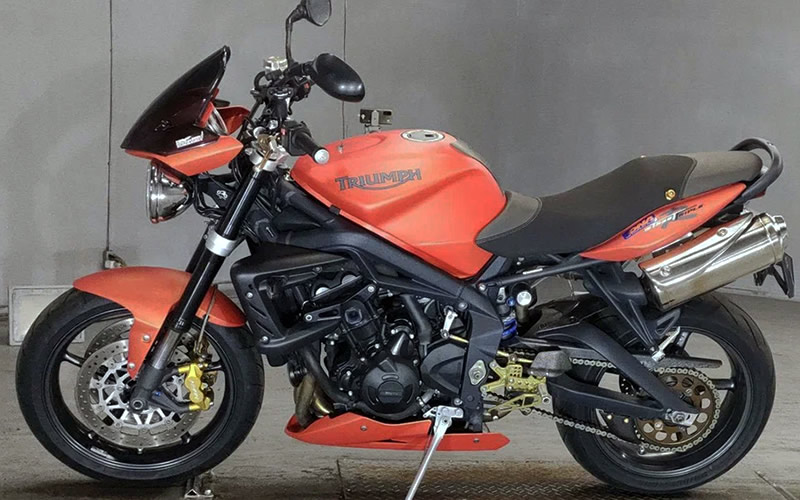
Street Triple, 2008 year, left view
In 2010, Triumph introduced the Tiger 800 and Tiger 800 XC, which utilize a longer stroke version of the Street Triple engine.
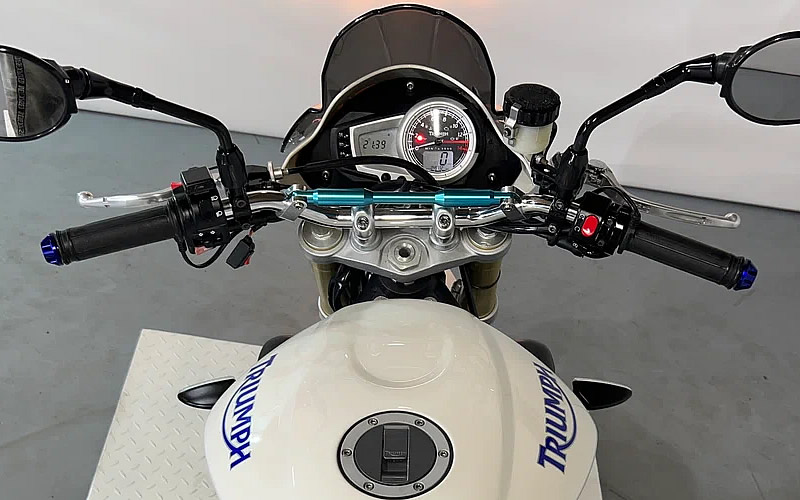
Street Triple, 2010 year, dashboard
Second generation (2011-2012)
For the 2012 model year, the Street Triple's iconic circular headlights were replaced with an angular design, aligning with the new aesthetic of modern naked models, a change first seen in the 2011 Speed Triple 1050. This shift sparked controversy, as the circular headlights had been a hallmark of modern naked bikes since 1997, earning the new iteration the nickname "bugeye" due to its insect-like appearance. Other cosmetic alterations included redesigned side casings, a brushed aluminum finish around the exhaust, black rear sets, and updated graphics. Importantly, these changes were purely aesthetic; the engine and mechanical components remained unchanged.
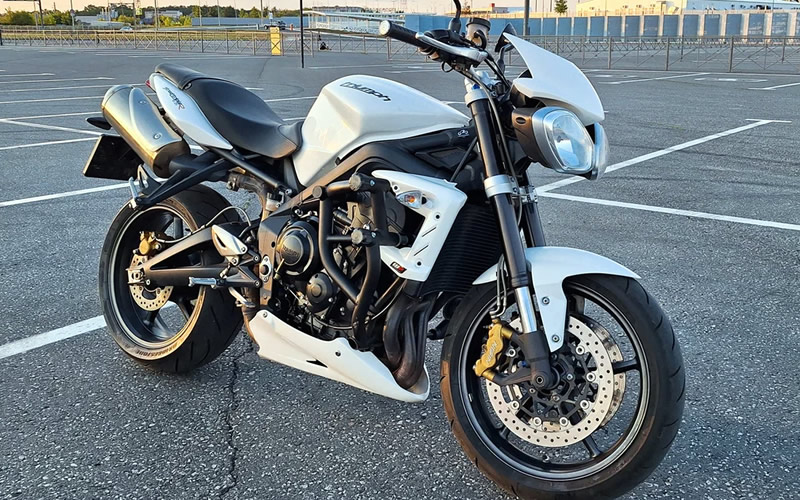
Street Triple, 2012 year, front view
Third generation (2013-2017)
In 2013, Triumph revamped the Street Triple's chassis, introducing a new frame constructed from aluminum but with fewer components and welds. The caster angle was adjusted from 24.3° to 24.1°, and the previous tubular sub-frame was replaced with a new aluminum cast sub-frame. A significant modification was the relocation of the exhaust to a position beneath the engine, replacing the underseat exhaust from the prior model, which shifted the center of mass forward and downward. The bike also received lighter rims, contributing to a total weight reduction of 6 kg, making it the lightest iteration of the Street Triple. While the engine specifications remained unchanged, the first gear was notably lengthened by adopting the gear ratios from the Daytona 675. This generation also introduced new suspensions, brake discs that could be paired with a multi-mode disengageable ABS, a coded key, increased storage space under the seat, an updated dashboard featuring a fuel gauge, improved finishes, new mirrors, and subtle modifications to the tank base.
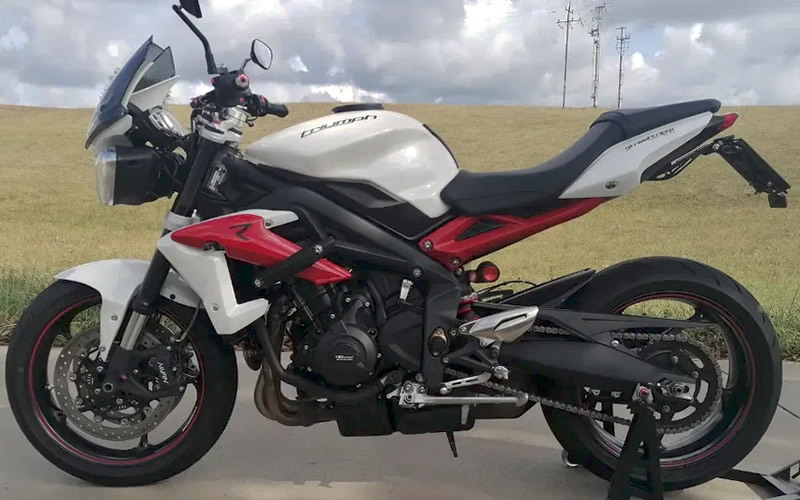
Street Triple R, 2014 year, left view
The Street Triple R featured a red sub-frame and a narrower caster angle, reduced from 23.9° to 23.4°. The R model retained its distinctiveness with a 19 mm radial master cylinder and radial four-piston brake calipers paired with 310 mm discs. Its suspension system, comprising a 41 mm inverted fork and a separate reservoir shock, offered adjustability for rebound, compression, and preload. An optional disconnectable and configurable feature was also available.
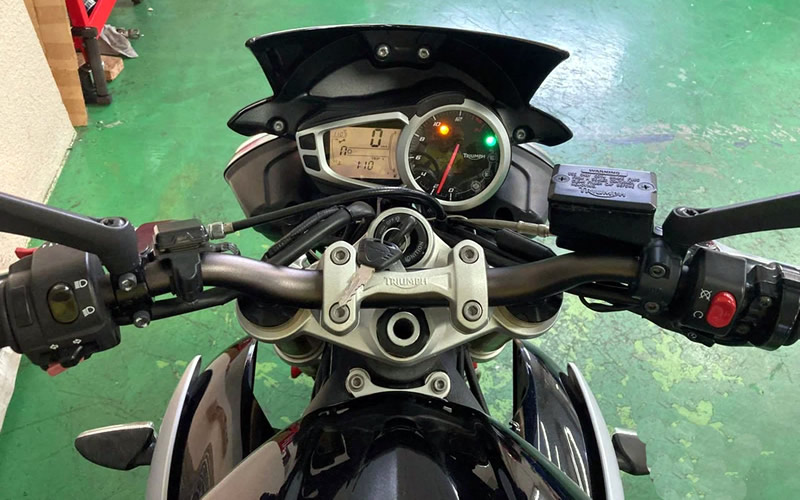
Street Triple, 2015 year, dashboard
In February 2015, Triumph launched the Street Triple Rx, based on the R model, which included the angular seat unit from the Daytona 675, a quick-shifter, and unique color options with red rims across all schemes.
Fourth generation (2017-present)
In January 2017, Triumph announced the replacement of the 675 cc Street Triple with a new lineup of 765 cc models, officially launched as 2018 models. Despite the increase in engine capacity by 90 cc, the new models are slightly lighter than their 675 cc predecessors, maintaining compact engine casings. This generation features four variants: the base model S, the mid-range R, and the high-spec RS. Consistent with earlier models, the headlight design is shared with the 2016 Speed Triple.
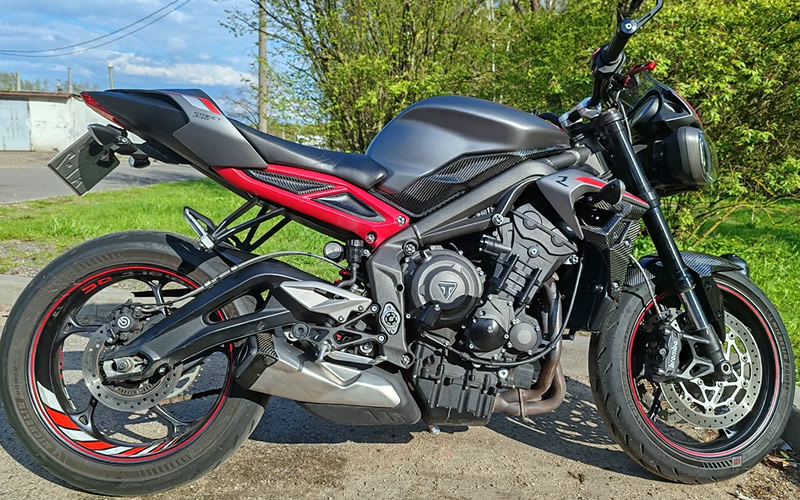
Street Triple R, 2020 year, right view
Each model offers varying levels of equipment, including differences in brakes, suspension, and the inclusion of a quick shifter, along with distinct power outputs: 113 hp (84 kW) for the S, 118 hp (88 kW) for the R, and 123 hp (92 kW) for the RS. Additionally, a 660 cc version of the S has been made available for the UK's A2 license. Triumph also introduced a Low Ride Height (LRH) variant of the R model, which lowers the seat height to 780 mm by adjusting the front stroke, shortening the rear shock, eliminating rebound adjustment, and modifying the seat profile, while retaining all other features of the R model.
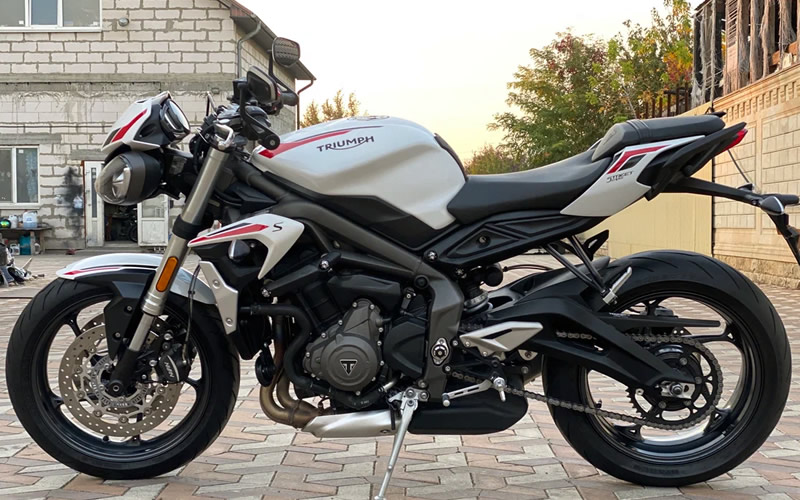
Street Triple S, 2021 year, left view
In 2020, the Street Triple underwent a mid-cycle update. The more track-oriented RS version received minor adjustments to the intake and exhaust without changes to power output, alongside cosmetic updates to the mirrors and headlight. A new lower seat height option was introduced, featuring a different seat and modified suspension. The 2020 model was homologated by the FIM for the World Supersport Next Generation class in 2022.
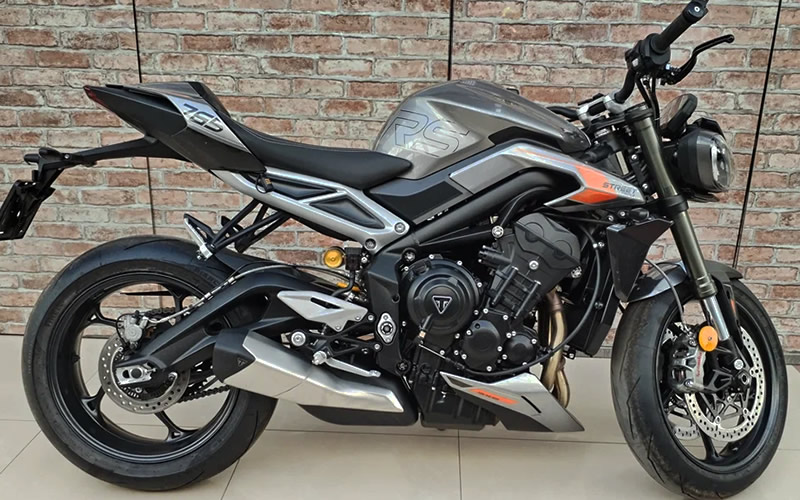
Street Triple RS, 2023 year, right view
In 2023, both the R and RS versions were upgraded with a more powerful engine outputting up to 130 horsepower, shorter gearing, higher-spec Brembo Stylema brakes (exclusive to the RS), and refined chassis geometry that raised the rear, reducing the wheelbase, rake, and trail for sharper handling. For the first time, IMU-based cornering ABS and traction control were introduced. The R model now features a full-TFT instrument cluster, albeit smaller than the RS’s 5-inch version, while the fuel tank capacity was reduced by 2.4 liters to 15 liters. A new limited-edition Moto2 version was also launched, equipped with clip-on handlebars and additional track-oriented enhancements.
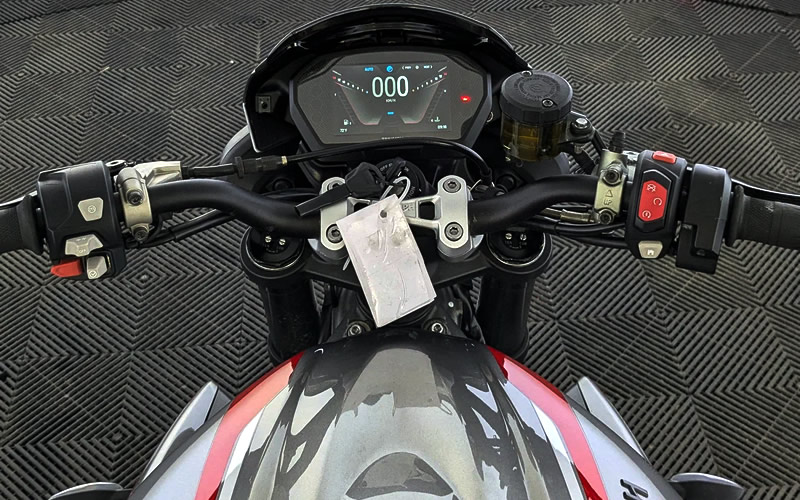
Street Triple RS, 2022 year, dashboard
Specifications
| Models | Street Triple | Street Triple R | Street Triple | Street Triple R | Street Triple S | Street Triple R | Street Triple RS |
| Years | 2007-2012 | 2009-2012 | 2013-2016 | 2017- | |||
| Engine | Liquid-cooled inline three-cylinder, 12 valves | ||||||
| Displacement | 674.8 cc | 660 cc | 765 cc | ||||
| Bore × Stroke | 74 × 52.3 mm | 76 × 48.5 mm | 77.99 × 53.38 mm | 77.99 × 53.4 mm | |||
| Fuel System | Keihin EFI | Sequential multi-point EFI SAI | Sequential multi-point electronic injection with SAI. Electronic throttle control | ||||
| Compression Ratio | 12.65:1 | 12.1:1 | 12.5:1 | 12.54:1 | |||
| Max Power | 106 hp (78 kW) at 11750 rpm | 48 hp (35 kW) at 9000 rpm (A2 version); 95 hp (70 kW) at 11250 rpm (unrestricted version) | 118 hp (87 kW) at 12000 rpm | 123 hp (90 kW) at 11700 rpm | |||
| Max Torque | 68 Nm at 9100 rpm | 73 Nm at 9100 rpm | 77 Nm at 9400 rpm | 79 Nm at 9350 rpm | |||
| Transmission | Multi-plate wet clutch, 6 speeds | Multi-plate wet clutch, 6 speeds | |||||
| Final Drive | Chain | Chain, 118 links | |||||
| Chassis | Aluminum twin cradle | Front: aluminum twin cradle Rear: two high-pressure cast alloy pieces | |||||
| Front Suspension | Kayaba (KYB) 41 mm telescopic fork | Showa 41 mm USD inverted fork | Showa 41 mm SF-BPF inverted fork | Showa large diameter BPF inverted fork Ø41 mm | |||
| Front Suspension Adjustments | - | Compression, rebound, and preload | - | Compression, rebound, and preload | Preload | Compression, rebound, and preload | |
| Front Suspension Travel | 120 mm | 115 mm | 110 mm | 115 mm | |||
| Rear Suspension | Kayaba mono-shock | Showa separate reservoir shock | Öhlins STX40 with separate reservoir | ||||
| Rear Suspension Adjustments | Preload | Compression, rebound, and preload | Preload | Compression, rebound, and preload | |||
| Rear Suspension Travel | 126 mm | 130 mm | 126 mm | 135 mm | 124 mm | 134 mm | 131 mm |
| Front Brake | Double disc Ø308 mm | Double disc Ø308 mm | Double disc Ø310 mm Nissin, ABS | Floating double disc Ø310 mm, Nissin 2-piston calipers, ABS | Floating double disc Ø310 mm, monobloc radial mount 4-piston Brembo M4-32 calipers, ABS | Floating double disc Ø310 mm, monobloc radial mount 4-piston Brembo M50 calipers, disconnectable ABS | |
| Rear Brake | Disc Ø220 mm | Disc Nissin Ø220 mm | Disc Brembo Ø220 mm ABS | Fixed single disc Ø220 mm, single piston Brembo caliper ABS | |||
| Wheels | Front: 3.5x17 Rear: 5.5x17 | ||||||
| Tires | Front: 120/70 ZR 17 Rear: 180/55 ZR 17 | ||||||
| Fuel Tank | 17.4 L | ||||||
| Height (without mirrors) | 1060 mm | 1110 mm | 1060 mm | 1110 mm | 1060 mm | 1065 mm | 1085 mm |
| Dry Weight | 182 kg | 168 kg | 168 kg | 166 kg | |||
| Width | 735 mm | 2009-2010: 735 mm 2011-2012: 755 mm | 735 mm | 740 mm | 765 mm | 775 mm | 775 mm |
| Length | 2000 mm | 2030 mm | 2000 mm | 2055 mm | |||
| Wheelbase | 2007-2009: 1394.5 mm 2010: 1390 mm 2011-2012: 1410 mm | 2009-2010: 1394.5 mm 2011-2012: 1410 mm | 1410 mm | 1410 mm | 1410 mm | 1405 mm | 1405 mm |
| Steering Angle, Trail | 24.3° 95.3 mm | 23.9° 92.4 mm | 24.1° 99.6 mm | 23.4° 95 mm | 24.3° 103.4 mm | 23.5° 98.3 mm | 23.9° 100 mm |
- Information for owner
- Introduction to manual
- Engine and systems
- Engine repair
- Fuel and control system
- Lubrication system
- Cooling system
- Transmission
- Running gear and frame
- Frame and hinged elements
- Front suspension and handlebar
- Rear suspension
- Brake system
- Wheels and tires
- Electric equipment
- Equipment and devices
- Starting and charging system
- Electrical circuits
Aprilia: RS-series Shiver (map) BMW: F-series R-series K-series (map) Ducati: ST series Monster (map) Harley: Street Sportster V-Rod (map) Honda: Africa Twin CB series VTX series (map) Kawasaki: ZX-6R Versys Vulcan (map) Suzuki: DR-Z V-Strom Boulevard (map) Triumph: Rocket Street Triple Tiger (map) Yamaha: Fazer DragStar R1 (map)