
Repair manuals for boxer motorcycles BMW R-series (opposite 2 cylinder)
See this section in russian language
In this section you will find a guide for self-service and repair of German motorcycles "BMW R1150GS", which were produced between 1999 and 2004.
Description and history of German motorcycles BMW R-series
| Historical: | R2 R3 R4 R5 R11 R12 R16 R17 R26 R27 R32 R35 R42 R45 R50 R50S R51 R51/2 R51/3 R52 R60 R60/2 R65 R68 R69 R69S R71 R75 /5 Series /6 Series /7 Series R100GS R100R R80 R80G/S |
| Cruisers: | R18 R850C R1200C |
| Sport: | R1100S R1200S |
| Naked: | R1100R R1150R R1200R K27 R1200R K53 R1250R R nineT |
| Touring: | R850RT R1100RT R1150RT R1200RT K26 R1200RT K52 R1250RT |
| Dual-sport: | R1100GS R1150GS R1200GS K25 R1200GS K50 R1250GS R1300GS |
| Sport-touring: | R1100RS R1150RS R1200ST R1200RS R1250RS |
BMW R2 (1931-1936)
The BMW R2, which was released in 1931, was the second single-cylinder motorcycle model from BMW after the R39. The R2 was the first model designation from BMW from which the engine displacement could be inferred.
In 1931, BMW reintroduced a single-cylinder model to the market after a four-year hiatus. Since 1928, motorcycles up to 200 cm³ could be ridden in Germany without a license and tax-free. The R2 was designed for this market, being one of the most expensive motorcycles at 975 Reichsmarks. The more than 15,000 R2 units sold by 1937 contributed to BMW's good reputation and paved the way for profitable mass production after the Great Depression, allowing the price to drop to just 790 Reichsmarks by the end of its production run. Its successor, the BMW R20, with a tubular frame, was introduced in March 1937.
The small side-valve engine produced 6 hp (4 kW) in the first two series and later 8 hp (6 kW). It was already very advanced with a tunnel housing and an axially mounted crankshaft. This design was groundbreaking for subsequent single-cylinder models and later newly developed boxer engines. The onboard electrical system was powered by a 6V/30W DC generator located at the lower left of the engine block. The battery was situated to the left behind the engine. The ignition system was a so-called battery ignition, controlled by a contact breaker activated by the camshaft, located in a cylindrical housing in front of the engine.
The R2 featured a hand-shifted gearbox with a drive shaft on the right side of the unsprung rear wheel. BMW referred to the power transmission from the gearbox to the rear wheel as "cardan drive", the drive shaft as "cardan shaft", and the gearbox housing at the rear wheel as "cardan housing" – technically, it was merely a shaft drive of the rear wheel, as there were no universal joints.
The kickstarter was operated parallel to the vehicle's longitudinal axis and was located on the right side – a sidecar operation was not intended.
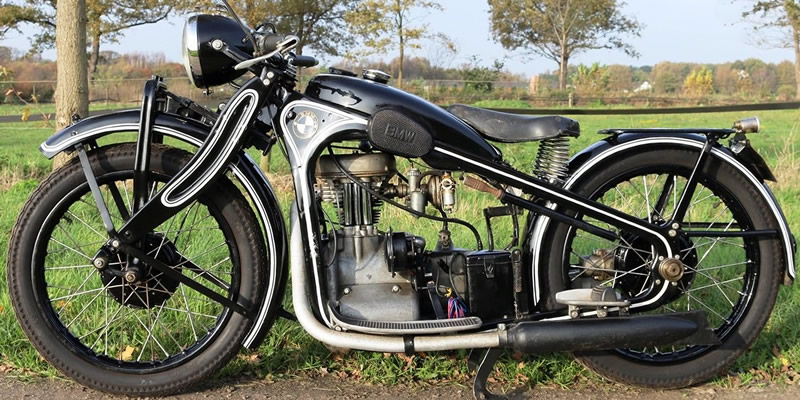
BMW R 2, 1934 year, left view
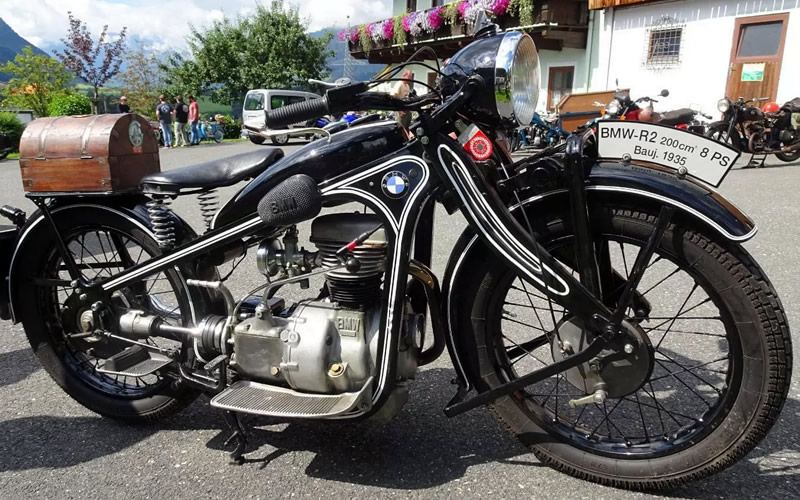
BMW R 2, 1935 year, right view
BMW R3 (1936-1937)
The BMW R3 was a touring motorcycle with a 300 cm³ engine produced by the German motorcycle manufacturer BMW, which was only built in 1936.
Four years after the introduction of the large single-cylinder motorcycle R4, BMW presented the R3 at the German Motor Show in Berlin in February 1936. Only one series of the R3 was produced. The introductory price was 1,050 RM; by September 1936, the price had been reduced to 995 RM.
With a displacement of 300 cm³, it was poorly positioned in the market because it neither had the power of the R4 nor the advantage of exemption from licensing and taxes that made the R2 attractive. With only 740 units produced in its single year of production, it fell short of expectations. By 1937, the R 3 and R 4 models were replaced by the R35.
The R3 is characterized by a larger displacement than the R2 and also by its great robustness. Technically, however, the R3 is more closely related to the last two series of the BMW R4.
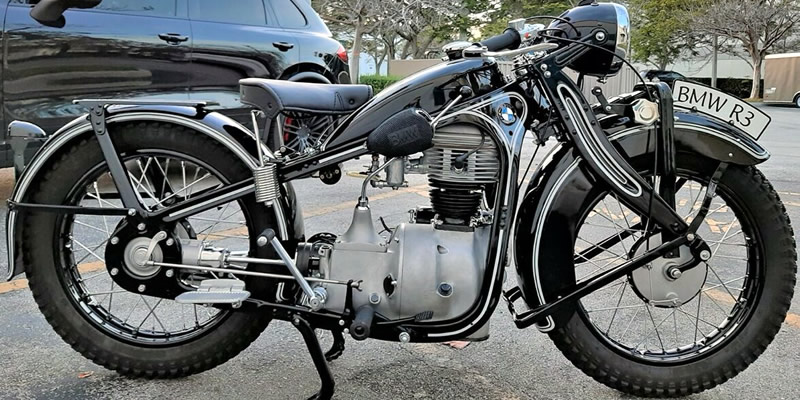
BMW R 3, 1936 year, right view
BMW R4 (1932-1937)
The BMW R4, introduced in 1932, was a single-cylinder motorcycle from BMW with a displacement of 400 cm³.
As BMW did not have a successor to the R52 in the 500 cm³ class, the BMW R4 was brought to the challenging market during the Great Depression as an economical middle-class motorcycle, offering the same performance as the R52, positioned between the tax- and license-free R2 and the twin-cylinder models in the 750 cm³ class. Series production started in December 1931, and it was marketed by BMW as an off-road sports model with a selling price of 1,250 Reichsmarks. From 1933 until the end of production in 1937, the R 4 cost only 1,150 Reichsmarks.
The longitudinally mounted engine with a vertical cylinder, fully enclosed valve drive, and hanging valves produced 12 hp (9 kW) at 4,000 rpm. The engine's stroke is 84 millimeters. The BMW R4 was thus the first motorcycle with an engine featuring this longest stroke length of all BMW motorcycles. Only the later models BMW R3 and BMW R35 had engines with an identical stroke length.
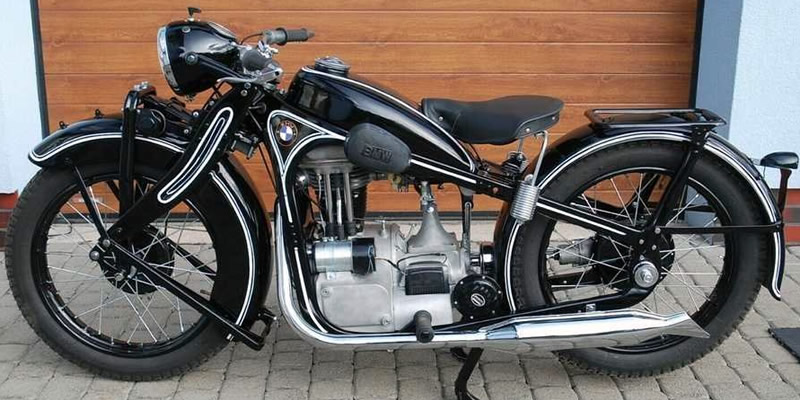
BMW R 4, 1934 year, left view
BMW R5 (1936-1937)
The BMW R5 was a sporty twin-cylinder motorcycle in the 500 cm³ class from Bayerische Motoren Werke, which was completely newly developed and launched in 1936. It remained a benchmark for motorcycle construction at BMW until the 1950s.
The BMW R5 was created as a somewhat simpler "replica" of the 1935 factory racing motorcycles of type 255. Instead of the DOHC racing engine with a supercharger, it was equipped with a 494 cm³ OHV engine and the necessary equipment for road use, such as lighting system, horn, and kickstarter. Rudolf Schleicher was the lead designer for both models. The R5 was introduced as a production motorcycle at the motorcycle fair in Milan in January 1936.
The successor to the R5 was the R51, introduced in 1938, which differed from the R5 primarily through the newly developed swingarm rear suspension.
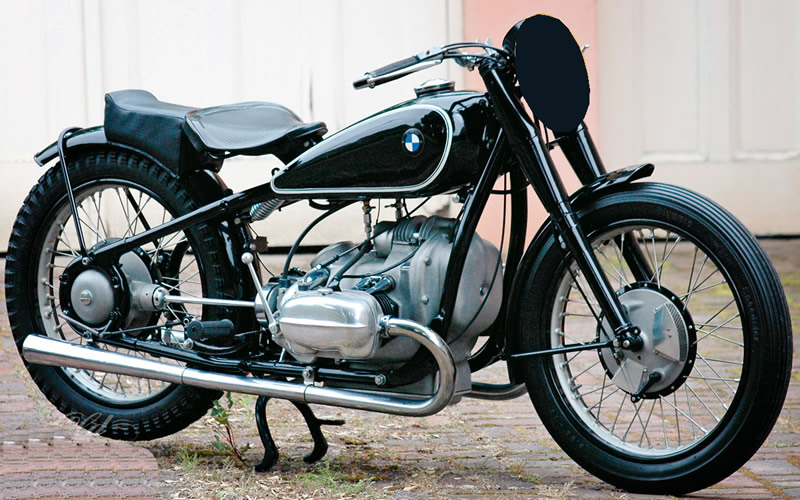
BMW R 5, 1937 year, right view
BMW R11 (1929-1934)
The BMW R11 was the first touring motorcycle in the 750 cm³ class produced by the German motorcycle manufacturer BMW, featuring a pressed steel frame in a double-loop design inspired by the pressed steel motorcycles of Ernst Neumann-Neander.
The engine, designated M 56, was designed as a longitudinally mounted two-cylinder boxer four-stroke engine with side valve (SV) operation. It produced 18 hp (13.2 kW) at 3,400 rpm.
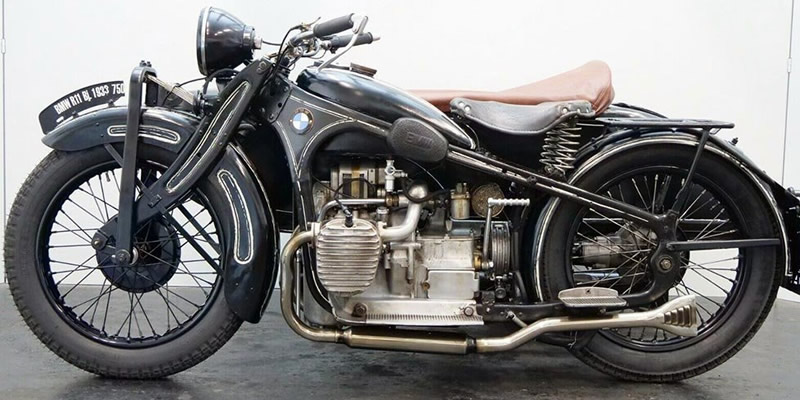
BMW R 11, 1933 year, left view
BMW R12 (1935-1942)
The BMW R12 was a motorcycle from Bayerische Motoren Werke, presented in 1935, and is considered the most produced pre-war motorcycle from BMW. Pioneering features of the R12 and the concurrently released BMW R17 included the first hydraulically damped telescopic fork in motorcycle construction, which had 88 mm of travel.
The engine, designated M 56 S 6 or 212, was a longitudinally mounted twin-cylinder boxer four-stroke engine with upright valves. The R12 with two carburetors was equipped with a battery ignition, while the "authorities' machine" with a single carburetor system had a magneto ignition that operated independently of the battery. For military use, the engine was throttled from 20 to 18 hp.
The R12 featured a claw-shifted four-speed transmission with hand shifting on the tank and a helical, "silent" fourth gear; the drive shaft ran on the right side of the unsprung rear wheel.
BMW referred to the power transmission from the gearbox to the rear wheel as "cardan drive", the drive shaft as "cardan shaft", and the gearbox housing at the rear wheel as "cardan housing" – technically, it was merely a shaft drive of the rear wheel, as there were no universal joints.
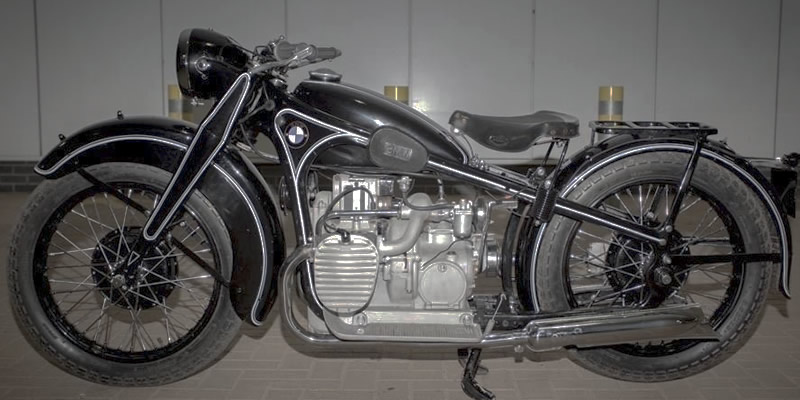
BMW R 12, 1939 year, left view
BMW R16 (1930-1934)
The BMW R16 is a motorcycle produced by BMW from 1930 to 1934, featuring a two-cylinder boxer four-stroke engine. As a sport motorcycle, it was the sister model to the R11, which was designed as a touring motorcycle with a side-controlled engine.
In 1929, BMW changed the frame construction of its motorcycles. The company moved away from tubular frames and instead built pressed frames from sheets of metal, riveted together, inspired by the pressed steel motorcycles of Ernst Neumann-Neander. The 750 cc two-cylinder boxer models were now designated as the touring model R11 and the sporty OHV variant R16, while maintaining the same engines. It produced 25 hp (18 kW) at 4,500 rpm.
The front fork continued to be a drawn short swingarm with leaf spring suspension.
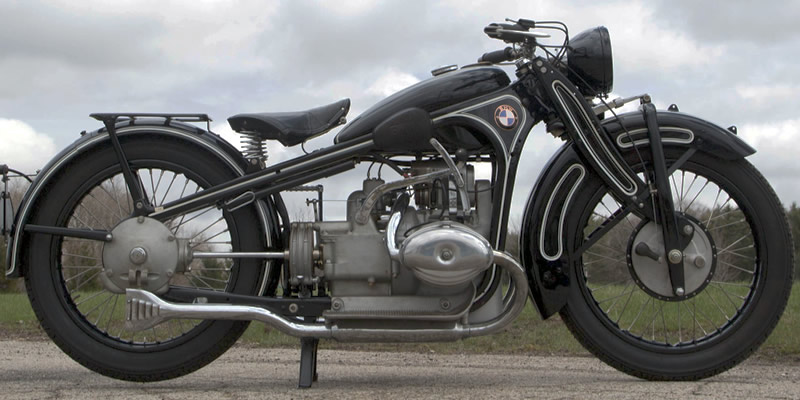
BMW R 16, 1930 year, right view
BMW R17 (1935-1937)
The BMW R17 was the fastest purely German street motorcycle before World War II. Only a few sport models with large J.A.P. engines from England, built by some other manufacturers (e.g., Brough Superior), were stronger and faster. The BMW R17 had the characteristic longitudinally mounted boxer engine and cardan drive typical of BMW.
On February 14, 1935, BMW presented the R17 alongside its sister model R12 to the public for the first time at the German Motor Show in Berlin as the successor to the R16. New to these models was the first use of a hydraulically damped telescopic fork in motorcycle construction, replacing the previously common leaf spring fork at BMW.
With 33 hp (24 kW) from 736 cm³ and still an unsprung rear wheel, an extremely fast street sport model was created for its time, manageable only by skilled riders.
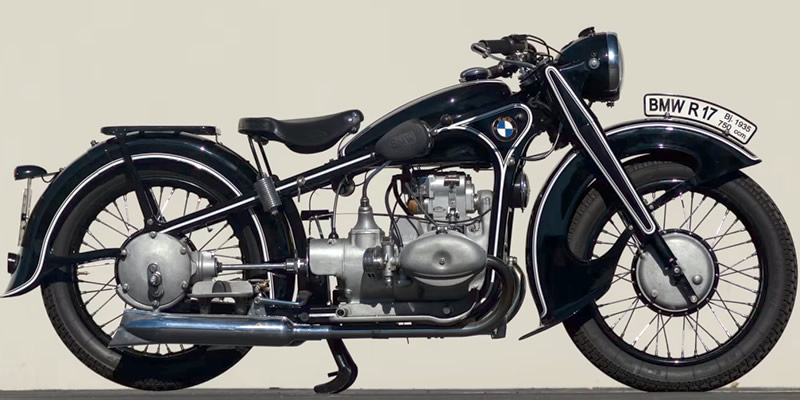
BMW R 17, 1935 year, right view
BMW R18 (2020-current)
The BMW R18 is a motorcycle model from the vehicle manufacturer BMW in the cruiser segment. The retro-designed motorcycle was unveiled on April 3, 2020, and reached the market in September 2020. In late July 2021, three additional models were introduced: R18 Classic, R18B ("Bagger"), and R18 Transcontinental. In May 2023, the R18 Roctane was released. The new models feature a windshield, while the Bagger and Transcontinental are fully dressed luxury touring machines.
Development began in 2015 with a concept study called R5 Hommage, which is reminiscent of the appearance and visible technology of the R5 from 1936; the fish-tail exhaust pays homage to the prototype R7 from 1934. The motorcycle comes with a double-loop steel tube frame, exposed drive shaft, and wire-spoke wheels as standard. The rear wheel is guided by a cantilever swingarm, with the bearings and spring-damper unit concealed to create the impression of a rigid frame without rear suspension. Otherwise, the technology includes a telescopic fork, fuel injection, anti-lock braking system, and modern assistance systems.
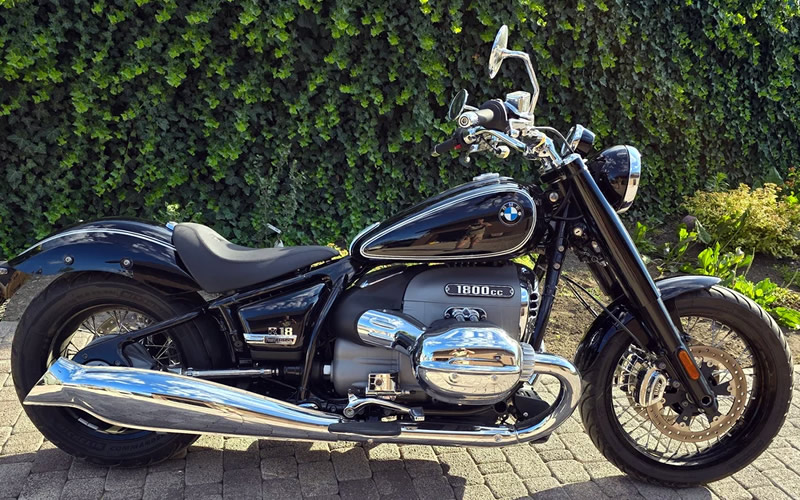
BMW R 18, 2020 year, right view
The R18 is primarily intended to serve the market segment of large-displacement motorcycles, such as the American Harley-Davidson, Indian, the British Triumph Thunderbird or Rocket III, cruisers from Moto Guzzi, and Japanese brands like Honda, Kawasaki, Suzuki, and Yamaha. The Austrian motorcycle magazine speculated as early as April 2019 that alongside the unfaired version of the R18, a fully faired version with a luggage system, known as a Full-Dresser, could follow. With a design that allows for easy customization, BMW aims to attract the custom bike scene, as it did with the R nineT.
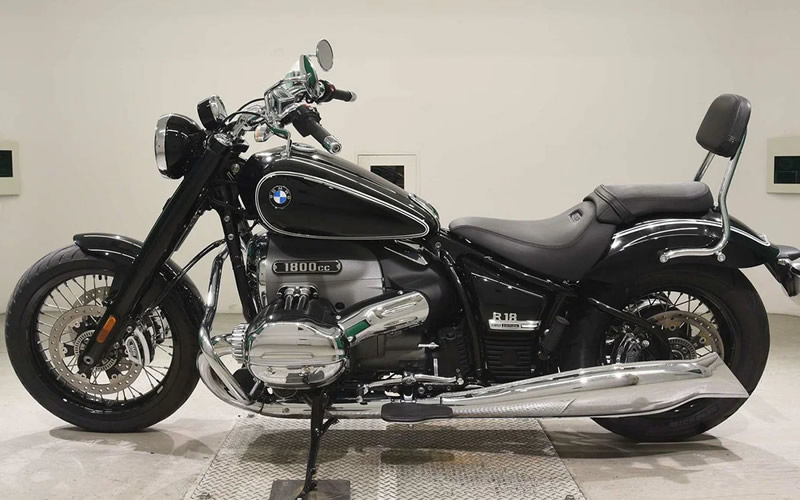
BMW R 18, 2021 year, left view
The motorcycle is powered by a newly developed air- and oil-cooled twin-cylinder boxer engine with a displacement of 1802 cm³. It is a four-stroke engine with four valves per cylinder, controlled by pushrods and rocker arms from two overhead, chain-driven camshafts. Unlike the design studies equipped with carburetors, the production model features an electronically controlled fuel injection system with digital engine management and an electronic throttle. The exhaust gases are cleaned by a three-way catalytic converter, meeting the Euro 5 emissions standard. The power output is 67 kW (91 hp) at 4750 rpm, with a maximum torque of 158 Nm at 3000 rpm, and consistently over 150 Nm in the rpm range between 2000 and 4000 rpm. According to the manufacturer, the fuel consumption is 5.6 liters/100 km according to WMTC standards, with CO2 emissions of 129 g/km.
BMW R26 (1956-1960)
The BMW R26 is a single-cylinder motorcycle produced by BMW from 1956 to 1960. On January 30, 1956, BMW announced via a press release the transition of the single-cylinder series to the full-swing chassis, thus introducing the new R26 series. The boxer models had already appeared in 1955 with the new chassis.
The predecessor of the R26 was the model R25/3, which had a rated power of 13 hp (9.6 kW), a telescopic fork, and a swingarm rear suspension. The R26, built from 1956, differs from it by having a more powerful engine and a full-swing frame.
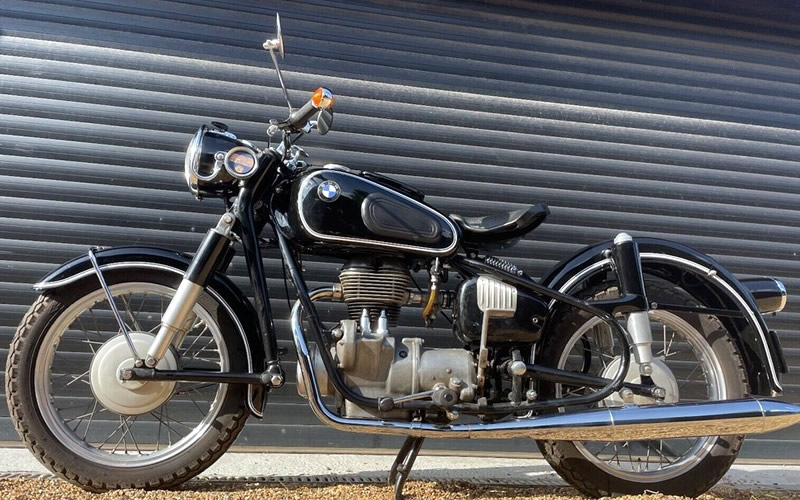
BMW R 26, 1958 year, left view
BMW R27 (1960-1966)
The R27 model is a motorcycle produced by BMW from 1960 to 1966, featuring a single-cylinder four-stroke engine, and it is the last model of the single-cylinder BMWs with cardan drive.
With this model, the era of West German motorcycle manufacturing came to an end, during which motorcycles were still the primary means of transportation. The emerging competition from affordable cars on one hand and sporty Japanese motorcycles for leisure on the other led to the decline of the market for these elaborately constructed motorcycles in West Germany — unlike in East Germany. Their special characteristics made BMWs like the R27 excellent touring machines capable of covering long distances with minimal fatigue.
The predecessor of the R27 was the BMW R26, which had 11 kW (15 hp), cardan shaft drive, and a largely identical frame with front and rear swingarms. The R27 differs from the R26 by having a four-stroke engine increased to 13 kW (18 hp), which was no longer connected to the frame by axle shafts but was mounted on elastic rubber buffers ("floating engine").
The R27 features a foot-operated four-speed transmission with claw shifting, a neutral indicator, and a kickstarter. An additional hand shifter commonly found on earlier BMW motorcycles had already been omitted with the R25/3.
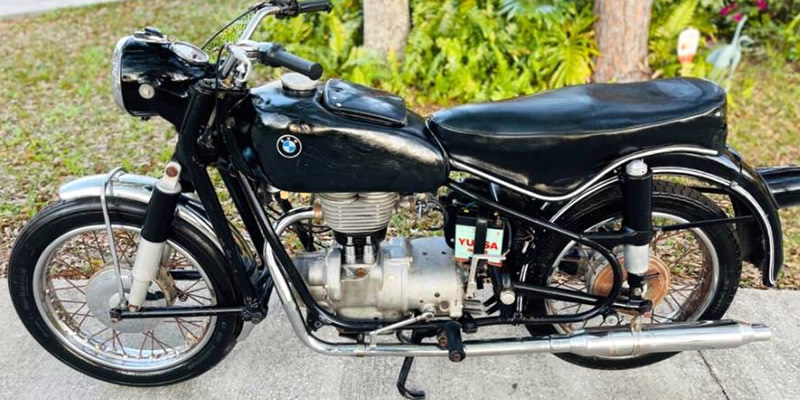
BMW R 27, 1961 year, left view
BMW R32 (1923-1926)
The BMW R32 was the first motorcycle model in the history of Bayerische Motoren Werke. The R32 was significantly developed by Max Friz, who participated in the "Through Bavaria's Mountains" ride of the ACM (Automobile Club Munich) with a prototype in May 1923. At the first Hindelang-Oberjoch race on September 16, 1923, BMW entered two R32 motorcycles. It is said that Friz designed the motorcycle within four weeks and presented his design in a 1:1 scale. On September 28, 1923, BMW unveiled the R32 to the public for the first time at the German Motor Show in Berlin.
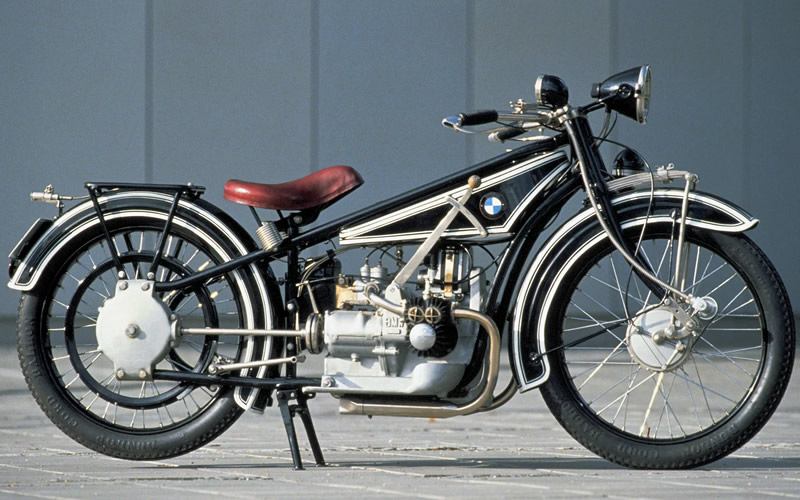
BMW R 32, 1923 year, right view
No part of the R32 was new in itself, but the combination set standards and brought numerous advantages that made the concept a milestone for BMW and motorcycle history. The boxer engine was mounted longitudinally, unlike the predecessor Helios and manufacturers like Douglas and D-Rad, meaning the crankshaft was aligned in the direction of travel. This allowed for excellent cooling of the cylinders and the critical area of the exhaust valves.
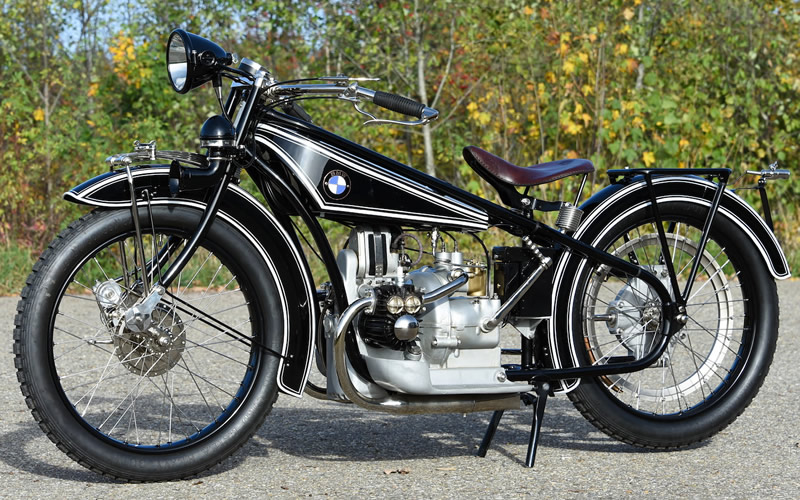
BMW R 32, 1924 year, left view
With this motorcycle, BMW established the modular principle for future production series. The chassis and gearbox with the base engine were largely identical; differentiation for the displacement classes of 500 cm³, 600 cm³, and 750 cm³, as well as for sport and touring models, was achieved through modified cylinder bores, crankshafts, and head or side-controlled cylinder heads and cylinders.
BMW R35 (1937-1955)
The BMW R35 was a touring motorcycle in the 350 cm³ class produced by the German motorcycle manufacturer BMW, starting in 1937.
The R 35 succeeded the poorly selling BMW R3 and the BMW R4, which had been in production since 1931. The engine casing was taken from the R4, while the cylinder head was structurally similar to that of the R3. BMW used a pressed steel double-loop frame without rear suspension for the last time, and the front wheel featured a telescopic fork without hydraulic damping.
The engine is similar to that of the BMW R4 but has a reduced cylinder bore, resulting in a decreased displacement of 350 cm³. The power was increased by 2 hp (1.5 kW) to 14 hp (10 kW) at 4,500 rpm. The cylinder head and the pressed steel rigid frame (without rear suspension), which were borrowed from the BMW R3, were also used in the last series of the R 4. The front wheel received a new design with a telescopic fork.
Power is transmitted via a dry clutch, a manually shifted four-speed transmission, a drive shaft with an elastic coupling, and a bevel gear drive to the rear wheel.
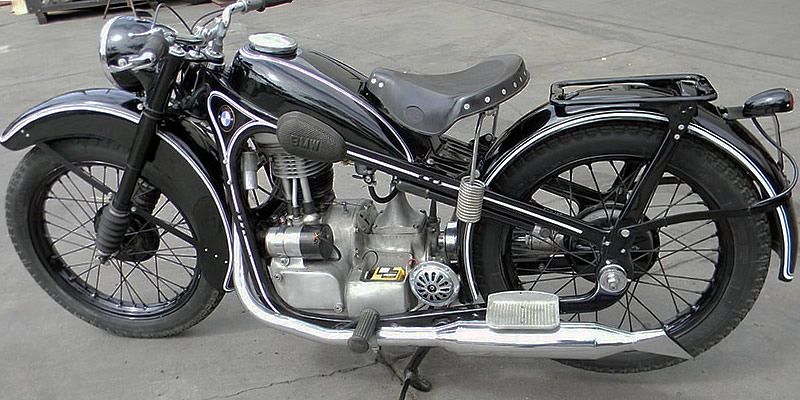
BMW R 35, 1948 year, left view
BMW R42 (1925-1928)
The BMW R42 was the second touring motorcycle produced by the German motorcycle manufacturer BMW. On November 26, 1925, two years after the R32, BMW presented its successor, the R42, to the public at the German Motor Show in Berlin. With this motorcycle, BMW continued the modular design principle. The chassis and transmission with the basic engine were largely identical; differentiation between sport and touring models was achieved through overhead or side-controlled cylinder heads and cylinders.
The engine, designated M43, was a longitudinally mounted two-cylinder boxer four-stroke engine with side valve (SV) operation. It produced 12 hp (9 kW) at 3,400 rpm.
The price of the motorcycle in 1927 was 1,510 Reichsmarks, which was 700 Reichsmarks less than for the R32. The lighting system, horn, speedometer, and passenger seat were not included in the purchase price. Production ended in 1928 after over 6,500 units; the successor was the R52, which began production in July 1928.
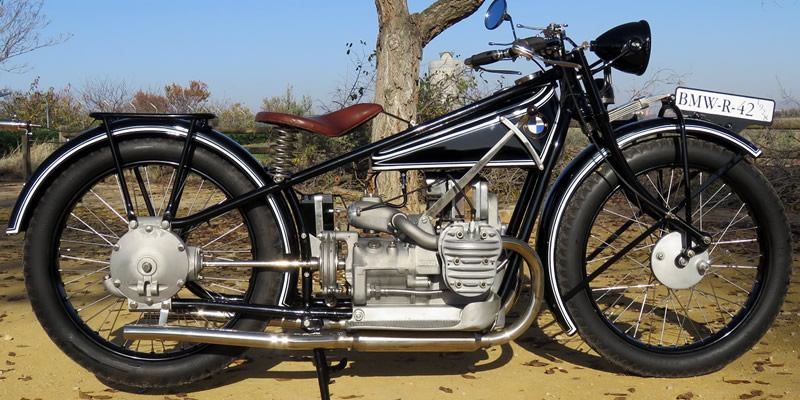
BMW R 42, 1926 year, right view
BMW R45 (1978-1985)
The BMW R45 is a mid-range motorcycle from BMW with a boxer engine, produced from 1978 to 1985. In 1979, the R45 topped the sales charts in Germany in the 27 hp class. By the time of the model update in 1980, 15,905 R45 units had been produced, and a total of 28,158 machines of this type by the end of production.
The engine is an air-cooled two-cylinder four-stroke engine. With a bore of 70 mm and a stroke of 61.5 mm, it has a displacement of 473 cm³. At an engine speed of 6500 rpm, the engine reaches its maximum power of 20 kW (27 hp). The fuel mixture is prepared by two constant-pressure carburetors from Bing. The lubrication system operates on the principle of pressure circulation.
The clutch is a single-disc dry clutch. The gearbox has five gears and is claw-shifted.
The BMW R45 was available in two versions: a less powerful N version with 20 kW (27 hp) and a stronger S variant with 26 kW (35 hp), for which a top speed of 160 km/h was specified. The list price was 5,880 DM. With an otherwise identical frame and base engine, there was a larger displacement model, the BMW R65, with 649.6 cm³ and 33 kW (45 hp), and from 1981, with 37 kW (50 hp).
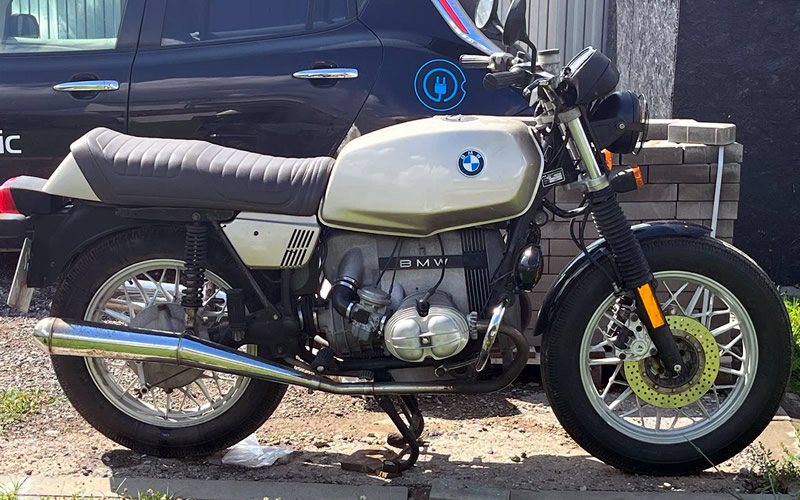
BMW R 45, 1979 year, right view
BMW R50 (1955-1960)
The R50 model is a motorcycle produced by BMW in the second half of the 1950s, featuring a 2-cylinder four-stroke OHV boxer engine. It is the base model of a series of largely identical touring and sport motorcycles with various engine outputs, which this article presents with technical specifications. The predecessor of the R50 was the BMW R51/3 model, which had a rated power of 18 kW, with a telescopic fork and swingarm suspension. The R50, built from 1955, differs from it by having a full-swing chassis with a pushed long swingarm and rear swingarm, as well as encapsulated suspension and a slightly increased engine output of 19 kW.
The double-tube frame is welded from steel tubing with laterally mounted ball heads for sidecar operation. The TR 500 from Steib was a suitable sidecar but required a special gear ratio for the cardan drive. The fenders and tank are made of steel sheet, while the rims and full hubs are made of aluminum.
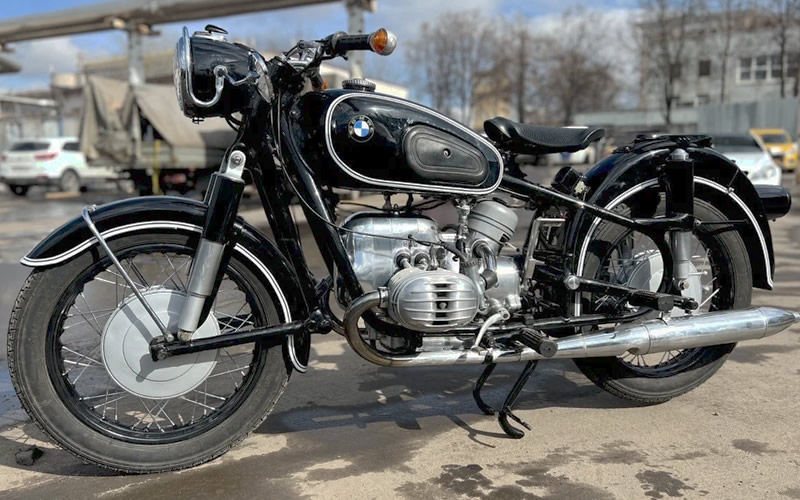
BMW R 50, 1959 year, left view
BMW R50S/R69S (1960-1962)
The BMW R50S was a motorcycle produced by Bayerische Motorenwerke from 1960 to 1962, during a financially challenging time for the company, with a total of 1,634 units built. It was the performance-enhanced, sporty variant of the base model BMW R50, featuring a two-cylinder boxer engine. The R69S was also introduced in 1960 and was manufactured until 1969.
Technically, the R50S was largely similar to the standard R50 model, featuring a double-loop tube frame, a front swinging arm, and a rear swinging arm with two shock absorbers. Additionally, it came with a hydraulic steering damper instead of the mechanical one found on the R50. The power increase of the 500 cc engine from 26 hp to 35 hp was primarily achieved through a higher compression ratio (9.2:1 instead of 6.8:1), higher RPM (7,650/min instead of 5,800/min), and carburetors with an enlarged throat from 24 mm to 26 mm.
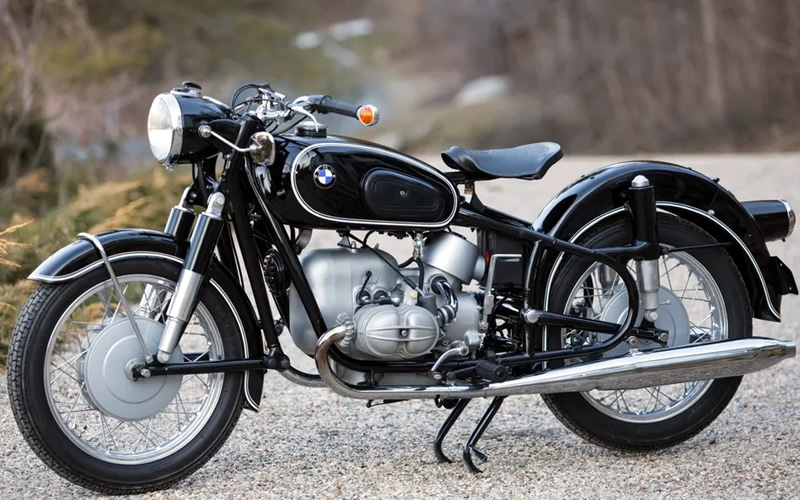
BMW R 50 S, 1961 year, left view
In 1960, the 42 hp R69S replaced the R69, which had 35 hp. With a top speed of 175 km/h (lying down; 160 km/h sitting upright, according to the operating manual), this 600 cc BMW was among the fastest motorcycles of its time.
BMW R51 (1938-1941)
The BMW R51 is a two-cylinder motorcycle manufactured by BMW, featuring a 500 cc boxer engine with an output of 17 kW. It was produced from 1938 to 1941. The predecessor of the R51 is the R5, which was built until 1937.
Alongside the sporty 500 cc model, a side-valve 750 cc model known as the R71 was produced, which had slightly lower performance and was primarily suited for sidecar operation due to its high torque.
On February 18, 1938, BMW presented the R51, R61, R66, and R71 at the 28th International Automobile and Motorcycle Exhibition (IAMA) in Berlin, showcasing a new series of large-volume motorcycles with rear suspension.
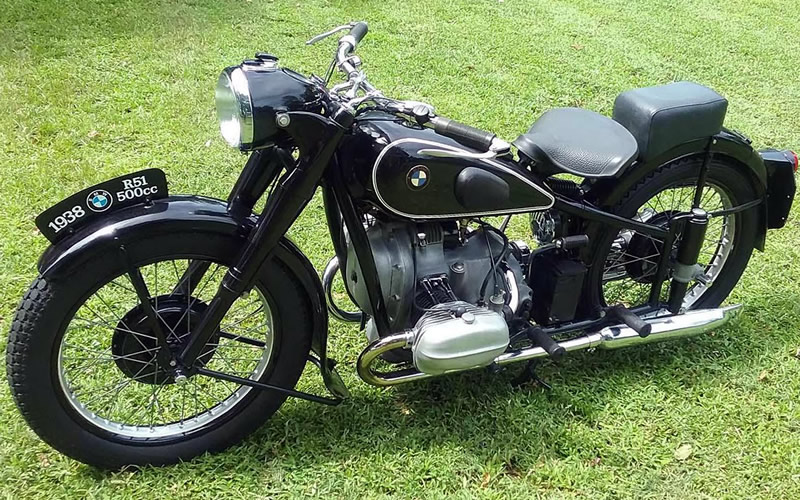
BMW R 51, 1938 year, front view
The fenders, tank, and rims are made of steel sheet. The engine block, like the transmission and the housing of the cardan drive, is made of aluminum casting. Similar to the predecessor model BMW R5, the engine is mounted in the frame using motor plug axes. The exhaust pipe is directly attached to the engine axle and frame with clamps.
BMW R51/2 (1950-1951)
The BMW R51/2 is the first boxer motorcycle that BMW produced after World War II. It was manufactured in a limited quantity of 5,000 units in 1950 and 1951. The successor model, the BMW R51/3, was produced in much larger numbers starting in 1951.
BMW unveiled the R51/2 to the public on October 18, 1949, at the Bayerischer Hof hotel in Munich. The predecessor of the R51/2 was the BMW R51, built from 1938 to 1940, which had essentially the same chassis, telescopic fork, and direct-acting rear suspension.
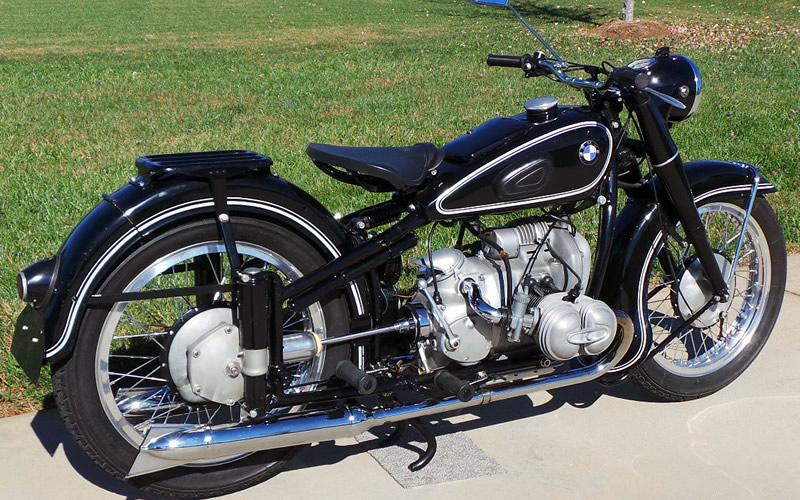
BMW R 51/2, 1950 year, right view
The engine of the R51/2 is the last version of the pre-war two-cylinder engines with two camshafts above the crankshaft, driven by a timing chain; the engine of the successor model R51/3 has only one camshaft driven by spur gears. The engine now has only one circulating oil fill; the predecessor engines of the R5 and R6 had separate oil fills for each cylinder head in addition to the crankcase lubrication.
BMW R51/3 (1951-1954)
The BMW R51/3 is a sidecar-compatible two-cylinder motorcycle produced by BMW from 1951 to 1954, with a total of 18,420 units manufactured. It features a 500 cc displacement, a boxer engine with 18 kW (24 hp), and a cardan drive. The selling price was 2,750 DM. Along with the concurrently released BMW R67, it was the first significant new motorcycle development by BMW after World War II, following the BMW R51 (1938–1940) and the briefly produced R51/2 in 1950.
The double-loop frame is welded from steel tubing and has lateral ball joints for attaching a sidecar. Suitable sidecars include the S350, LS200, and preferably the TR500 from Steib. For sidecar operation, a modified (shorter) gear ratio of the cardan drive is required.
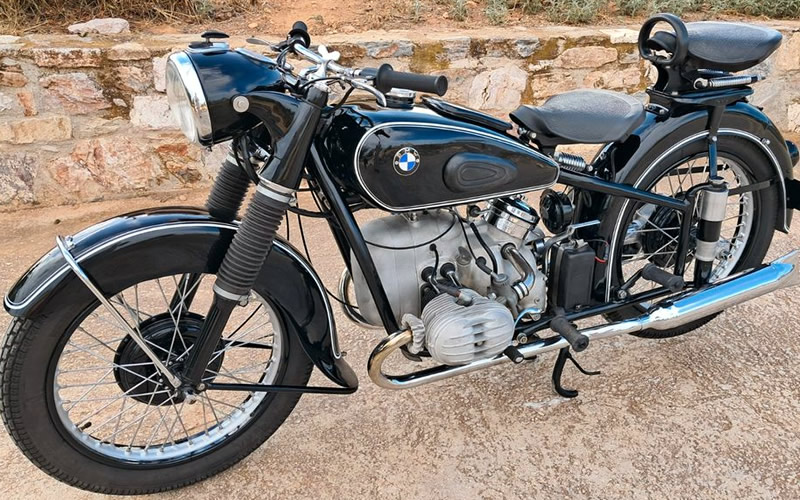
BMW R 51/3, 1953 year, front view
The engine of the R51/3 is completely newly developed compared to the similarly powered predecessor R51/2, now featuring only one gear-driven camshaft above the crankshaft; the predecessor engine BMW R51/2 had two camshafts driven by a chain.
BMW R52 (1928-1929)
The BMW R52 is a touring motorcycle in the 500 cm³ class produced by the German motorcycle manufacturer BMW. A total of 4,377 R52 units were produced during its production period from 1928 to 1929.
The predecessor of the R52 is the BMW R42 model, which has 9 kW/12 hp and essentially the same tubular frame with a shaft drive. The R52 differs from this model by its front brake, which has been enlarged to 200 mm, and by the newly designed engine, which is configured as a long-stroke engine with a bore of 63 mm and a stroke of 78 mm.
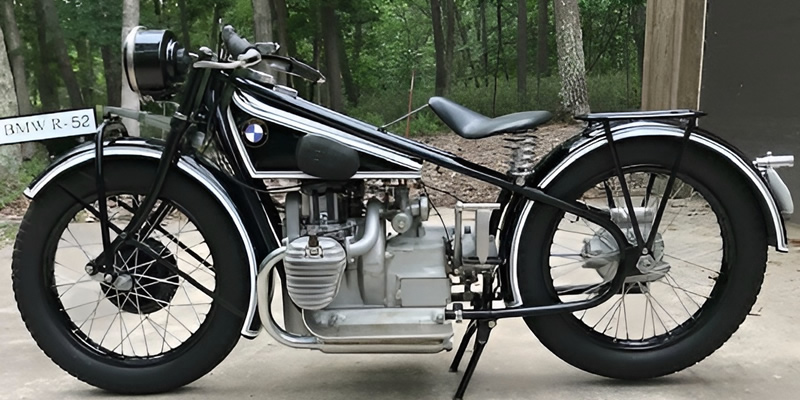
BMW R 52, 1928 year, left view
BMW R60 (1955-1960)
The R60 was introduced in 1955 as the successor to the R67/2. The R60 was part of a whole series of new models: the 250 cc touring model R26, the 500 cc touring model R50, the 600 cc touring model R60, and the 600 cc sport model R69. This entire series consisted of "full-swing BMWs", which significantly improved riding characteristics compared to their predecessors. The R60 featured a swingarm rear suspension with two fully enclosed spring/damping elements, which had adjustable preload.
The BMW R60 was a touring motorcycle with its sporty counterpart being the R69. The successor to the R60 was the R60/2, introduced in 1960. This model also had a sporty "brother", the R69S.
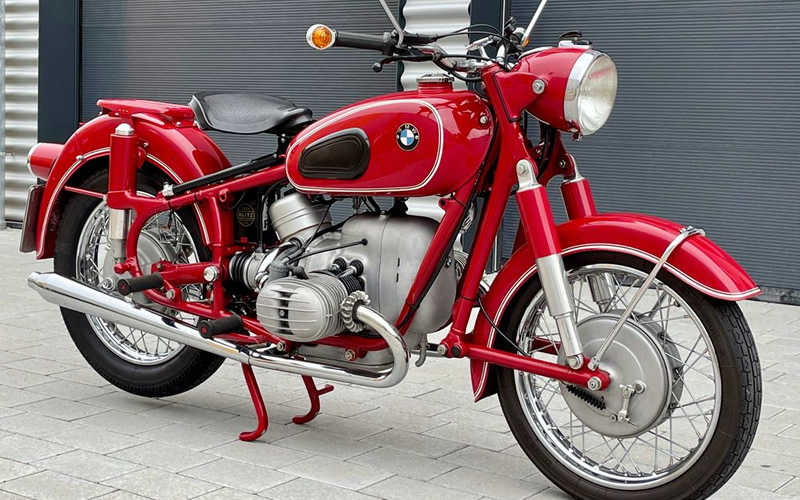
BMW R 60, 1959 year, front view
BMW R60/2 (1960-1969)
The R60/2, introduced in 1960, was again part of a series of motorcycles that included the 250 cc R27, the 500 cc touring motorcycle R50/2, the 500 cc sport motorcycle R50S, the 600 cc touring motorcycle R60/2, and the 600 cc sport motorcycle R69S. Compared to the series from 1955, there were few technical differences. However, the turn signals were now readily available, and the frames were slightly reinforced. During the production period, there were complaints from customers regarding the steering behavior of the machines.
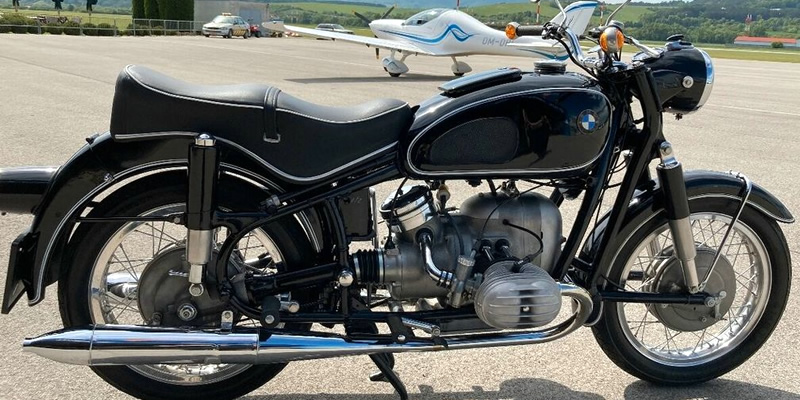
BMW R 60/2, 1965 year, right view
BMW R65 (1978-1993)
The BMW R65 is a naked motorcycle produced by the vehicle manufacturer BMW. The machine was built from 1978 to 1993.
The model from 1985 had a dry weight of 205 kg (fully fueled) and an allowable touring total weight of 440 kg. The short-stroke engine (bore × stroke: 82×61.5 mm) achieved a top speed of 147 km/h with an output of 20 kW, while the 50-hp version is noted to have a top speed of 175 km/h.
At the beginning of its production, the R65 cost 7,290 DM; by 1990, the base price was 9,850 DM, and a year later it was 10,200 DM.
The R65 is powered by a boxer engine with a displacement of 649.6 cm³, producing a nominal output of 33 or 37 kW (45 or 50 hp). The two-cylinder engine features a low-mounted camshaft driven by the crankshaft via a single roller chain. The camshaft actuates the valves—two per cylinder — through pushrods, rocker arms, and tappets in the cylinder head.
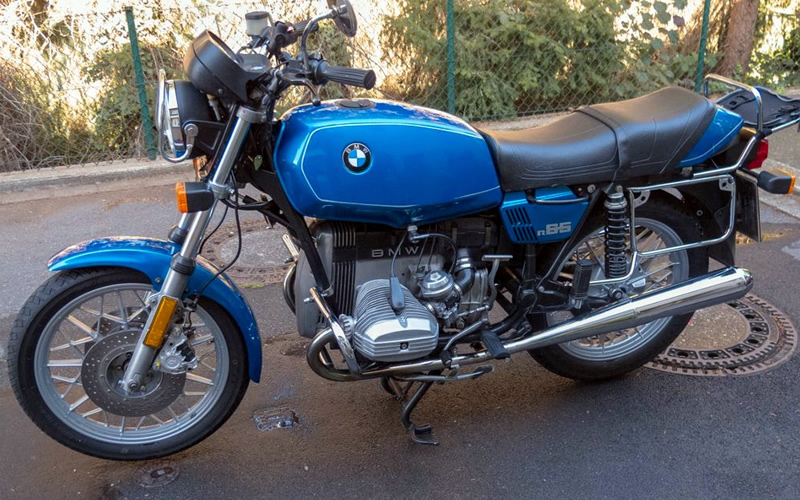
BMW R 65, 1981 year, left view
BMW R68 (1952-1954)
The BMW R68 is a two-cylinder motorcycle with a displacement of 600 cm³ and a nominal power output of 26 kW (35 hp) at 7,000 revolutions per minute. The machine was developed by increasing the power of its 600 cc sister model, the R67. The standard equipment emphasizes the sporty character of the R68 with a narrow front fender that required a reinforcing brace between the fork legs, as well as a special seat cushion, known as the "Rennbrötchen", which is coupled with the saddle and compresses and decompresses with it, positioned above the rear fender. The non-foldable additional footrests were not only intended for (occasional) passenger operation but also allowed the rider to adopt a more racing-oriented seating position.
Between 1952 and 1954, only 1,452 units of the R68 were produced, ultimately due to its exclusivity and high purchase price of 3,950 DM.
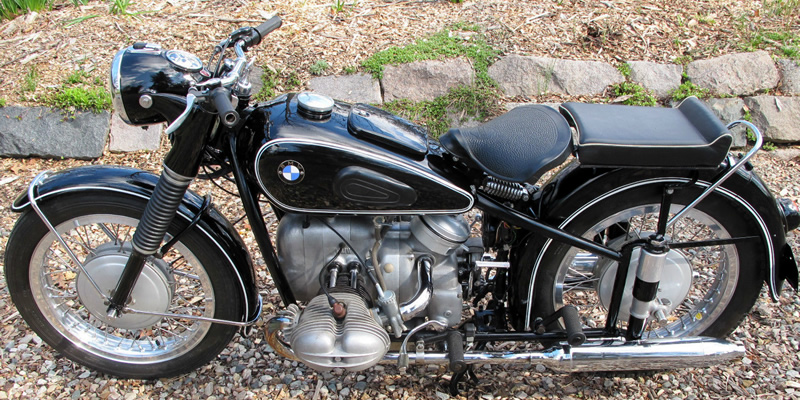
BMW R 68, 1953 year, left view
BMW R69 (1955-1959)
The R69 was introduced in 1955 as the successor to the R68. The R69 was part of a whole series of new models: the 250cc touring model R26, the 500cc touring model R50, the 600cc touring model R60, and the 600cc sport model R69. This entire series consisted of "full-swing BMWs", which significantly improved handling compared to their predecessors. The R68 had painfully demonstrated that the old chassis components could no longer handle the power of models like the R68.
Power increased considerably from 35 to 42 hp compared to the R68. For the first time, the drive shaft was no longer exposed to the outside but was housed in a drive shaft tunnel filled with an oil bath. Over time, electric turn signals (the "cow eyes") and a dual seat became available. The BMW R69 was a sport motorcycle with a touring counterpart, the R60. The successor to the R69 was the R69S, introduced in 1960, which also had a touring "brother", the R60/2.
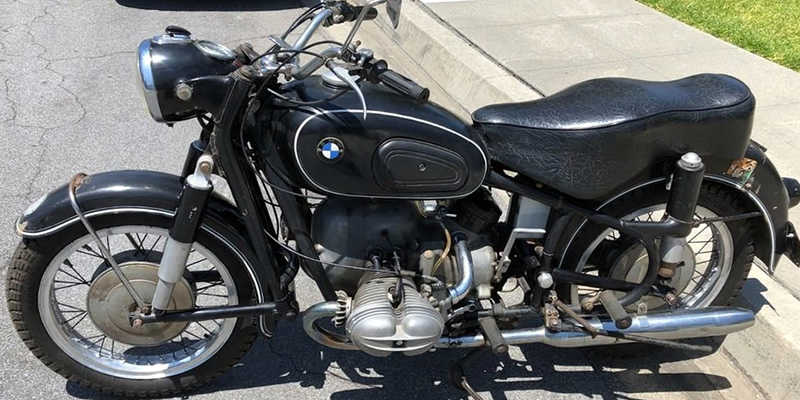
BMW R 69, 1956 year, left view
BMW R69S and R69US (1960-1969)
The R69S, introduced in 1960, was part of a series of motorcycles that included the 250cc R27, the 500cc touring model R50/2, the 500cc sport model R50S, the 600cc touring model R60/2, and the 600cc sport model R69S. Initially, there were few technical differences compared to the series from 1955. However, the turn signals were now readily available, and the frames were slightly reinforced.
The R69S did not have a direct successor. When the series was discontinued in 1969, it was followed by the /5 series, which consisted of three touring models: R50/5, R60/5, and R75/5. The next sport motorcycle would be the R90S, introduced in 1973.
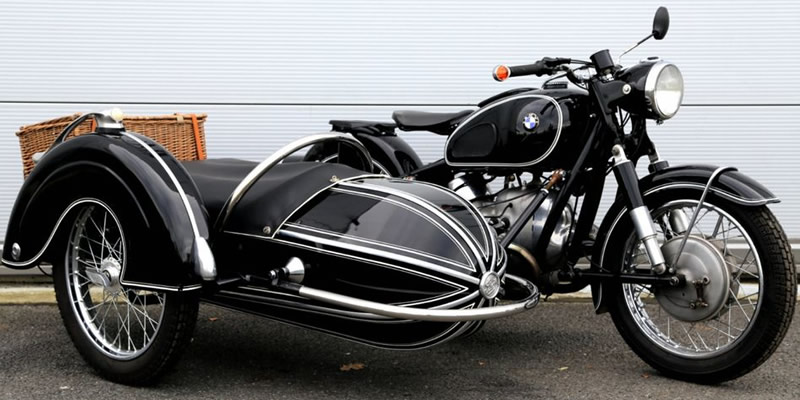
BMW R 69S, 1961 year, with sidecar
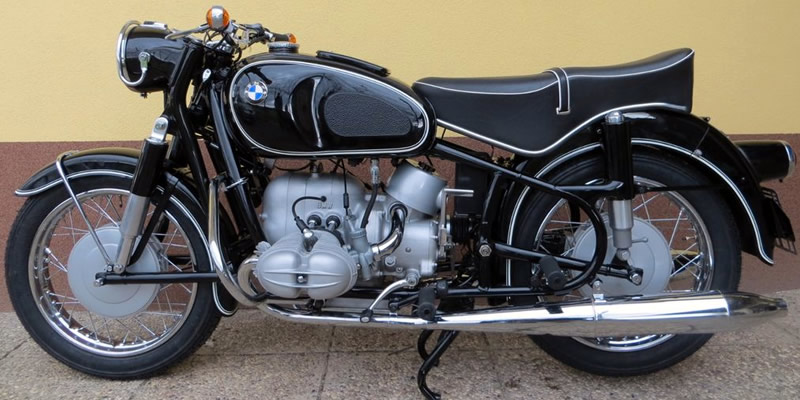
BMW R 69S, 1962 year, left view
BMW R71 (1938-1941)
The BMW R71 was produced from 1938 to 1941 and was the last motorcycle with a side-valve engine in the 750 cc class from the German manufacturer BMW. It followed the pressed frame model R12 and adopted the hydraulically damped telescopic fork developed for the R11 and R12, but it featured a completely newly developed engine with a tunnel housing and a new chassis with a welded tubular frame and the previously developed swinging arm suspension, replacing the earlier pressed frame halves with a rigid rear.
At the automobile exhibition in Berlin, BMW presented a new series of large-capacity motorcycles with rear suspension on February 18, 1938, including the models R51, R61, R66, and R71.
The R71 served as the basis for the Soviet URAL M72 and the derived DNEPR M72. These two brands, in turn, inspired the Chinese Chang Jiang 750.
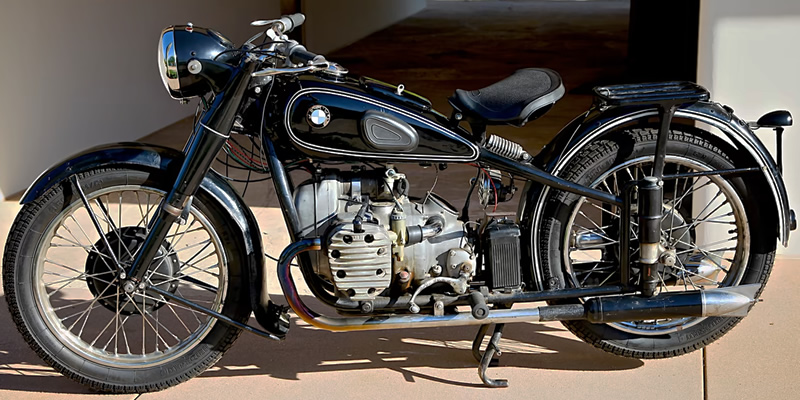
BMW R 71, 1939 year, left view
BMW R75 (1941-1944)
The BMW R75 is a motorcycle sidecar with a powered sidecar and reverse gear produced by Bayerische Motoren Werke from 1941 to 1944, also referred to as the "heavy Wehrmacht sidecar". It was used, among other places, in the North African desert with Rommel's Afrika Korps and in the war against the Soviet Union from 1941 to 1945.
The BMW R75 features a multi-part bolted steel tube frame with an additional brace to the top of the gearbox and a telescopic fork with hydraulic damping; the rear wheel is not suspended, while the sidecar has a leaf spring. The bolted construction allows the frame to be split, simplifying engine removal. The tires are the same size, 4.5×16 inches, with off-road tires on all three wheels. Drum brakes with a diameter of 250 mm are installed on all wheels. The front brake is operated by a cable, while the sidecar and rear wheel brakes are hydraulic. The standardized towing hook allows for the attachment of the light special trailer 1 (SdAnh 1) and other loads. This off-road capable sidecar has a track width of 1180 mm, weighs 400 kg, and has a load capacity of 270 kg. Fuel consumption (tank capacity 24 liters) is 6.3 l/100 km on the road and up to 8.5 l/100 km off-road. The maximum speed is 95 km/h, the sustained speed is 85 km/h, and the minimum speed is 4 km/h.

BMW R 75, 1943 year, left view
The sidecar is powered by an air-cooled two-cylinder OHV boxer engine of type 275/2 with a displacement of 745 cm³ (bore and stroke both 78 mm), with a compression ratio of 5.8:1. The engine has two Graetzin carburetors (SA 24/1+2) and a Noris ZG a2 magneto ignition, as well as Bosch spark plugs (W 225 T1). The output is 26 hp (19 kW) at 4000 rpm.
BMW R75/5, R60/5, R50/5 (/5 Series) (1969-1973)
The R75/5 is a motorcycle produced by BMW featuring an air-cooled two-cylinder four-stroke boxer engine, manufactured from 1969 to 1973. It is the top model of the so-called "slash five" series, which includes the R75/5 (750 cc, 37 kW/50 hp), R60/5 (600 cc, 30 kW/40 hp), and R50/5 (500 cc, 24 kW/32 hp).
BMW responded to the new demand for sport motorcycles with the R75/5 after sales of the outdated swing-arm models had nearly come to a standstill. This was a comprehensive redesign. Instead of following the trend of massive power increases, especially from Japanese motorcycle manufacturers, BMW focused on relatively low specific power (less than 67 hp/L) while ensuring good torque and durability.
The R75/5 was succeeded by the R75/6, and the R60/5 was succeeded by the R60/6. The 500 cc model did not receive a successor. Above the 750 cc model, the successor series offered two larger 900 cc models, the R90/6 with 60 hp and the R90S with 67 hp.
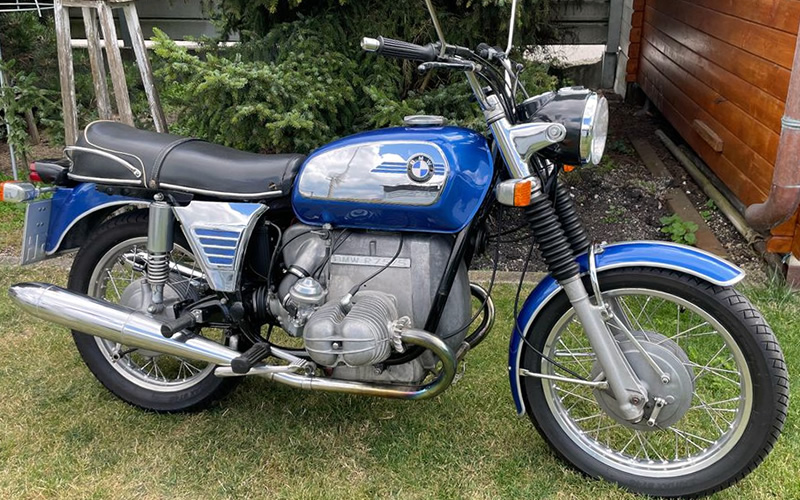
BMW R 75/5, 1970 year, right view
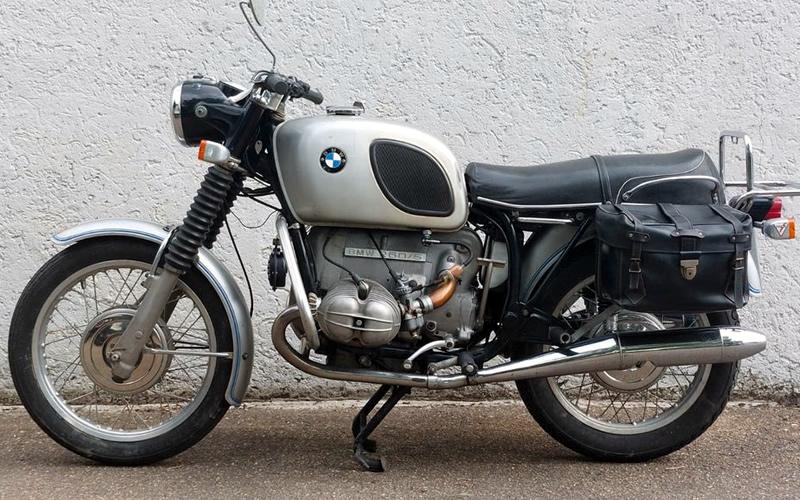
BMW R 60/5, 1971 year, left view
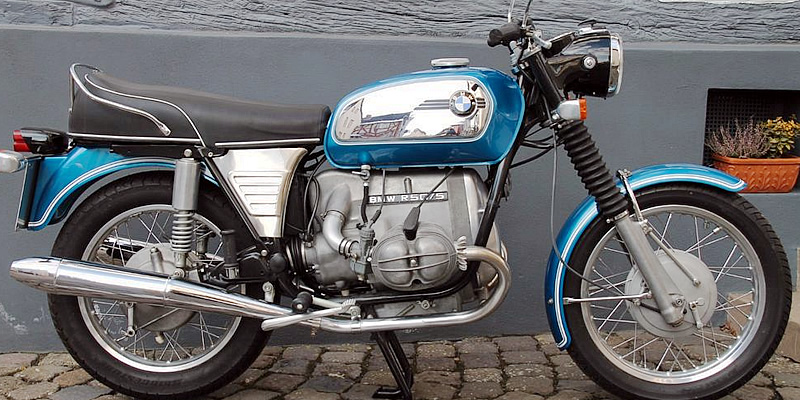
BMW R 50/5, 1972 year, right view
BMW R90S (/6 Series) (1973-1976)
The BMW R90S is a motorcycle from BMW featuring a two-cylinder four-stroke boxer engine. With a displacement of 898 cm³ and an output of 49 kW (67 hp), it was the flagship model of the so-called "slash six" series. A total of 17,465 R90S units were produced.
The R90S and its smaller sibling models R90/6, R75/6, and R60/6 were manufactured from 1973 to 1976 and were successors to the "slash five" series (R50/5, R60/5, and R75/5). With a top speed of nearly 200 km/h, the R90S was one of the fastest production motorcycles in the world. It emerged from BMW's efforts to compete with the more powerful motorcycles from competitors (e.g., Norton Commando, Moto Guzzi V7 Sport, Laverda 1000, Kawasaki Z1, Honda CB750 Four, Harley-Davidson 1000).
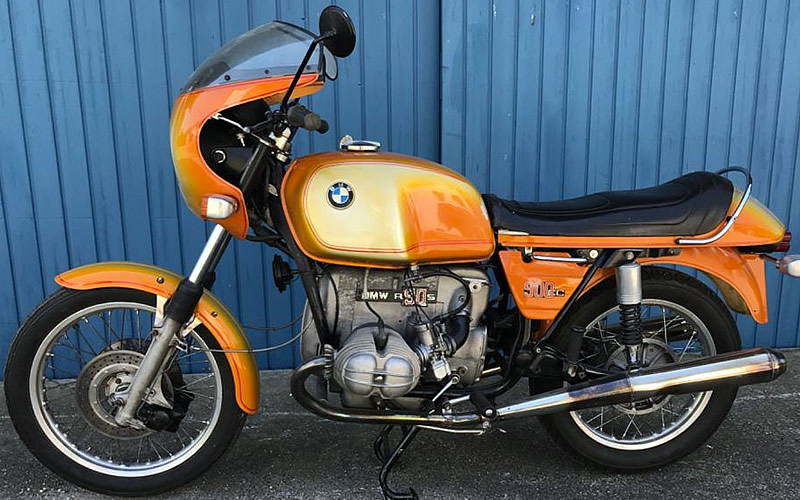
BMW R 90 S, 1975 year, left view
At the same time, the BMW factory in Berlin also produced the essentially chassis- and equipment-identical smaller displacement models R75/6 (37 kW) as successors to the R75/5, and the R60/6 (30 kW) as successors to the R60/5. There was no model with a 500 cc displacement as a direct successor to the 24 kW (33 hp) R50/5.
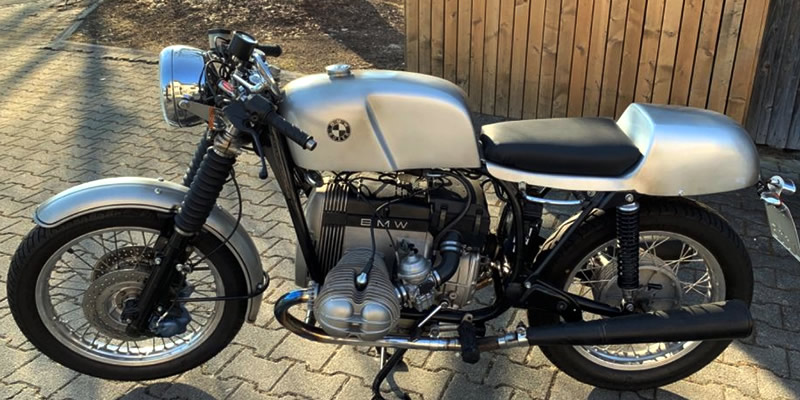
BMW R 75/6, 1976 year, left view
The transmissions of the "slash six" series had five gears for the first time. The crankshaft was modified: from this engine series onward, it was balanced with heavy metal plugs, which reduced the outer diameter of the crankshaft and facilitated installation and removal. The "slash five" engines have forged steel weights on the crankshaft; their crankshafts can only be removed with great skill through special cutouts in the engine housing. The engine housings of the 900 cc engines were significantly reinforced after tests with the predecessor model showed that the old housing could no longer withstand the higher forces of larger cylinders.
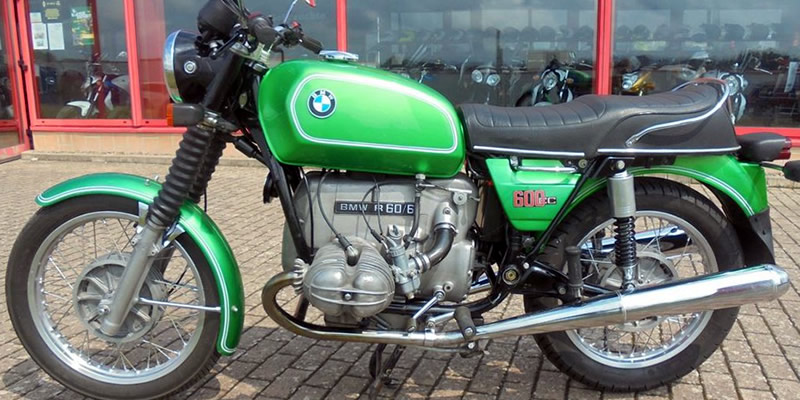
BMW R 60/6, 1974 year, left view
To meet the increased performance compared to their predecessors, the 900 cc and 750 cc models were equipped for the first time with a front disc brake system. The motorcycle accelerates from 0 to 100 km/h in 4.8 seconds and reaches a top speed of 200 km/h.
BMW R100 (/7 Series) (1976-1996)
The BMW R100, with and without the additions T, S, CS, RS, RS Classic, RT, RT Classic, R, and GS, is a designation used by BMW for various motorcycle series, all featuring a two-cylinder four-stroke boxer engine with nearly 1000 cm³ of displacement. This designation was used for different models from 1976 to 1996.
Upon the introduction of the new series under the collective name "slash seven", the model variants included the BMW R100RS (51 kW/70 hp), R100S (initially 48 kW/65 hp), R100 (44 kW/60 hp), R75/7 (37 kW/50 hp), and R60/7 (30 kW/40 hp). The internal designation was Type 247.
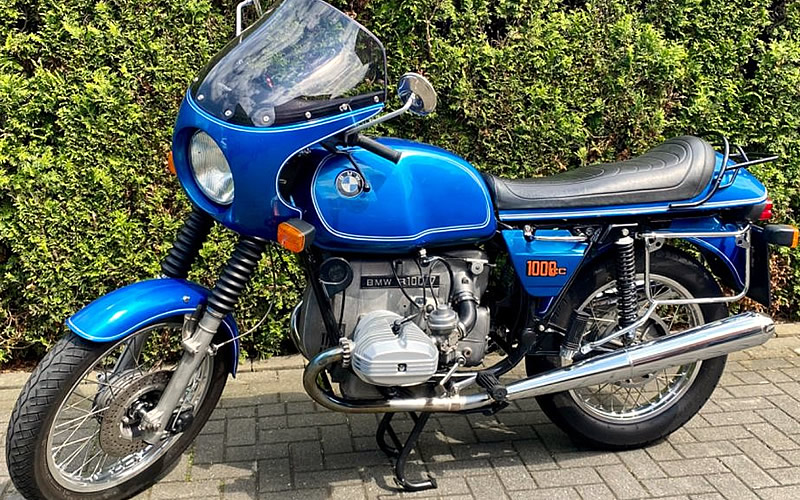
BMW R 100/7, 1978 year, left view
The R100RS was the first motorcycle to feature a frame-mounted full fairing as standard. Additionally, this fairing differed significantly from the previously common fairings from various manufacturers. The design, like that of the R90S, was created by Hans A. Muth. The 100RS fairing weighs 9.5 kg. The machine reached a top speed of 200 km/h.
The R100S (later CS for Classic Sport) has the same handlebar-mounted half fairing as the predecessor model R90S and a rear tail.
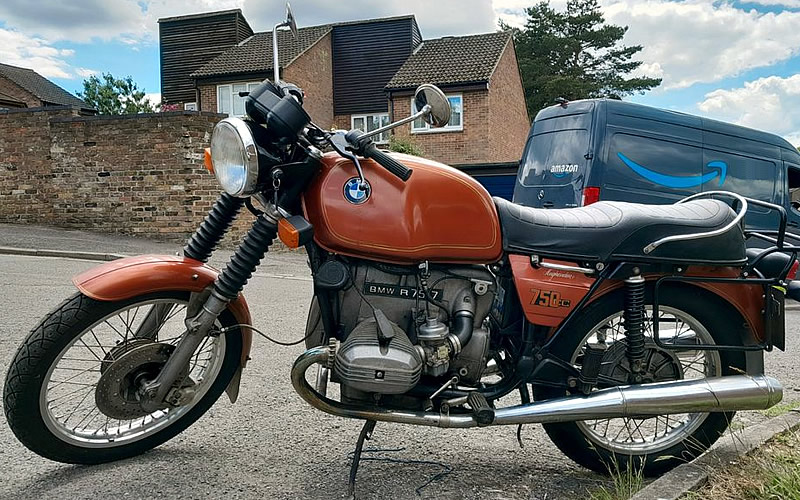
BMW R 75/7, 1977 year, left view
Later, three additional machines were introduced in the same series: the R80/7 as a slightly larger displacement replacement for the R75/7, then a touring model (R100RT), which was essentially identical to the R100RS but with a modified upper fairing and a taller windscreen, and the R100CS, which had a power increase of 5 hp over the S model. The R100CS, with a top speed of over 200 km/h, was one of the fastest production motorcycles in the world.
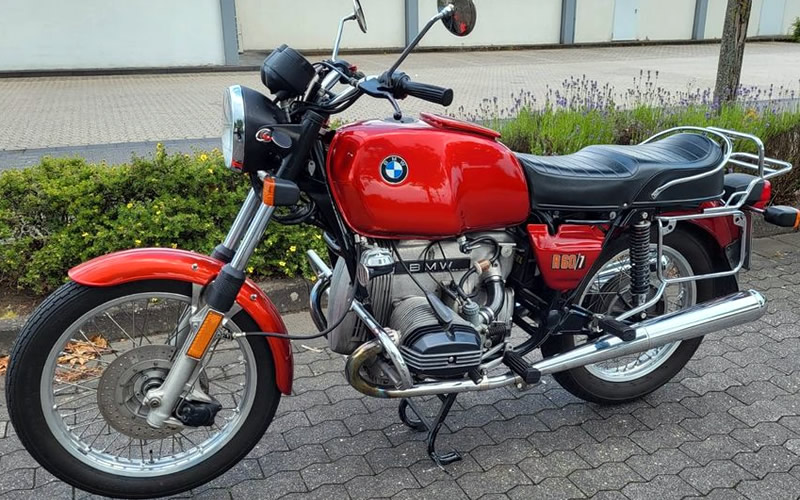
BMW R 60/7, 1979 year, left view
After 33,648 units were built and the limited special model "Classic 500" of the R100RS was produced in only 500 copies, BMW wanted to promote the water-cooled K75 and K100 models for environmental protection and marketing reasons and catch up with the technical lead of the Japanese motorcycle industry. To this end, they planned to discontinue the production of the "old" two-valve boxer models. After this decision led to protests from customers and dealers, BMW resumed delivering R100 models, albeit with modified, less powerful engines that improved torque characteristics, producing 44 kW (60 hp). An 800 cc version with 37 kW (50 hp) was also reintroduced. In parallel, the enduro model R80G/S was launched in 1980 with modified chassis (single-sided swingarm rear) and simpler equipment (without a tachometer), which was replaced in model year 88 by the GS model (without a slash). In 1981, 2,333 units were sold in West Germany.
BMW R100GS (1987-1996)
The BMW R100GS is an off-road motorcycle from BMW. When it was reintroduced on August 24, 1987, in Florence, the BMW R100GS was the largest displacement travel enduro in the world. By 1988, the thousand cc model had become the best-selling motorcycle in Germany. Production and sales of the machine ended in 1996 after approximately 34,000 units were delivered, as stricter environmental regulations could not be economically implemented with the well-known air-cooled boxer concept.
The designation R100GS consists of three elements: The abbreviation R traditionally refers to the construction principle of the boxer engine at BMW. The number 100 indicates the displacement class and stands for 1000 cubic centimeters of displacement. The abbreviation GS stands for GeländeSport (Off-Road/Sport for the R80G/S).
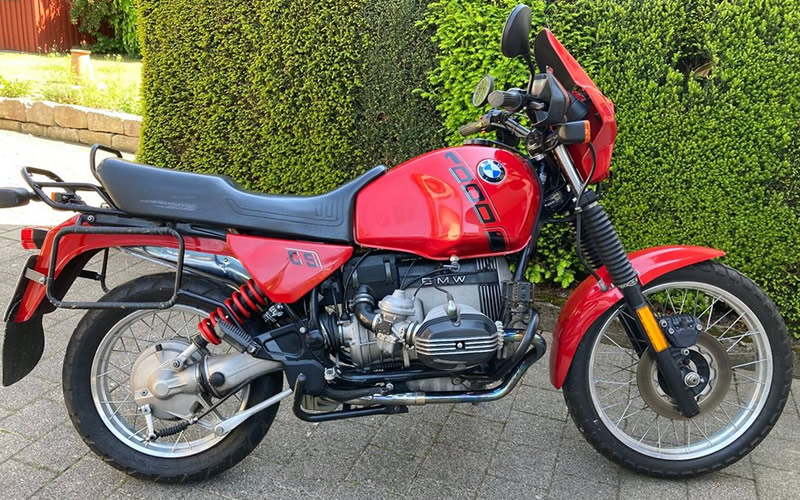
BMW R 100 GS, 1990 year, right view
The engine is an air-cooled two-cylinder four-stroke boxer engine with a displacement of 979.9 cm³, based on the engine of the BMW R100. The fuel mixture preparation is done through two Bing constant vacuum carburetors with a 40 mm channel diameter, with the inlet diameter at the cylinders reduced to optimize torque in the lower RPM ranges. The air filter and Hall ignition with dual ignition coil were carried over unchanged from the predecessor model. The two cylinders have a bore of 94 mm, and the pistons have a stroke of 70.6 mm with a compression ratio of 8.5:1. The motorcycle accelerates from 0 to 100 km/h in 4.8 seconds and reaches a top speed of 181 km/h. The manufacturer states an average fuel consumption of 4.9 liters per 100 km at a constant speed of 90 km/h, with a standard fuel tank volume of 24 liters.
BMW R100R (1991-1996)
The BMW R100R is a motorcycle produced by Bayerische Motoren Werke AG, BMW Motorrad Deutschland. This naked bike was primarily designed for the North American market. In the early 1990s, the special edition of the "Classic" series from BMW featured air-cooled two-valve boxer engines for the last time. A smaller sibling model, the R80R, was also offered.
The air-cooled two-cylinder four-stroke boxer engine of the model has a chain-driven overhead camshaft and two rocker arms operated by pushrods for valve control, achieving a nominal output of 44 kW (60 hp) at 6500 rpm with a displacement of around 980 cm³. The gasoline-air mixture (regular gasoline) is produced by two constant vacuum carburetors, and the ignition is transistor-controlled. The rear wheel is driven through a single-disc dry clutch, a five-speed transmission, a cardan shaft, and a bevel gearbox. The fuel tank has a capacity of 24 liters. When fully fueled, the motorcycle weighs 218 kg, and the permissible total weight is stated to be 465 kg.
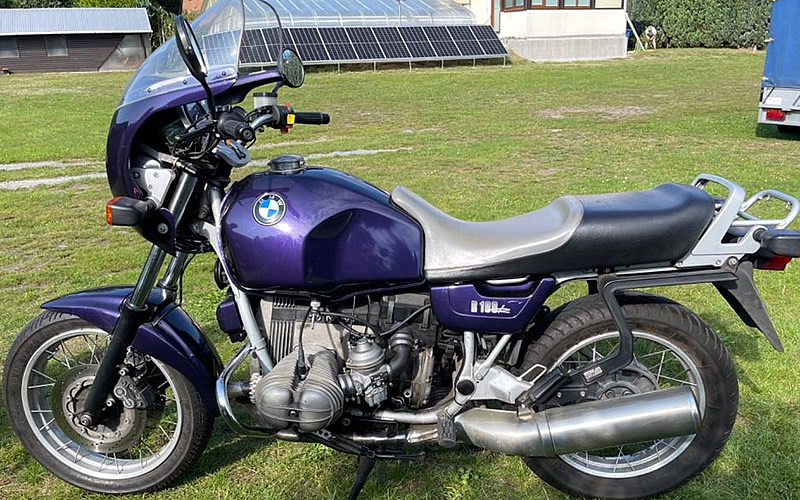
BMW R 100 R, 1992 year, left view
Production of the R100R model ended in late 1996 after 20,589 units were manufactured at the BMW factory in Berlin.
BMW R80 (1985-1992)
The BMW R80 was a motorcycle model from the manufacturer BMW. This unfaired naked bike is the successor to the BMW R80/7 and served as the technical basis for the BMW R80RT models from 1985 to 1995. It was the first boxer BMW that could run on unleaded gasoline.
Its boxer engine, with a displacement of 797 cm³ and an output of 37 kW (50 hp) at 6500 rpm, was derived from the BMW R80/7. The exhaust and intake tract were optimized for better torque characteristics. With this engine, the machine achieved a top speed of nearly 180 km/h, and fuel consumption at a constant speed of 90 km/h was reported to be 4.6 liters per 100 km.
The model was produced from 1985 to 1992 in 13,815 units, including 314 government models. Its successors were the BMW R80R and BMW R100R with Paralever.
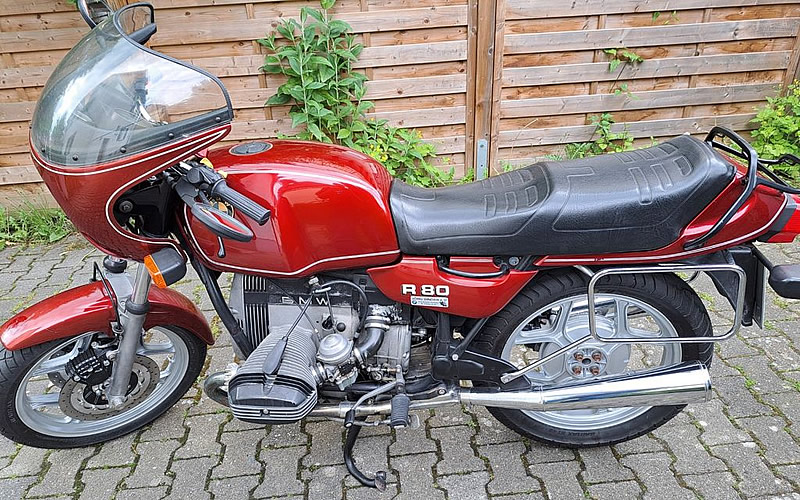
BMW R 80, 1986 year, left view
BMW R80G/S (1980-1987)
The BMW R80G/S was a motorcycle model from Bayerische Motoren Werke. It was the first enduro with a multi-cylinder engine and the first series BMW with a single-sided swingarm.
Its boxer engine, with a displacement of 797 cm³ and an output of 37 kW (50 hp), was modified from the BMW R80/7. At the time of its introduction, it was the most powerful but also the heaviest enduro. With this model, BMW re-entered the off-road racing scene, winning the Paris-Dakar Rally in 1981, 1983, 1984, and 1985.
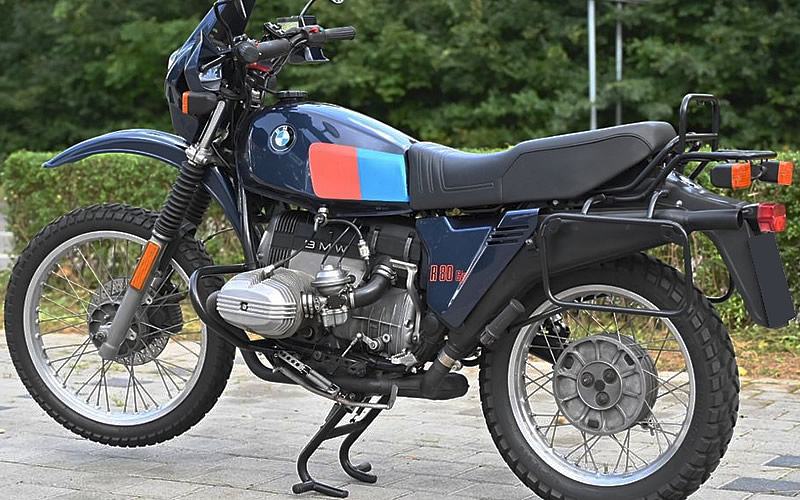
BMW R 80 G/S, 1983 year, left view
The motorcycle was presented to the international press in Avignon in September 1980. From 1980 to 1987, 33,247 R80G/S units were manufactured at the BMW factory in Berlin-Spandau. The design of the G/S was developed by Karl-Heinz Abe and was later revived in the R9T Urban G/S. Marketing manager Heino D. Würfel described the R80G/S as "a universally usable leisure instrument for new forms of experience". The successor models were the R80GS and R100GS with Paralever, as well as the R65GS with Monolever.
BMW R850C (1998-2001)
The R850C is a motorcycle model from the Bavarian manufacturer BMW. The 848 cm³ engine is achieved by reducing the bore from 99 to 87.5 mm. The R850C was produced between 1998 and 2001, with a total of 1,505 units made. It is the younger sister of the R1200C, sharing its appearance. The engine produces 50 horsepower at 5,250 rpm.
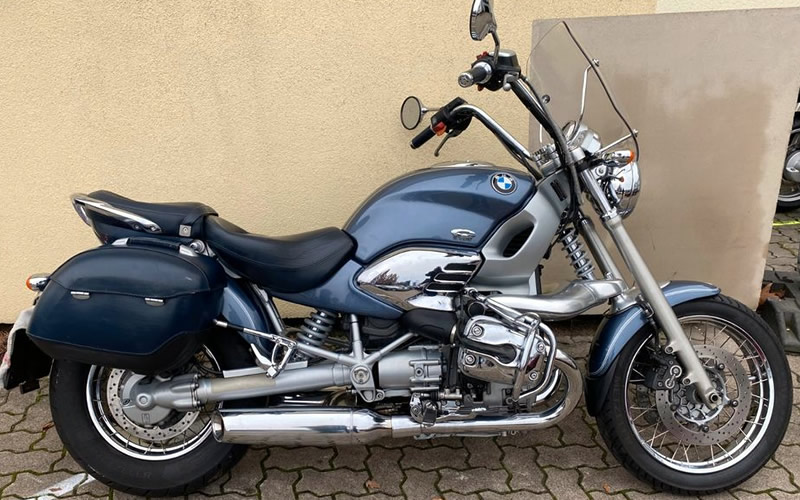
R 850 C, 2000 year, right view

R 850 C, 2001 year, left view
BMW R1200C (1997-2004)
The BMW R1200C is a motorcycle from the manufacturer BMW. The cruiser was presented to the press in Tucson in June 1997 and, like all models in the R series, is powered by a boxer engine with two cylinders. The model code is 259C.
The R1200C was the first cruiser that BMW added to its motorcycle lineup in the fall of 1997. The smaller variant R850C followed in the spring of 1999. Production of the R850C ended in 2000, and production of the R1200C ceased in 2004.
The design of the R1200C is distinctive and sets it apart from classic choppers. Unlike other manufacturers that clearly orient their cruisers/choppers towards Harley-Davidson models, BMW attempted to incorporate its own history into this model. A notable innovation was the use of BMW’s characteristic two-cylinder boxer engine instead of a V-twin; similar exotic status can be found in models like the Triumph Rocket III with its three-cylinder engine or the Moto Guzzi California, which features a longitudinal V2 engine. Also atypical for this class are the technical refinements of the BMW cruiser, such as an anti-lock braking system, shaft drive, single-sided swingarm, and the Telelever suspension system. The R1200C is particularly noted for its light handling compared to heavier cruisers like the Triumph Rocket III or the Honda Valkyrie Rune.
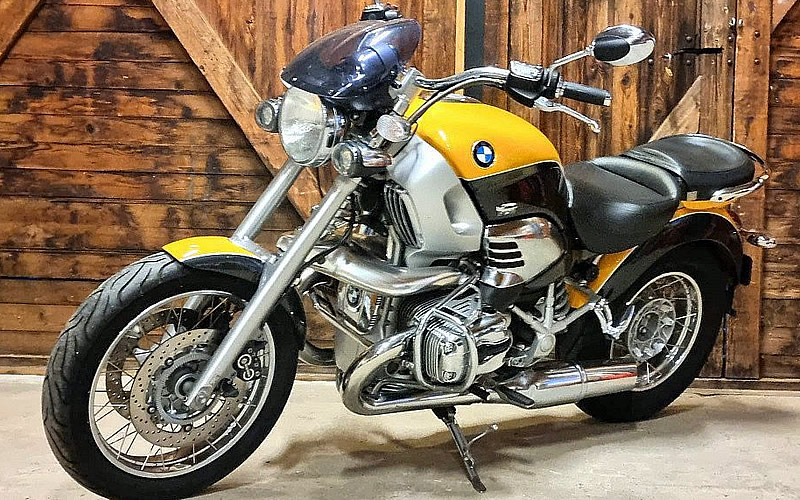
R 1200 C, 2003 year, front view
The front frame section, to which the Telelever suspension is attached, is made of aluminum cast components, while the rear part consists of steel tubes. The engine is part of the load-bearing structure and allows for a rated output of 45 kW (61 hp) and a top speed of 168 km/h. The two cylinders have a bore of 101 mm, with a stroke of 73 mm; the compression ratio is 10:1. To increase the wheelbase, the single-sided swingarm at the rear was extended by 90 mm and is supported by a Monolever suspension. This extended the overall length of the cruiser to 2415 mm. The hydraulically operated single-disc dry clutch is combined with a 5-speed transmission based on the 6-speed transmission of the K 1200 RS. A chrome-plated stainless steel catalytic converter is standard equipment. The ready-to-ride weight is 277 kg, with a maximum payload of 173 kg.
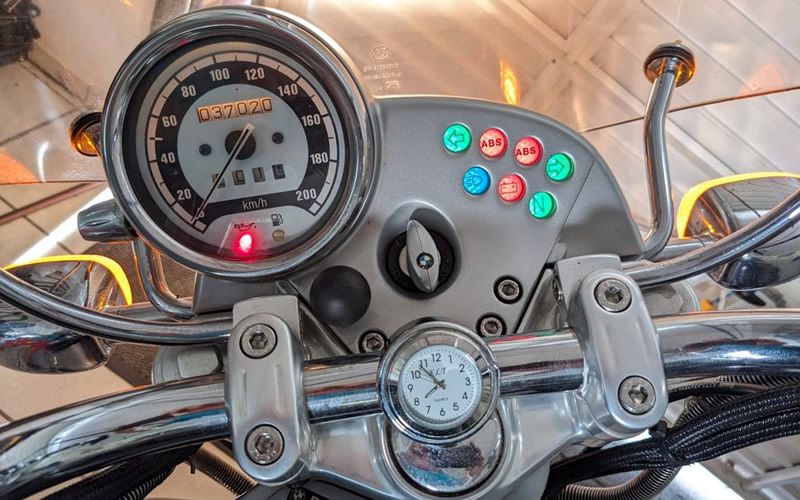
R 1200 C, 1998 year, dashboard
Production ended in 2004. BMW may not have been able to meet market demand for larger displacement with the current boxer engine version (which had already led to the discontinuation of the 850), especially as Triumph set an unreachable standard with the Rocket III and its 2300 cm³ displacement. Additionally, the cruiser was merely a niche model compared to the successful R1200GS.
BMW R1100S (1998-2005)
The BMW R1100S is a motorcycle from the manufacturer BMW. Marketed as a sport boxer, the motorcycle was introduced on September 12, 1998, as the last model of the R 1100 series, producing 98 hp, and was replaced by the BMW R1200S in 2006. BMW referred to this motorcycle as the first superbike from BMW in over 50 years from its own production. In fact, there was a Boxer Cup brand trophy with a higher suspension to increase the cornering clearance of the boxer engine. The cup vehicle also received a rear wheel widened to 5.5*17".
The three-part frame consists of a front frame, a welded main frame made of aluminum, and a rear frame made of steel. The engine is load-bearing. A single-sided swingarm supports the rear wheel.
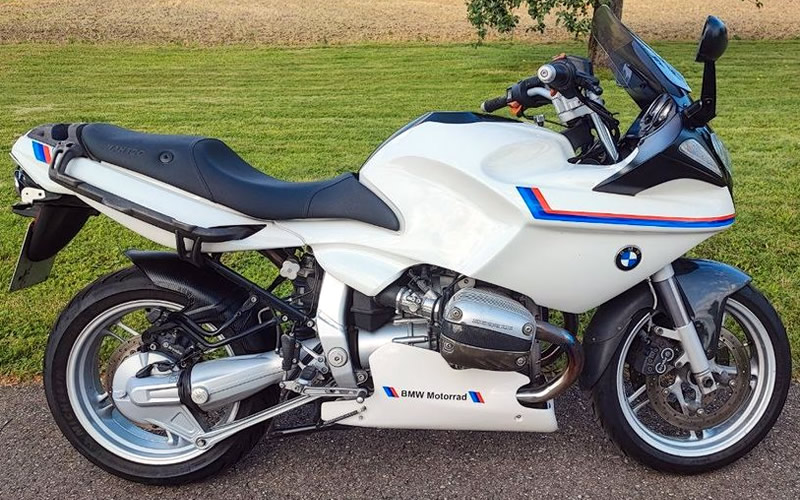
R 1100 S, 1998 year, right view
The air- and oil-cooled boxer engine with two horizontally opposed cylinders produces a rated output of 72.3 kW (98 hp). The motorcycle accelerates from 0 to 100 km/h in 3.8 seconds and reaches a top speed of 226 km/h. Each cylinder head has four valves operated by a "semi-high" camshaft. The two cylinders have a bore of 99 mm, with a stroke of 70.5 mm and a compression ratio of 11.3:1. From 2003 onwards, a dual ignition system was incorporated. Power is transmitted via a hydraulically operated single-disc dry clutch, a 6-speed transmission, and a shaft drive; the transmission was revised in the fall of 2002. The exhaust system’s performance-optimized mufflers are located under the seat. The motorcycle comes standard with a three-way catalytic converter and Bosch's Motronic engine management system (MA 2.4) with fuel injection.
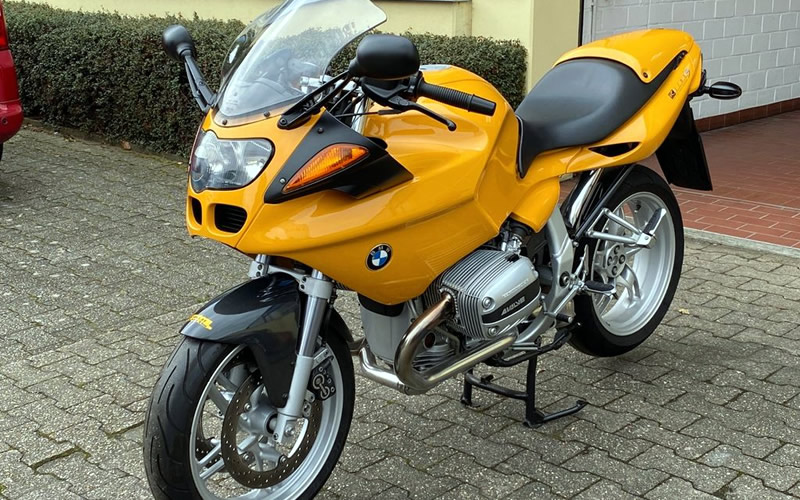
R 1100 S, 1999 year, front view
The motorcycle was built at the BMW factory in Berlin, Spandau; 14,806 units were sold in Germany.
Motorcycles with comparable characteristics include the Benelli Tornado Tre 1130, Ducati GT 1000, and Honda CBF 1000.
BMW R1200S (2006-2008)
The BMW R1200S is a motorcycle from the manufacturer BMW, produced from 2006 to 2008 at the BMW factory in Berlin, Spandau.
The R1200S is the direct successor to the R1100S, which was marketed as a so-called sport boxer but still possessed good touring capabilities. The R1200S, on the other hand, is designed more as a superbike. The passenger seat is only suitable for short distances. However, it is now possible to attach luggage racks and BMW sport cases.
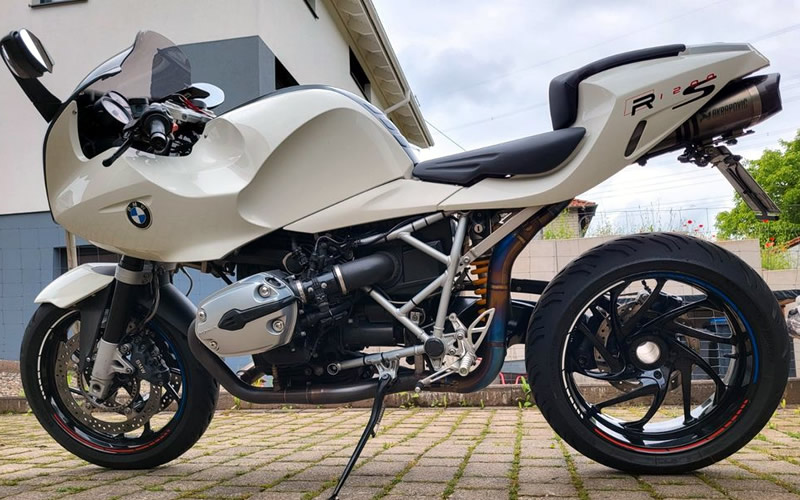
R 1200 S, 2006 year, left view
The air- and oil-cooled boxer engine is installed longitudinally and produces a rated output of 90 kW (122 hp) from two cylinders with a displacement of 1170 cm³ at an engine speed of 8250 min−1, and a torque of 112 Nm at 6800 min−1. Each cylinder head has a chain-driven camshaft that operates two intake and two exhaust valves via rocker arms. The cylinders have a bore of 101 mm, with a stroke of 73 mm and a compression ratio of 12.5:1. The four-stroke engine features digital engine management and a wet sump pressure circulation lubrication system.
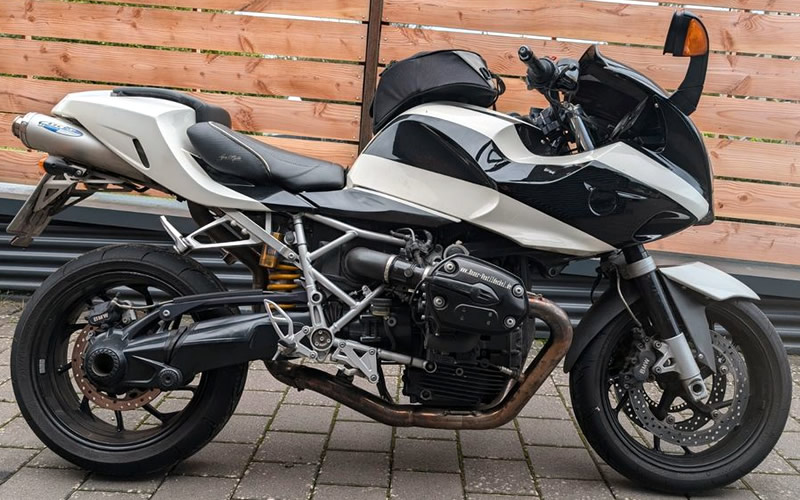
R 1200 S, 2007 year, right view
The motorcycle accelerates from 0 to 100 km/h in 2.9 seconds and reaches a top speed of 243 km/h.
BMW ceased production in early 2008. The premium version HP2 Sport, produced from 2007 to 2010, differs significantly in price and equipment from the R1200S.
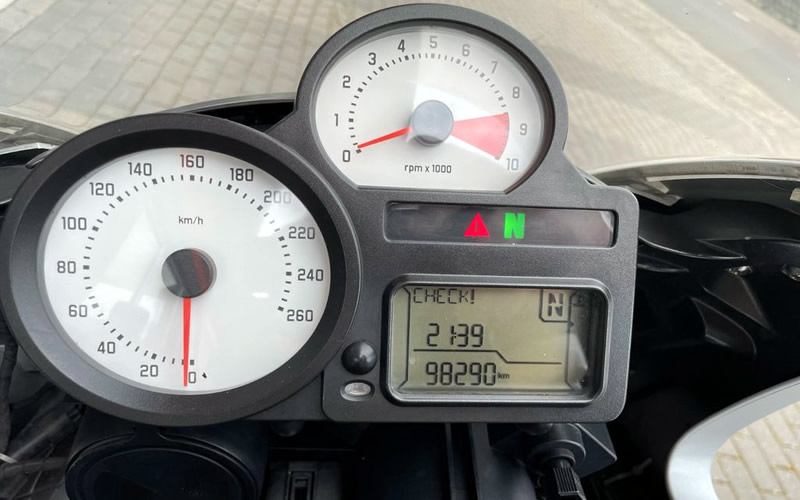
R 1200 S, 2008 year, dashboard
Compared to the good sales figures and long production run of the predecessor R1100S, the R1200S must be regarded as only moderately successful. For the more comfort-oriented BMW riders, the motorcycle was too sporty. The concept did not appeal to customers of Japanese or Italian superbikes.
BMW R1100R (1994-2000)
The BMW R1100R is a motorcycle from the manufacturer BMW with an air-oil-cooled two-cylinder boxer engine. The naked bike has several similarly constructed sister models, such as the touring sports model R1100RS and the touring model R1100RT. From 1994 until the end of production in 2000, 53,685 units of the roadster were built at the BMW factory in Berlin.
The chassis and engine are identical to the R1100GS; however, the "R" has a steering damper due to the lower front wheel load. The front brake comes from the R1100RS. In the spring of 1997, the R1100R received a new cockpit with a more appealing design and a larger headlight.
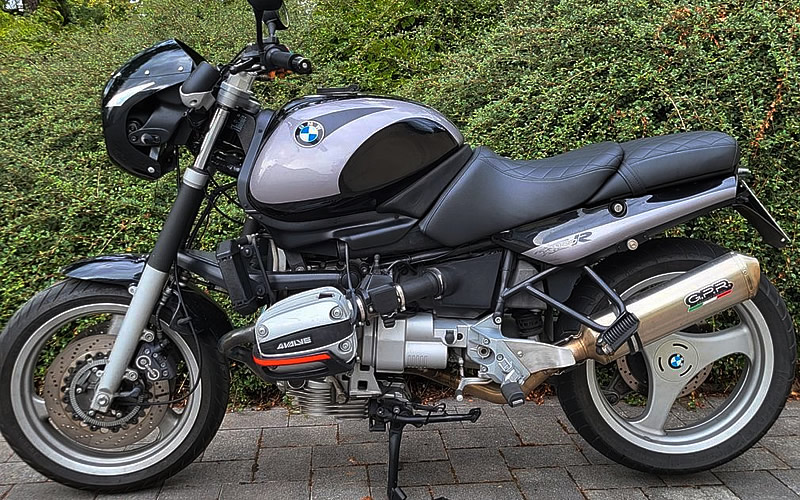
R 1100 R, 1997 year, left view
The two cylinders of the boxer engine have a bore of 99 mm. The pistons have a stroke of 70 mm with a compression ratio of 10.3:1. Power output is 57 kW (77.5 hp) at 6,500 min−1.
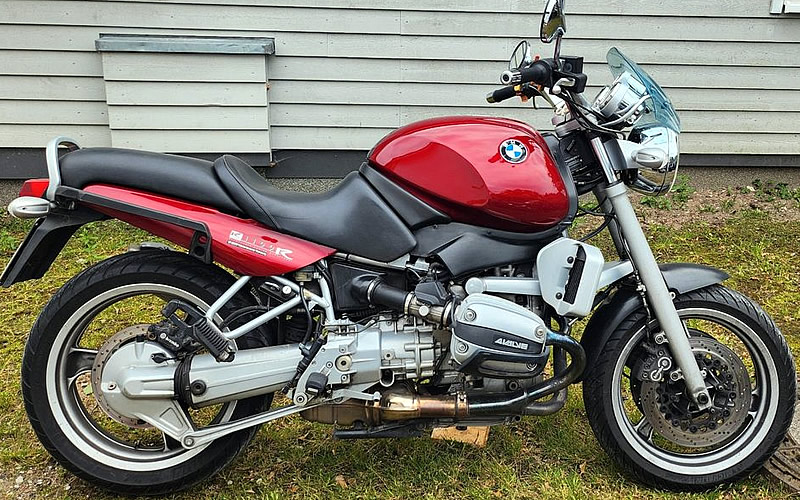
R 1100 R, 1998 year, right view
The R1100R replaced the R100R with the 1994 model year. The motorcycle is optionally equipped with an anti-lock braking system. A similar motorcycle with only 848 cm³ displacement was also offered. The R850R features an engine producing 71 hp (52 kW) with a maximum torque of 77 Nm. It was often used as an official motorcycle.
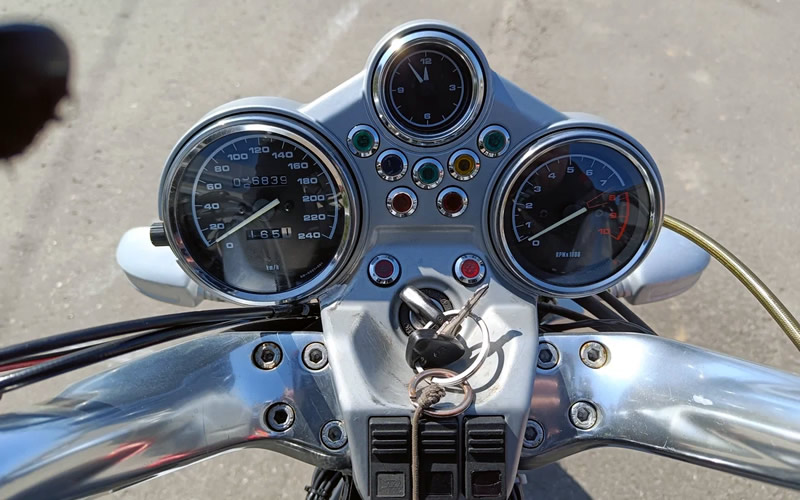
R 1100 R, 1999 year, dashboard
With the 2001 model year, the R1100R was replaced by the R1150R.
BMW R1150R (2000-2006)
The BMW R1150R is an unfaired motorcycle from the manufacturer BMW. Like all models in the R series, the naked bike is powered by a boxer engine with two cylinders.
The roadster has several similarly constructed sister models, such as the R1150R Rockster variant, the touring enduro R1150GS/Adventure, the touring sports model R1150RS, and the touring model R1150RT, all with largely identical engines but different fairings and chassis designs. The tank of the R1150R holds 20.4 liters of premium gasoline. The front suspension is realized through a Telelever system, and the rear is supported by a Paralever construction.
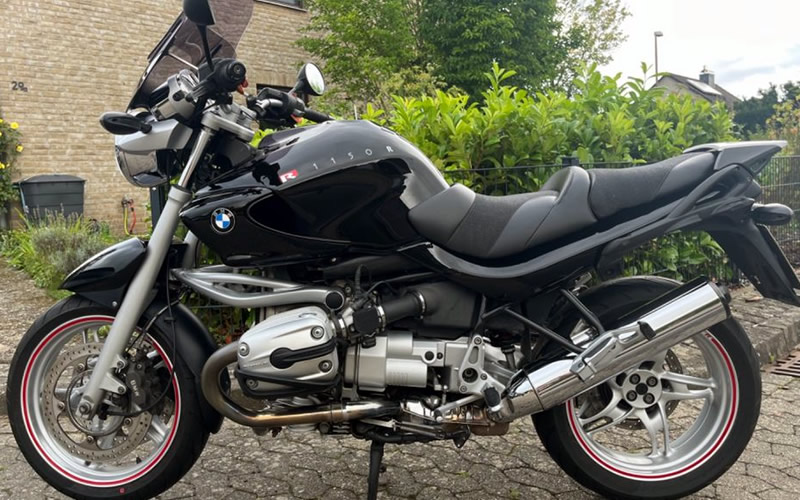
R 1150 R, 2002 year, left view
Air/oil-cooled two-cylinder four-stroke boxer engine, displacement 1130 cm³, power output 62.5 kW (85 hp) at 6,750 min−1.
A total of 43,018 units of the standard version R1150R were built, with an additional 8,336 units produced of the R1150R Rockster variant (2003–2005).
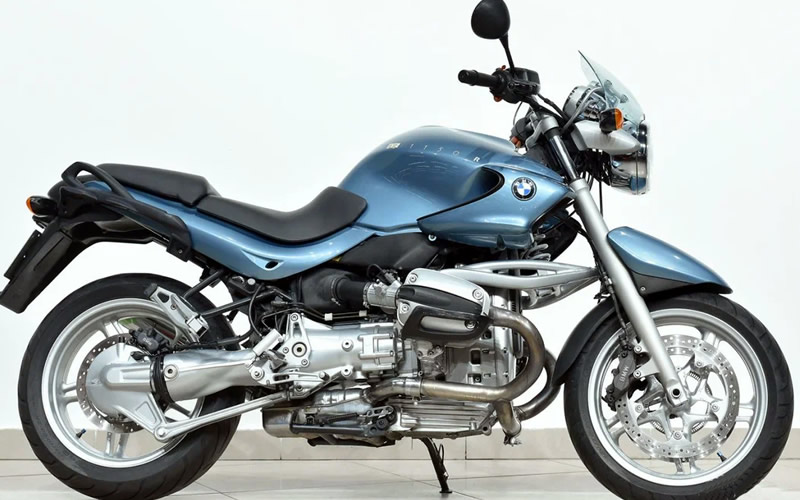
R 1150 R, 2001 year, right view
A similar but power-reduced version with only 848 cm³ displacement was offered as the R850R. Its rated output is 71 hp (52 kW) with a maximum torque of 77 Nm. It was often used as an official motorcycle.
With the 2007 model year, the R1150R was replaced by the R1200R.
BMW R1200R K27 (2006-2014)
The BMW R1200R (K27) is a motorcycle manufactured by BMW. The roadster was first presented on July 7, 2006, at the 6th International BMW Motorcycle Biker Meeting in Garmisch-Partenkirchen as the successor to the R1150R and is technically largely identical to the sport tourer R1200ST and the touring bike R1200RT, but without fairing. It was delivered starting in early 2007.
From the model update in March 2011, the cylinder head with two overhead camshafts and four radially arranged valves, already used in the HP2 Sport and from 2010 in the R1200GS, was installed. Additionally, the cockpit and headlight bracket, front fork, muffler, wheels, tail, and mirrors were modified. A variant called R1200R Classic with wire-spoked wheels and classic black-and-white paint was offered, giving it a slightly retro appearance.
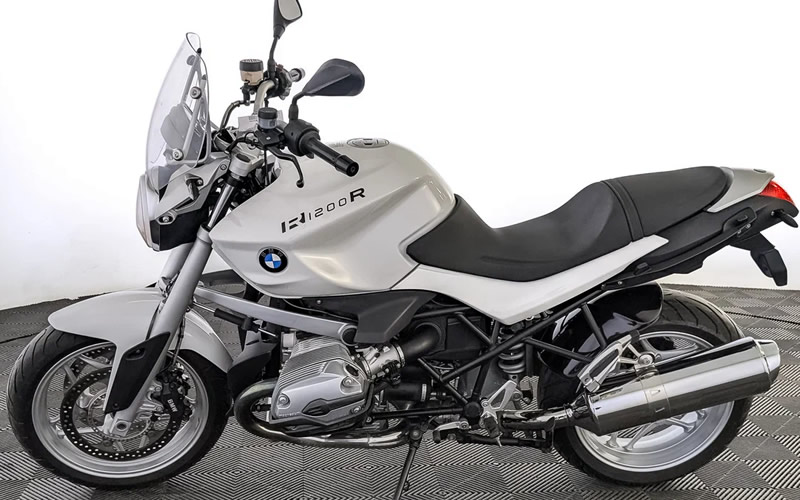
R 1200 R (K27), 2010 year, left view
The air- and oil-cooled two-cylinder four-stroke engine produces a rated power of 80 or 81 kW (109 or 110 hp). This power rating requires fuel with an octane rating of 98. For the first time, BMW used knock sensors to control the ignition timing and adapt to fuel qualities. The boxer engine has a displacement of 1170 cm³ (bore 101 mm, stroke 73 mm). The compression ratio is 12.0:1. The motorcycle accelerates from 0 to 100 km/h in 3.4 seconds and reaches a top speed of 220 km/h.
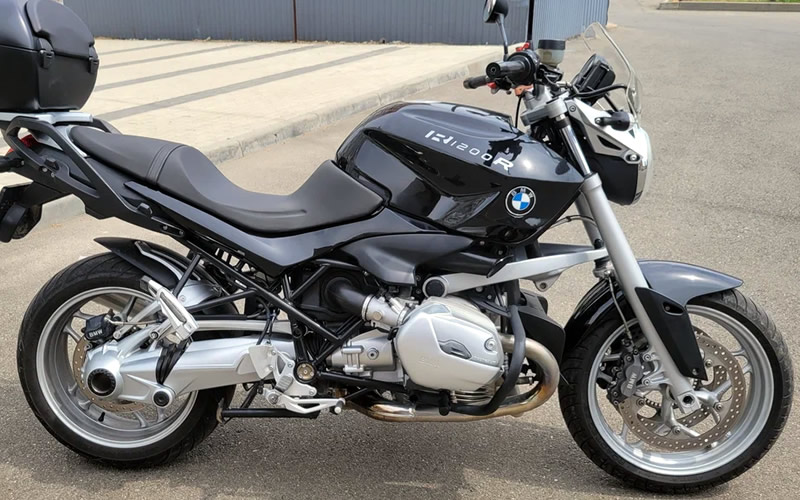
R 1200 R (K27), 2007 year, right view
With the 2015 model year, the R1200R (K27) was replaced at the end of 2014 by the completely redesigned successor model R1200R (K53) with a water-cooled boxer engine after more than 50,000 units were produced.
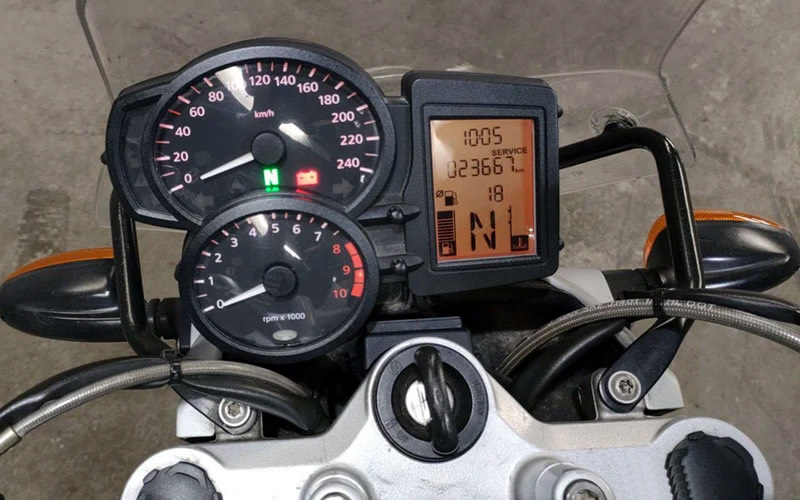
R 1200 R (K27), 2008 year, dashboard
Its technology was largely adopted for the R nineT (K21), introduced in 2014. However, this model features an upside-down fork instead of a Telelever, a significantly different frame construction, different brake calipers, and exhaust components.
BMW R1200R K53 (2014-2018)
The BMW R1200R (K53) is a naked motorcycle manufactured by BMW. The roadster was presented at Intermot 2014 and was, after the R1200GS, R1200GS ADV, R1200RT, and R1200RS – aside from the retro roadster R nineT – the last model of the boxer series to feature the air/water-cooled boxer engine with 1170 cm³ and 125 hp, which was first introduced with the GS in 2013. In this engine, the hottest, thermally most stressed areas in the cylinder heads are cooled by circulating coolant.
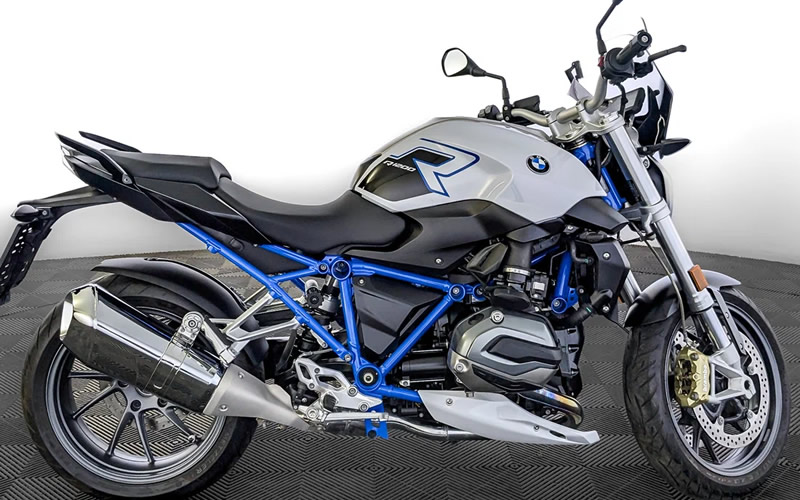
R 1200 R (K53), 2017 year, right view
The R1200R differs from the GS and RT models in the airbox and end muffler, which positively affects the torque in the lower RPM range. Over 100 Nm of torque is available from 2,500 to over 8,000 rpm. The engine is mounted in the bridge frame as with its predecessor. The chassis was developed by Martin Hartinger. Unlike its air-cooled predecessor, the K53 features an upside-down fork with a 45 mm stanchion diameter, derived from the S1000RR.
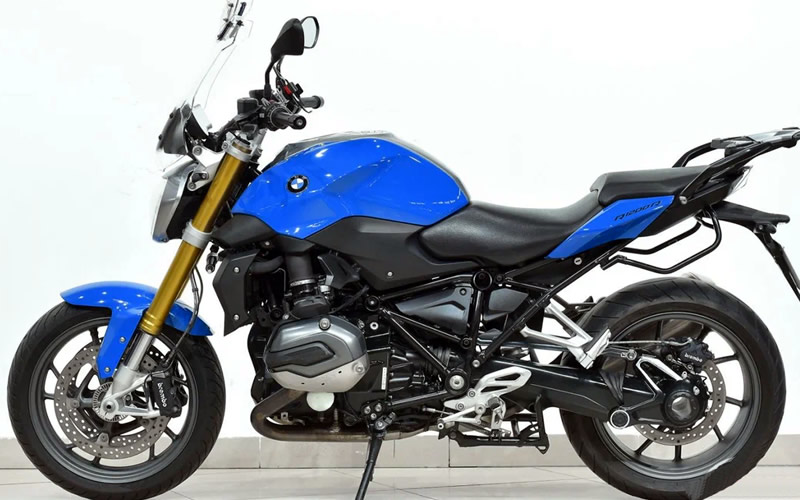
R 1200 R (K53), 2016 year, left view
The electronics include two riding modes, "Road" and "Rain"; in Rain mode, the throttle response is smoother, and the ABS and the basic traction control ASC (both standard) engage earlier and more defensively. Additionally, two further riding modes are available on request: "Dynamic", which is more aggressive than the "Road" mode, and a "User" mode, where the electronic throttle response and slip control can be programmed individually. Furthermore, Dynamic ESA is available on request, allowing the rebound and compression damping to be automatically adjusted during the ride in the two modes "Road" and "Dynamic". The spring base of the upside-down fork is not adjustable, while the rear shock can be adjusted at the push of a button in three settings: solo, solo with luggage, and two-up riding.
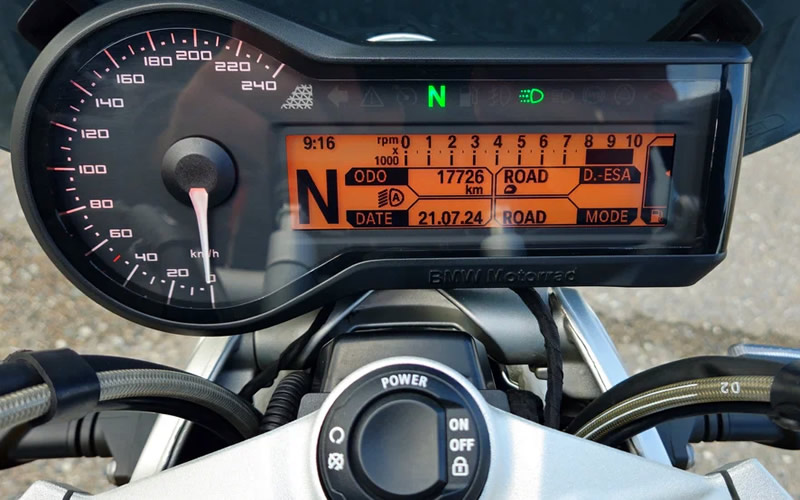
R 1200 R (K53), 2018 year, dashboard
In November 2018, the successor model R 1250 R was presented at EICMA for the 2019 model year, featuring a variable valve timing system. The technology known as "ShiftCam" is also used in the R 1250 GS.
BMW R1250R (2018-current)
The BMW R1250R is a naked motorcycle manufactured by BMW. The roadster was introduced in November 2018 at the EICMA trade fair and was sold starting in early 2019.
Like the GS, the new engine in the BMW R1250R produces 136 hp at 7,750 rpm and delivers 143 Nm at 6,250 rpm. The new Shift Cam technology from BMW is also used in the R1250R, which varies the timing and lift of the valves depending on the load and engine speed through an axial shift in two stages. In addition to more power, the new boxer is designed to provide more torque in the lower RPM range. The exhaust system has also been redesigned. The transmission and anti-hopping clutch are now integrated into the engine casing. Power transmission occurs via a multi-plate oil bath clutch.
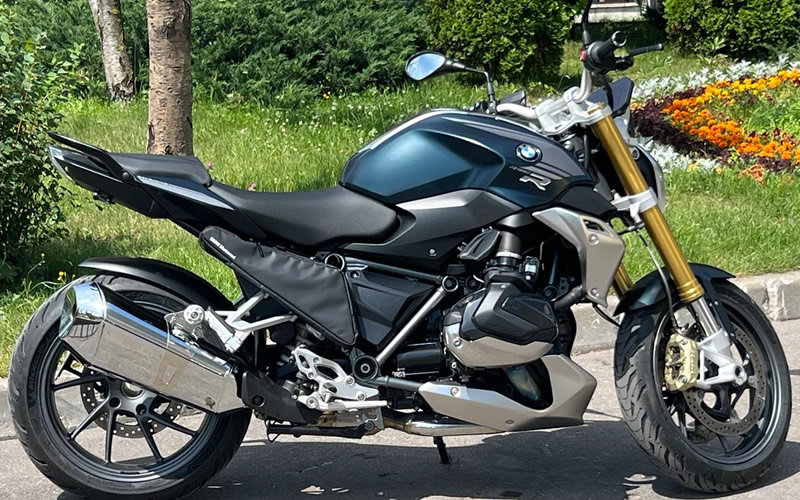
R 1250 R, 2019 year, right view
Standard features include the two riding modes "Rain" and "Road", ABS, a hill start assist, and a stability control system called ASC. An optional "Pro" riding mode is also available, which includes dynamic traction control, improved ABS, a hill start assist, and a dynamic brake assistant. Additionally, a sport handlebar is available as an option for a more active riding position.
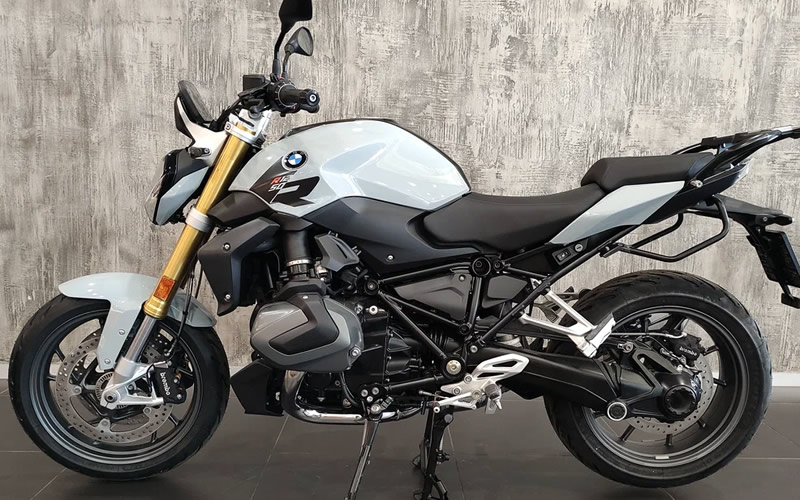
R 1250 R, 2024 year, left view
The standard seat height is 820 mm, but it can be adjusted to 760 mm, 790 mm, or 840 mm as an option. At the front, a floating 320 mm double disc brake and 4-piston radial calipers are used. At the rear, a single disc brake with a diameter of 276 mm provides stopping power. For tire dimensions, BMW opted for 120/70 ZR 17 (front) and 180/55 ZR 17 (rear). The bike weighs 239 kilograms ready to ride. The fuel tank has a capacity of 18 liters.
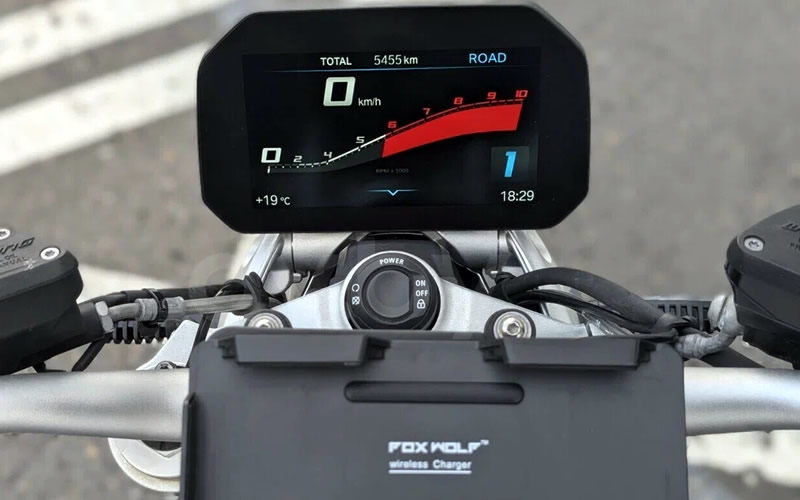
R 1250 R, 2020 year, dashboard
Unlike other BMW models introduced at EICMA with the new 1250 engine, LED headlights are not standard on the R1250R. This feature is also available as an option. The roadster comes standard with halogen headlights. New features include a 6.5-inch TFT display. The front spoiler and cockpit cover are also new additions.
BMW R850RT (2002-2006)
In 2002, an updated version of the touring model R850RT was released. Its technical specifications were improved with increased power (up to 73 horsepower) and torque (up to 80 Nm). However, overall, the model retained the same characteristics as its first version.
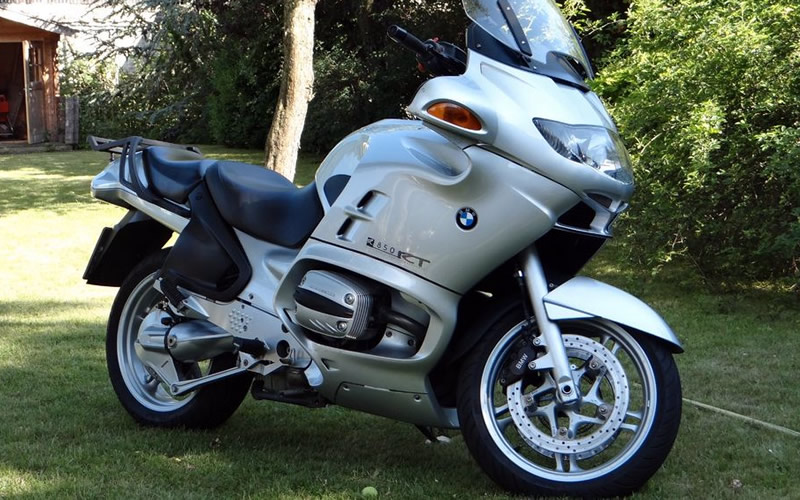
R 850 RT, 2003 year, front view
The 4-stroke, 2-cylinder boxer engine of the model was equipped with an air-oil cooling system. The engine displacement was 848 cc. The cylinder bore was 87.5 mm, and the stroke was 70.5 mm. The undeniable advantages of the motorcycle included the Bosch Motronic fuel injection system and an electric starter. The transmission consisted of a 5-speed gearbox and a shaft drive. As with previous versions of the model, the R850RT from the 2002 model year featured a Telelever front suspension and an aluminum Paralever swingarm.
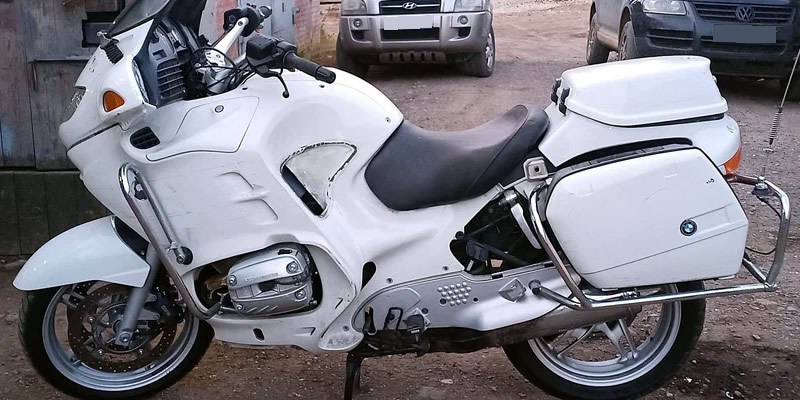
R 850 RT, 2004 year, left view
The length of the motorcycle was 2170 mm, its width was 940 mm, and its height was 1220 mm. The wheelbase length was 1487 mm. The seat height of the motorcycle could be adjusted between 805-845 mm. The fuel tank capacity is 20.5 liters. The average fuel consumption is 5.5 liters per 100 km. With a full tank, the model weighs 238 kg. The maximum speed of the motorcycle is 187 km/h.
BMW R1100RT (1995-2001)
The BMW R1100RT is a fully faired motorcycle from the manufacturer BMW, featuring a two-cylinder boxer engine. This touring bike has several mechanically similar sibling models, such as the sport-touring R1100RS and the naked bike R1100R, which share nearly identical engines but differ in fairing and chassis design. The motorcycle was presented at the IAA in September 1995. From 1995 to July 2001, a total of 53,092 units were produced at the BMW factory in Berlin-Spandau.
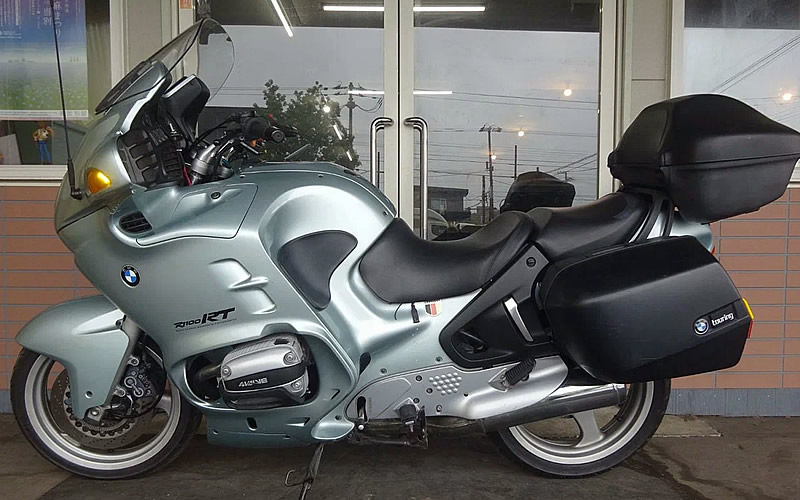
R 1100 RT, 1997 year, left view
The R1100RT replaced the R100RT starting with the 1996 model year. In addition to extensive changes to the full fairing, the engine output was significantly increased from 44 to 66 kW (90 hp), and the displacement was enlarged from 971 cm³ to 1085 cm³. The two cylinders have a bore of 99 mm, a stroke of 70.5 mm, and a compression ratio of 10.7:1. The motorcycle accelerates from 0 to 100 km/h in 3.9 seconds and reaches a top speed of 196 km/h. Standard features include an anti-lock braking system and a regulated three-way catalytic converter. The chassis is built in three parts, consisting of front and rear frames as well as a load-bearing engine-transmission unit. The front suspension is implemented via a Telelever, while the rear uses a Paralever swingarm. The fuel tank has a capacity of 25.2 liters, with 6 liters reserved. The average fuel consumption is 4.7 liters per 100 km at a speed of 90 km/h and 5.6 liters at 120 km/h.
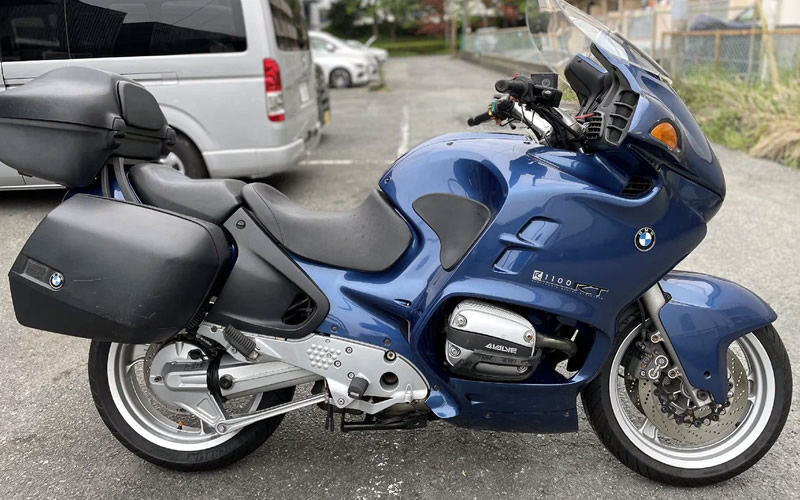
R 1100 RT, 1998 year, right view
BMW R1150RT (2001-2004)
The BMW R1150RT is a fully faired motorcycle from the BMW brand, equipped with a two-cylinder boxer engine. The tourer was introduced on January 12, 2001, as the successor to the BMW R1100RT and was manufactured at the BMW factory in Berlin-Spandau from 2001 to 2004.
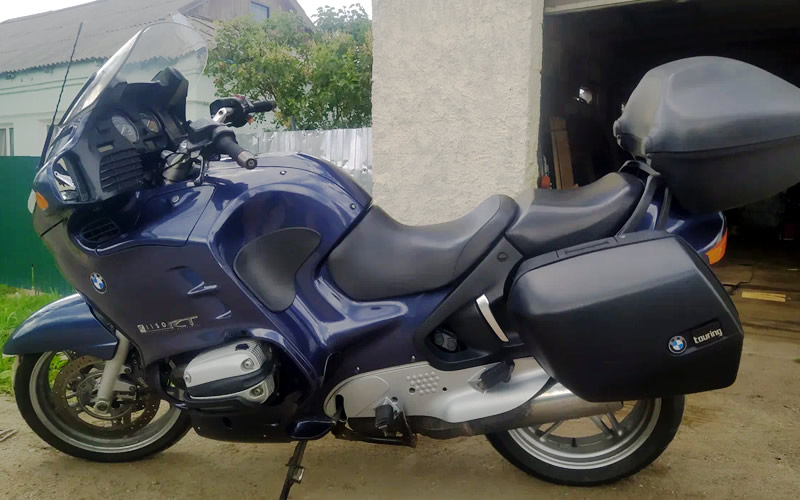
R 1150 RT, 2001 year, left view
The motorcycle has several mechanically similar sibling models with largely identical engines and different chassis designs and equipment: the naked bike R1150R, the sport model R1150RS, and the adventure touring R1150GS/Adventure.
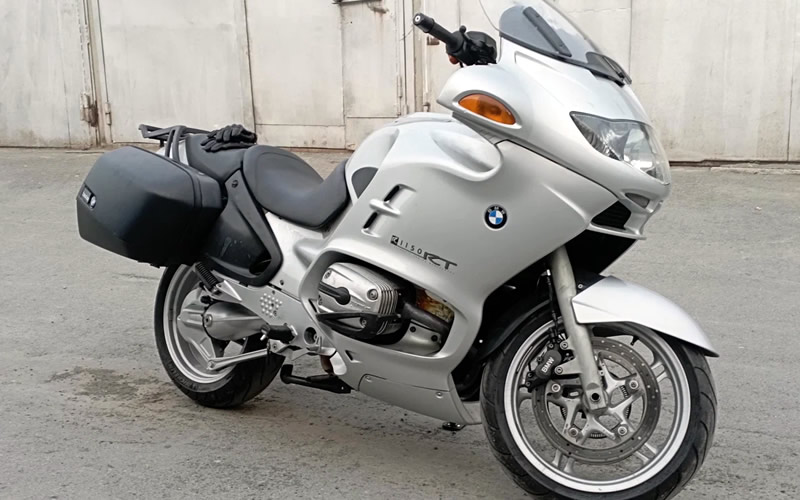
R 1150 RT, 2003 year, front view
The R1150RT replaced the R1100RT starting with the 2001 model year. Changes were primarily made under the plastic bodywork, with the engine output slightly increased from 66 to 70 kW (90 to 95 hp) and a marginal increase in displacement from 1085 cm³ to 1130 cm³. The motorcycle accelerates from 0 to 100 km/h in 4.3 seconds and reaches a top speed of 206 km/h.
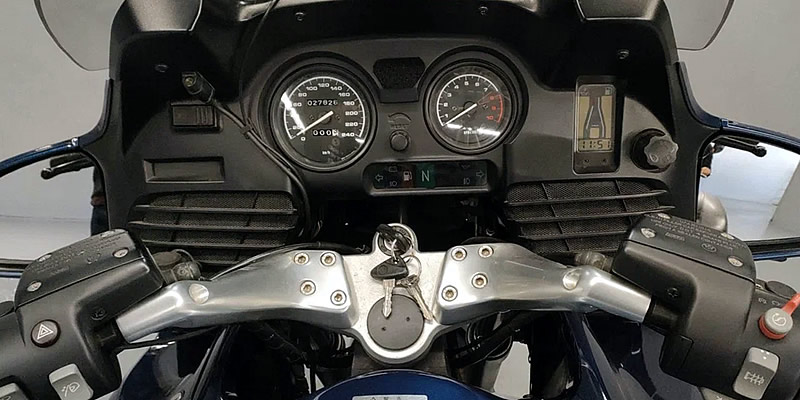
R 1150 RT, 2004 year, dashboard
BMW R1200RT K26 (2005-2013)
The BMW R1200RT (K26) is a motorcycle from the manufacturer BMW. The tourer was presented on December 2, 2004, at the Bologna Motor Show and has been sold since spring 2005 as the successor to the R1150RT. Like all models in the R series, the motorcycle is powered by a boxer engine and is manufactured at the BMW factory in Berlin-Spandau. As a police vehicle, the motorcycle is also offered with a smaller engine as the R900RT.
The two-cylinder engine produces a nominal output of 81 kW (110 hp). The motorcycle accelerates from 0 to 100 km/h in 3.9 seconds and reaches a top speed of 223 km/h. The air- and oil-cooled four-stroke boxer engine has a displacement of 1170 cm³, with a bore of 101 mm, a stroke of 73 mm, and a compression ratio of 12.0:1.
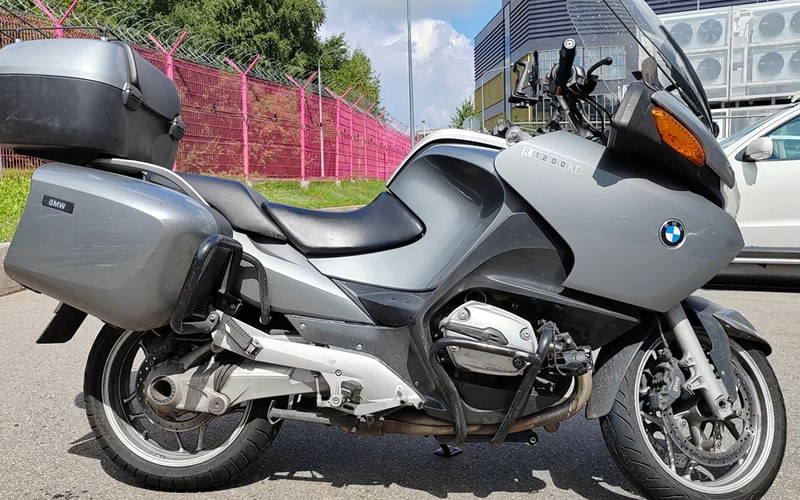
R 1200 RT (K26), 2005 year, right view
The chassis consists of front and rear frames with a load-bearing engine-transmission unit. The suspension settings can be electronically adjusted for spring preload and damping in nine levels. The semi-integral anti-lock braking system, standard from 2010, controls braking behavior in critical situations.
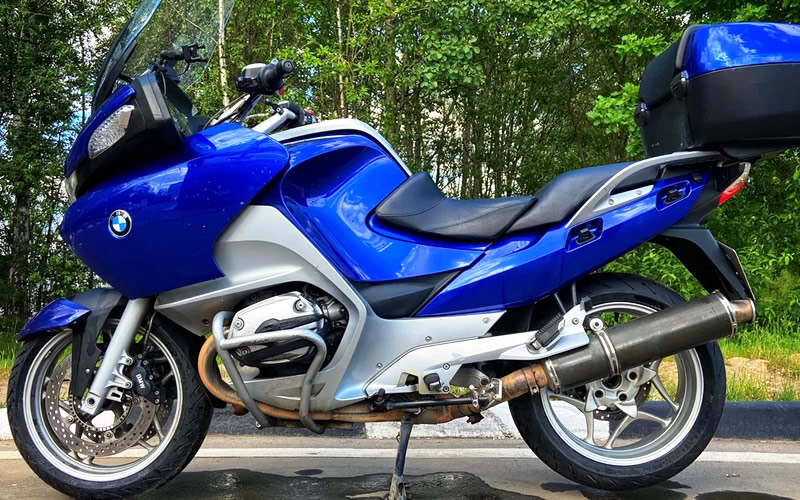
R 1200 RT (K26), 2008 year, left view
The tourer is technically largely identical to the sport-touring R1200ST, but comes standard with full fairing and luggage cases. Motorcycles with similar characteristics include the Ducati ST3, Honda ST1300 Pan European, Moto Guzzi Norge GT 8V, Triumph Sprint ST, and Yamaha FJR1300.
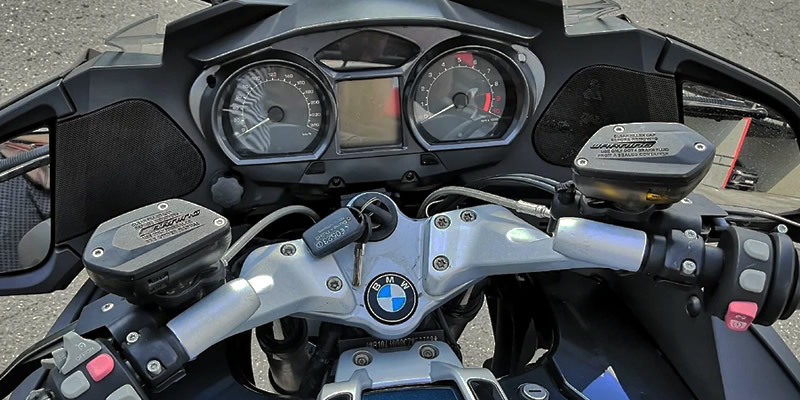
R 1200 RT (K26), 2010 year, dashboard
Since 2014, BMW has offered a newly designed successor under the same sales designation with the K52 series.
BMW R1200RT K52 (2014-2018)
The BMW R1200RT is a fully faired motorcycle from the manufacturer BMW. The tourer was presented on November 10, 2013, at the EICMA motorcycle show in Milan. The successor to the BMW R1200RT (K26) was sold starting in February 2014 and was replaced in October 2018 by the visually almost identical BMW R1250RT. Like all models in the R series, the motorcycle is powered by a boxer engine and is manufactured at the BMW factory in Berlin-Spandau. The suffix RT stands for "Reisetourer", and the factory code is K52.
Following the R100RT (1978–1984), R100RT Classic (1987–1996), R1100RT (1995–2001), R1150RT (2001–2004), and R1200RT (2005–2013), the K52 is already the sixth generation of the RT series produced since 1978.
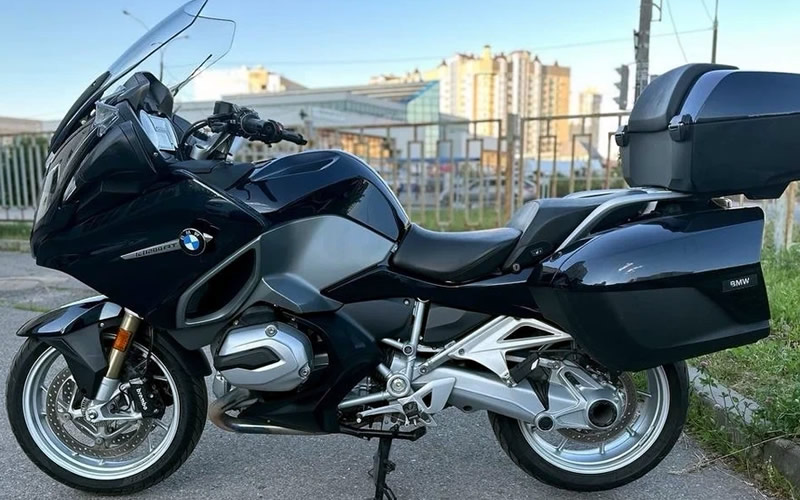
R 1200 RT (K52), 2017 year, left view
The K52 is completely newly developed compared to its predecessor model under the leadership of project manager Raimund Brandl. The cockpit, lighting system, and windscreen mechanism components are derived from the BMW K1600GT tourer. The air- and liquid-cooled two-cylinder engine was taken from the adventure touring BMW R1200GS K50, but the crankshaft (7004 instead of 6189 grams) and the alternator rotor received larger flywheels for improved smoothness. The engine speed level was tourer-typical lowered by a longer secondary gear ratio. The chassis of the RT is also based on the GS's tubular steel frame.
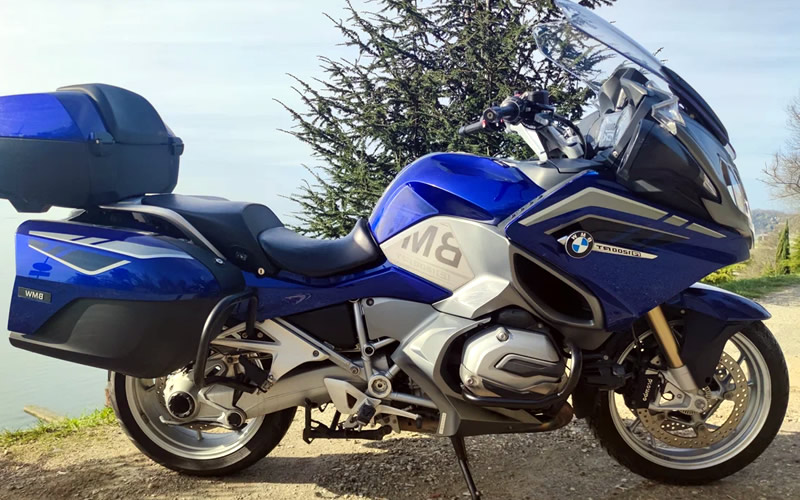
R 1200 RT (K52), 2015 year, right view
The air- and water-cooled two-cylinder engine produces a nominal output of 92 kW (125 hp) from a displacement of 1170 cm³ and a maximum torque of 125 Nm at a speed of 6500 min−1. The two opposing cylinders of the boxer engine have a bore of 101 mm, a stroke of 73.6 mm, and a compression ratio of 12.5:1. Each of the two cylinder heads of the four-stroke engine has two gear-driven, overhead camshafts (DOHC), which control two intake and two exhaust valves via rocker arms. The sequential gearbox has six gears with helical gearing and can optionally be operated with a shift assistant without engaging the wet clutch.
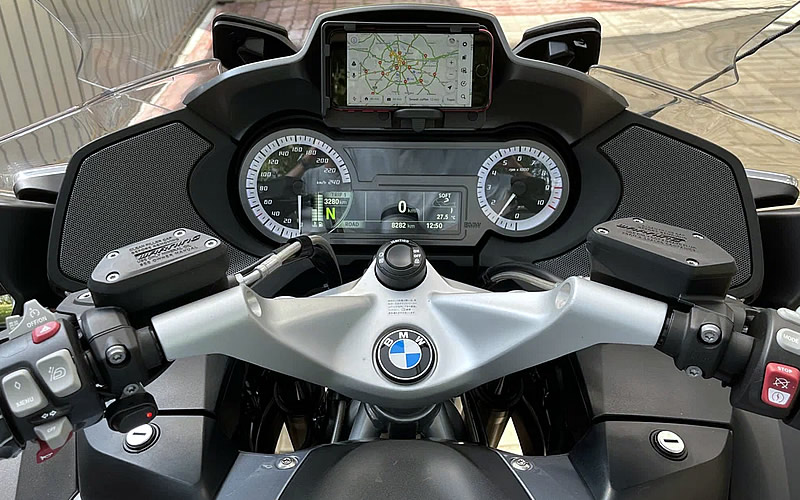
R 1200 RT (K52), 2016 year, dashboard
The motorcycle accelerates from 0 to 100 km/h in 3.8 seconds and reaches a top speed of 225 km/h.
BMW R1250RT (2018-current)
The BMW R1250RT is the revised version of the R1200RT, which it replaced in October 2018. Like all models in the R series, the motorcycle is powered by a boxer engine and is manufactured at the BMW factory in Berlin.
The R1250RT is the seventh generation of the RT series produced since 1978. The suffix RT stands for "Reisetourer". These motorcycles are characterized by long ranges, high seating comfort, good wind and weather protection, and ample storage capacity.
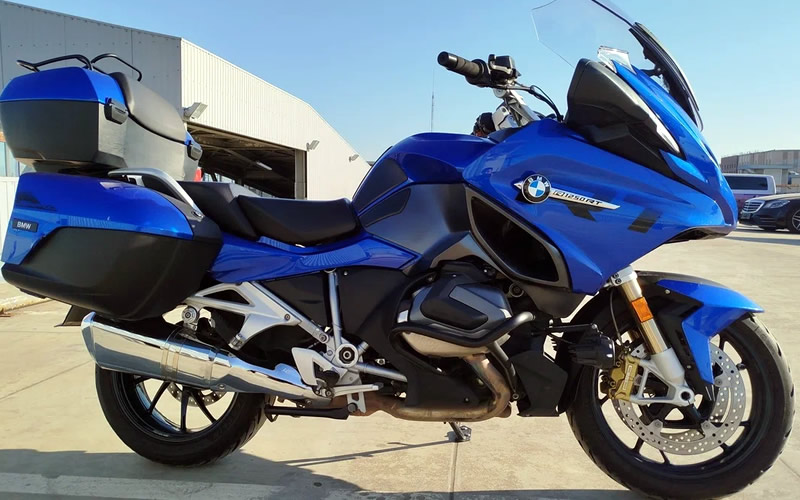
R 1250 RT, 2021 year, right view
In early November 2018, BMW Motorrad presented the sportier, fully faired R1250RS (sport touring) and the naked R1250R (roadster) at the EICMA. Both were developed in parallel and share the same ShiftCam boxer engine.
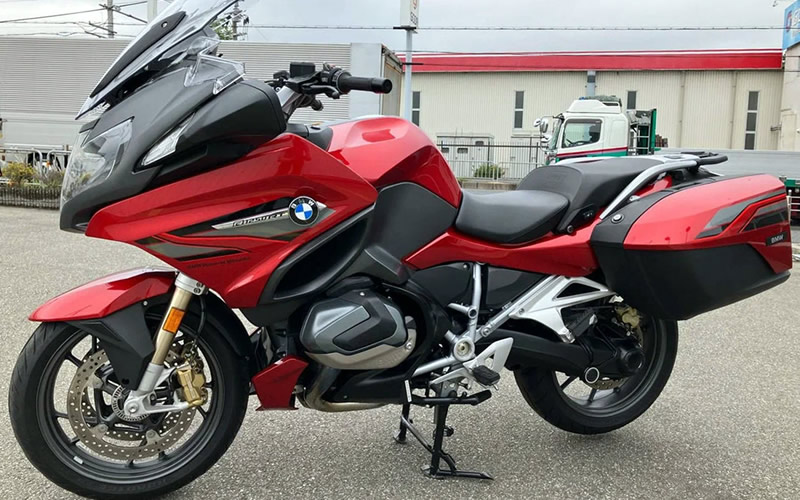
R 1250 RT, 2020 year, left view
The R1250RT was completely revised compared to its predecessor model by a project team led by Harald Spagl. It was introduced at Intermot. In October 2020, the RT was relaunched with a standard LED headlight.
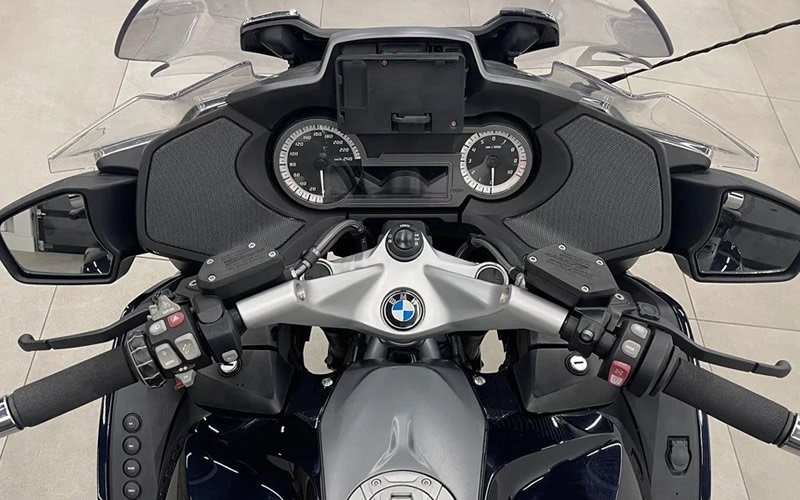
R 1250 RT, 2019 year, dashboard
The air- and water-cooled two-cylinder engine produces a nominal output of 100 kW (136 hp) from a displacement of 1254 cm³ at 7750 min−1 and a maximum torque of 143 Nm at 6250 min−1. The increase in displacement was achieved through a larger bore (102.5 mm) and a longer stroke (76 mm). The compression ratio of 12.5:1 was maintained. The motorcycle accelerates from 0 to 100 km/h in 3.6 seconds and reaches a top speed of 228 km/h. Fuel consumption is approximately 5 to 5.4 liters per 100 km.
BMW R1100GS (1994-1999)
The BMW R1100GS is a motorcycle from Bayerische Motoren Werke; it was presented in September 1993 at the IAA in Frankfurt am Main. It is an adventure touring bike that, like all models in the R series, is powered by a boxer engine and is assembled at the BMW factory in Berlin-Spandau. The model designation GS stands for "Gelände/Straße" (Off-Road/Road), and the internal factory code is R259. A total of 43,596 units of the model were produced from 1994 to 1999, with 21,800 sold in Germany.
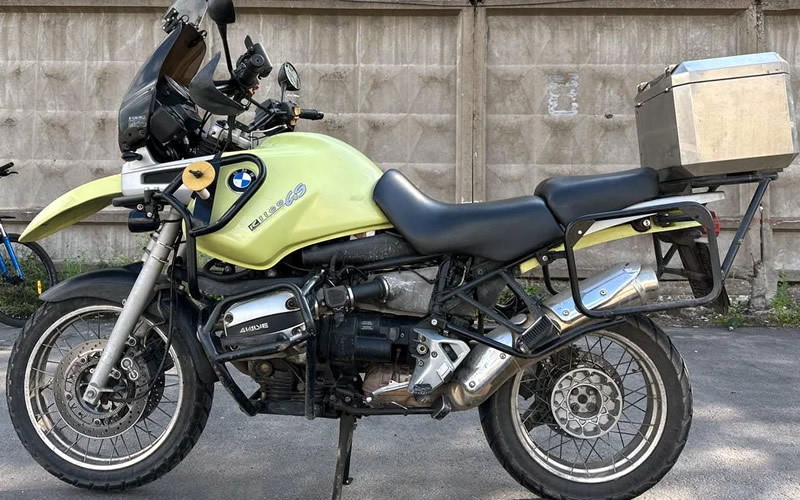
R 1100 GS, 1997 year, left view
The R1100GS features an air/oil-cooled two-cylinder boxer engine with four valves per cylinder and one overhead camshaft per cylinder. The engine has a displacement of 1085 cm³ and produces 59 kW (80 hp). For insurance reasons, most motorcycles sold in Germany are limited to 57 kW (78 hp). The top speed is 195 km/h. The motorcycle has a dry weight of 243 kg (fully fueled). The fuel tank has a capacity of 24 liters, allowing for ranges of over 400 km thanks to modern fuel injection technology. The GS is equipped with Bosch's MA 2.1/2.2 electronic engine management system (Motronic). The two cylinders have a bore of 99 mm, and the pistons have a stroke of 70.5 mm. The compression ratio is 10.3:1. The manufacturer recommends using unleaded gasoline with a minimum octane rating of 95.
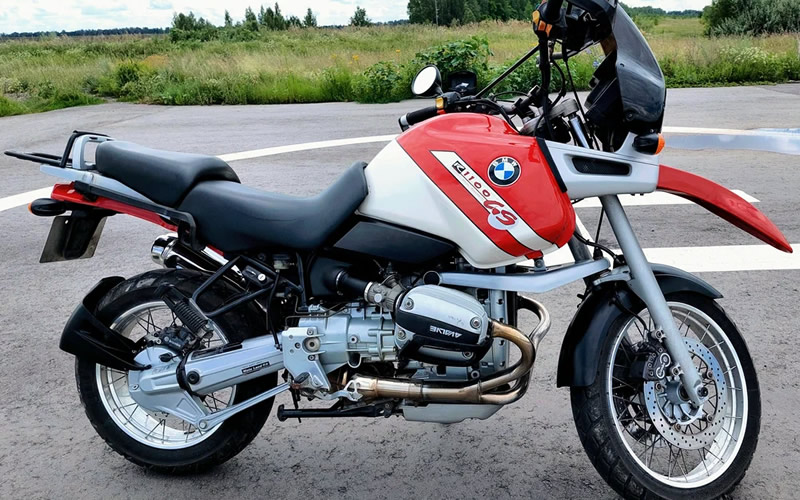
R 1100 GS, 1998 year, right view
The chassis is based on a load-bearing engine-transmission unit with a bolted subframe. The GS's positively regarded handling is attributed to a newly designed Telelever front suspension and a Paralever rear suspension.
BMW R1150GS (1999-2003)
The BMW R1150GS is an adventure touring motorcycle model from the manufacturer BMW, produced from autumn 1999 to 2003 at the BMW factory in Berlin-Spandau.
Since its market launch in September 1999, the off-road motorcycle has consistently ranked high in registration statistics in Germany and many other markets, becoming the best-selling motorcycle in Germany from 2001 to 2003. A total of 58,023 units were produced.
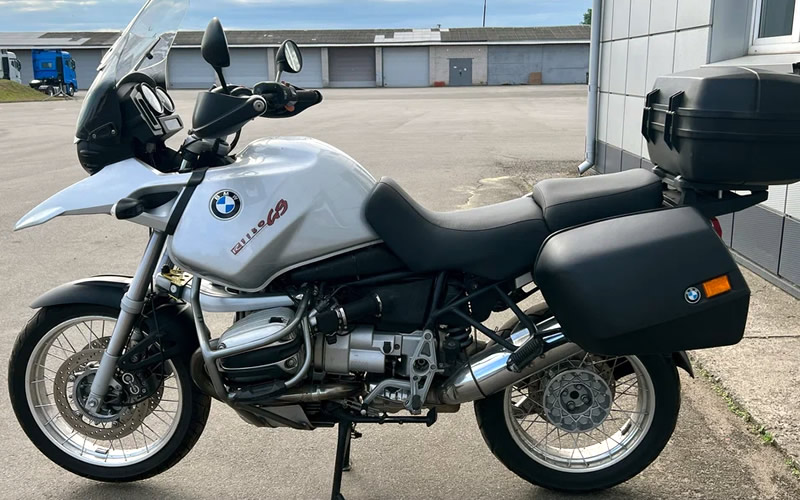
R 1150 GS, 2000 year, left view
Like all models in the R series, the motorcycle is powered by a boxer engine. The model designation GS stands for "Gelände/Straße" (Off-Road/Road), and the internal factory code is R21.

R 1150 GS, 2001 year, right view
The air- and oil-cooled boxer engine produces a nominal output of 62.5 kW (85 hp) from a displacement of 1130 cm³ and a maximum torque of 98 Nm at a speed of 5250 min−1. The two-cylinder engine has two intake and two exhaust valves per cylinder head, with one overhead camshaft driven by gears and chain per head. The four-stroke engine features a longitudinal crankshaft, wet sump lubrication, electronic fuel injection, and electronic engine management. The cylinder bore was increased from 99 to 101 mm compared to the predecessor model. The two pistons have a stroke of 70.5 mm with a compression ratio of 10.3:1. The cylinder heads and crankshaft are derived from the BMW R1100S. The cylinder head covers are made of magnesium.
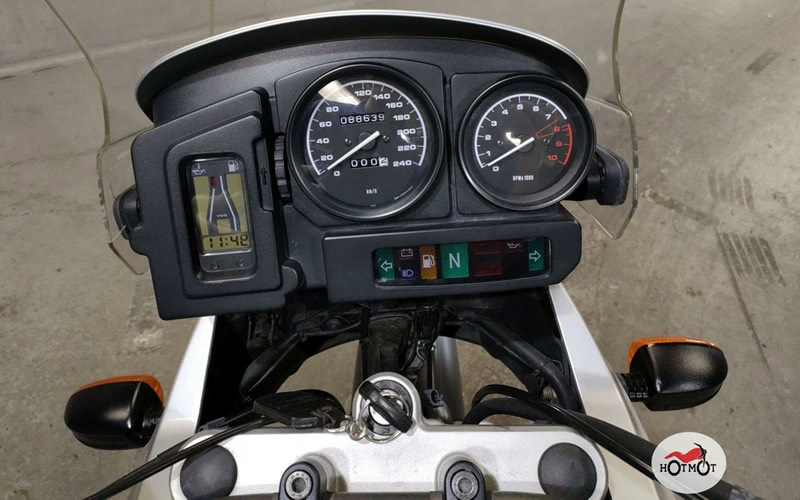
R 1150 GS, 1999 year, dashboard
The primary drive is via gear wheels, and power is transmitted through a hydraulically operated single-disc dry clutch. The sequential gearbox has six gears, and the secondary drive is a shaft drive. The sixth gear is designed as an overdrive. The seat height can be adjusted from 84 to 86 cm. The motorcycle weighs 271 kg when fully fueled, with a maximum payload of 197 kg and a permissible total weight of 460 kg.
BMW R1200GS K25 (2004-2012)
The BMW R1200GS is a motorcycle from the German vehicle manufacturer BMW. The adventure touring bike was launched in March 2004 and was the first BMW model equipped with a boxer engine that was expanded from a minimum of 1130 cm³ to 1170 cm³. The model designation GS stands for Gelände/Straße (off-road/road), and the internal model code is K25. From 2004 to 2012, 184,409 GS units were manufactured at the BMW plant in Berlin-Spandau.
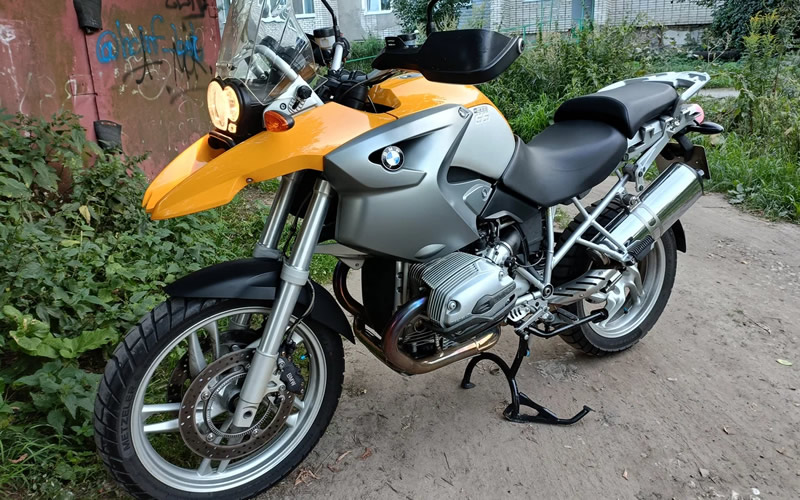
R 1200 GS (K25), 2004 year, front view
The R1200GS is powered by an air- and oil-cooled boxer engine. From the 2010 model year onwards, the four-stroke engine features two chain-driven, overhead camshafts (DOHC) in each cylinder head, which control two intake and two exhaust valves via rocker arms. The two cylinders have an average bore of 101 mm, and the pistons have a stroke of 73 mm with a compression ratio of 12.0:1. This configuration produces a rated output of 81.0 kW (110 hp) at 7750 rpm and a maximum torque of 120 Nm at 6000 rpm.
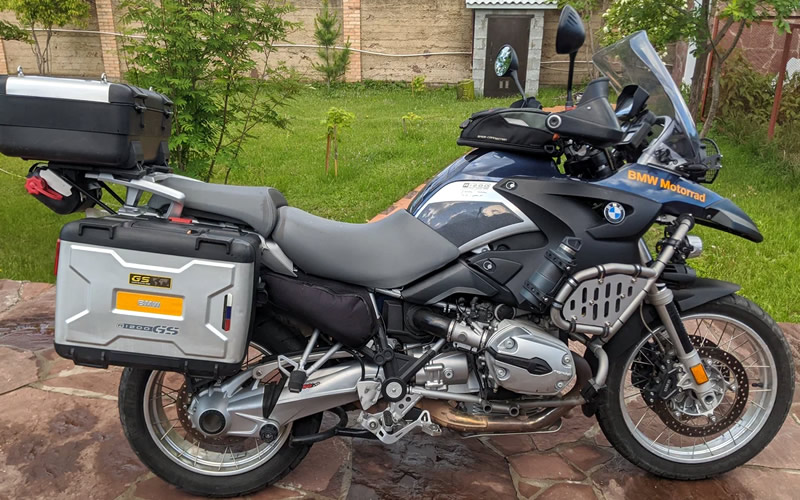
R 1200 GS (K25), 2005 year, right view
The single-disc dry clutch is hydraulically operated. The transmission has six gears. The secondary drive transmits torque from the transmission output to the rear axle through a cardan shaft with two joints, with a secondary ratio of 32:11.
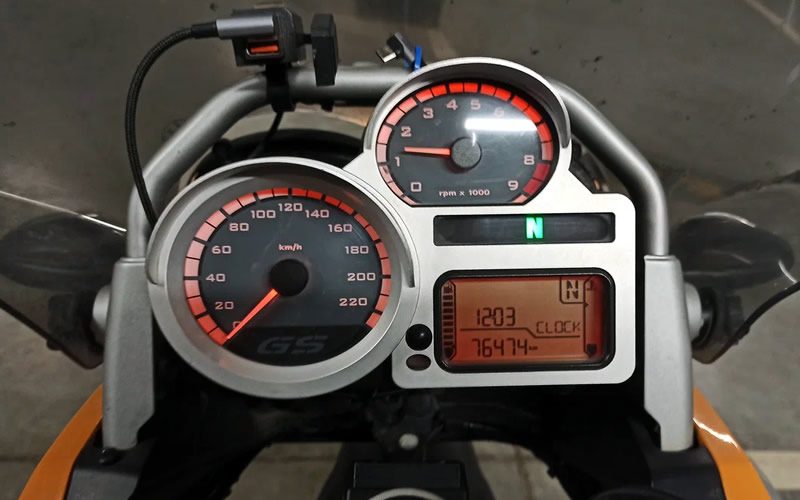
R 1200 GS (K25), 2008 year, dashboard
On October 3, 2012, the successor model BMW R1200GS K50 was presented at the Intermot motorcycle show in Cologne. Although BMW fundamentally redesigned the engine, chassis, and drivetrain, the sales designation remained unchanged, with the factory code now being K50. The engine now produces 92 kW (125 hp).
BMW R1200GS K50 (2013-2018)
The BMW R1200GS is a motorcycle from Bayerische Motoren Werke. The adventure touring bike was unveiled on October 3, 2012, at the Intermot motorcycle show in Cologne, with sales beginning on March 2, 2013.
Like all models in the R series, the motorcycle is powered by a boxer engine and is assembled at the BMW plant in Berlin-Spandau. The model designation GS stands for Gelände/Straße, and the internal factory code is K50. The sales designation remained unchanged.
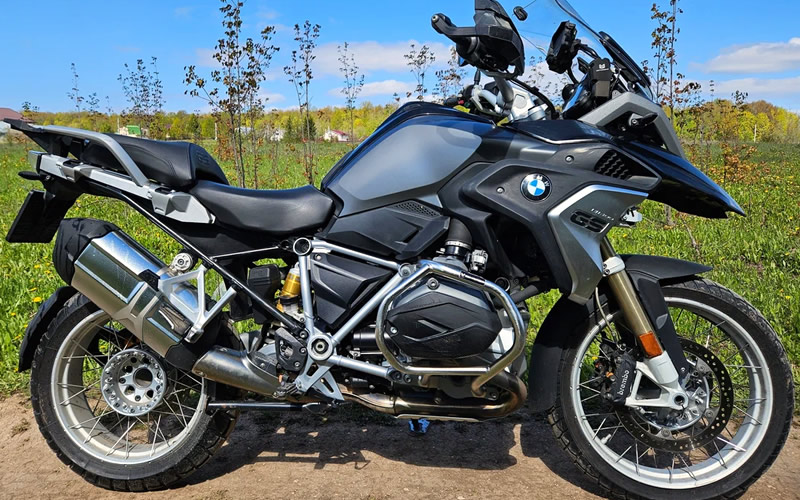
R 1200 GS (K50), 2017 year, right view
For the first time, a BMW boxer engine was water-cooled; the classic flow of the cylinder heads from back (intake side) to front (exhaust side) was changed to a flow from top to bottom for this boxer model.
On October 7, 2013, BMW introduced the BMW R1200GS Adventure (K51) in an official press release, which features a larger fuel tank and longer suspension travel, based on the K50.
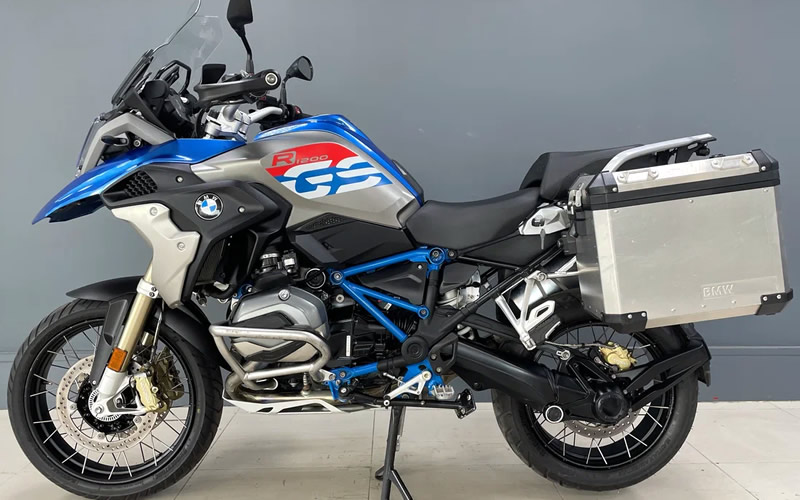
R 1200 GS (K50), 2016 year, left view
The model consistently topped German registration statistics throughout its production duration, making it the most successful motorcycle in the German market.
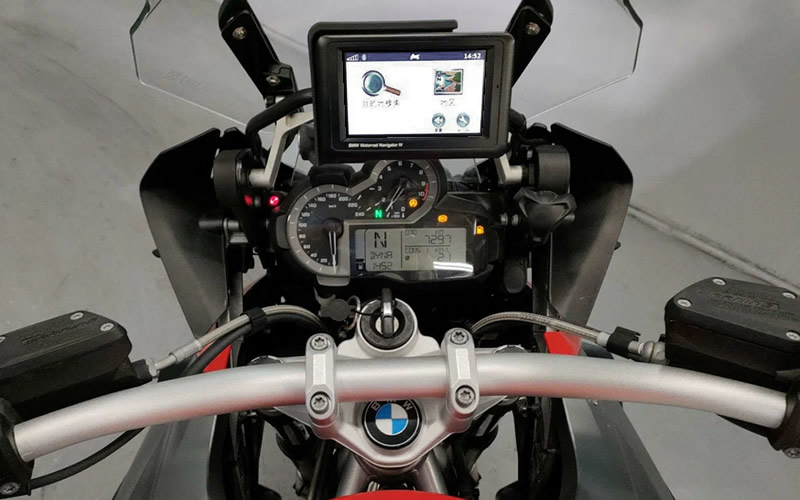
R 1200 GS (K50), 2014 year, dashboard
The air- and water-cooled two-cylinder four-stroke engine generates a rated output of 92 kW (125 hp) from 1170 cm³ of displacement and a maximum torque of 125 Nm at an engine speed of 6500 rpm. The two opposing cylinders of the boxer engine have a bore of 101 mm, and the pistons have a stroke of 73.6 mm with a compression ratio of 12.5:1. Torque exceeds 100 Nm starting from 2000 rpm. The motorcycle accelerates from 0 to 100 km/h in 3.6 seconds and reaches a top speed of 219 km/h.
BMW R1250GS (2018-2023)
The BMW R1250GS is an off-road, semi-faired motorcycle from Bayerische Motoren Werke. Like all models in the R series, it is powered by a boxer engine and is assembled at the BMW plant in Berlin-Spandau. The adventure touring bike was announced in a press release on September 17, 2018, and presented at the Intermot motorcycle show in Cologne on October 3, 2018. Deliveries began in October 2018.
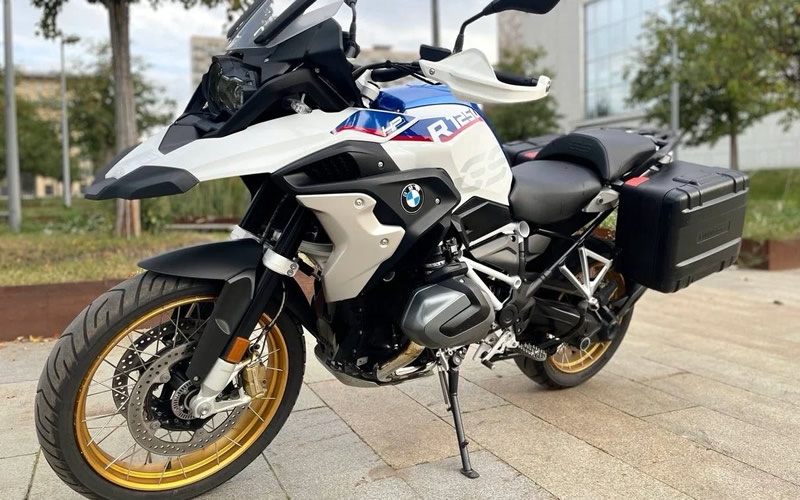
R 1250 GS, 2020 year, front view
The internal factory code is K50, despite extensive modifications to the engine and a new sales designation, similar to the predecessor model (without variable valve timing). The abbreviation GS stands for Gelände/Straße. The K50 is the fifth chassis generation of the GS series with a boxer engine, produced since 1980.
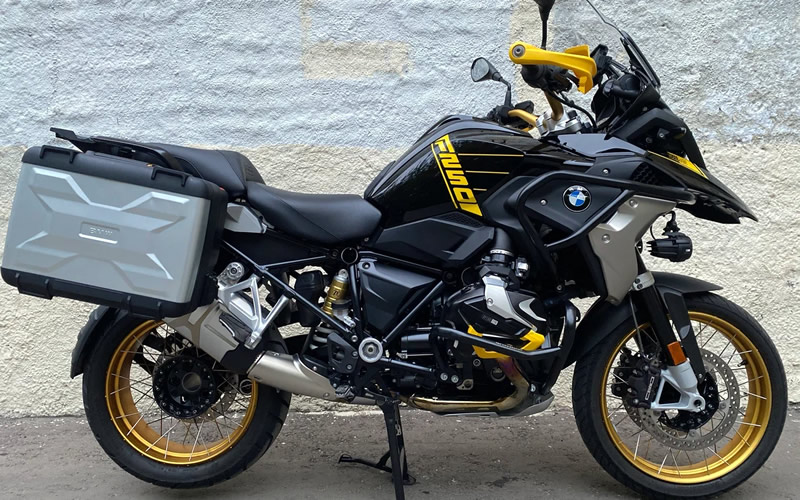
R 1250 GS, 2022 year, right view
Five years after the introduction of the K50, the engine was revised at the cylinders and cylinder heads. Externally, the R1250 differs from the R1200 only by minor changes to the fairing, new lettering, different colors, and a cockpit featuring a standard 6.5-inch (16.5 cm) full-color TFT display. The inner diameter of the cylinder (bore) was increased by 1.5 mm, and the stroke was extended by 3 mm, resulting in an increase in displacement of 84 cm³ (+7%). The maximum torque increased by 18 to 143 Newton meters at 6250 rpm, and the maximum power increased to 100 kW (136 hp) at 7750 rpm. The oil cooling was adjusted for the higher rated output, and the 1 kg heavier muffler was designed to comply with EURO-5 standards.
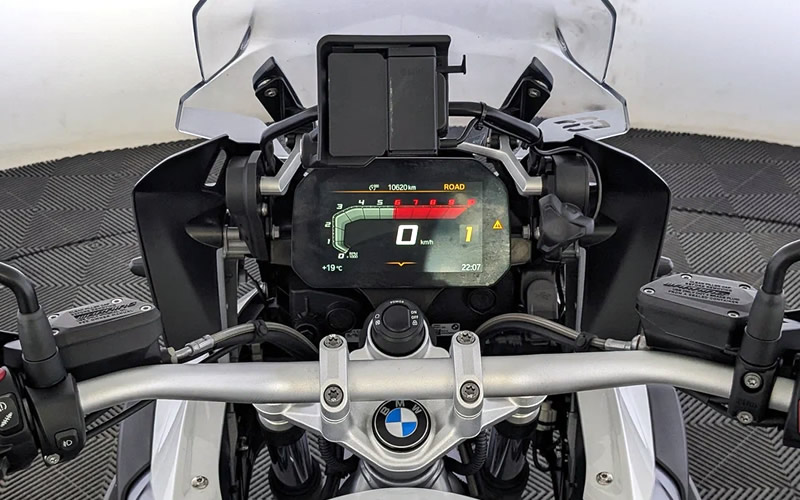
R 1250 GS, 2021 year, dashboard
In the engine speed range from 3500 to 7500 rpm, torque exceeds 120 Nm. The motorcycle accelerates from 0 to 100 km/h in 3.6 seconds and reaches a top speed of 219 km/h, according to the manufacturer.
BMW R1300GS (2023-current)
The BMW R1300GS is an off-road, semi-faired motorcycle from Bayerische Motoren Werke. Like all models in the R series, it is powered by a boxer engine and is assembled at the BMW plant in Berlin-Spandau. The adventure touring bike was introduced on September 28, 2023, and has been available for sale since November 2023.
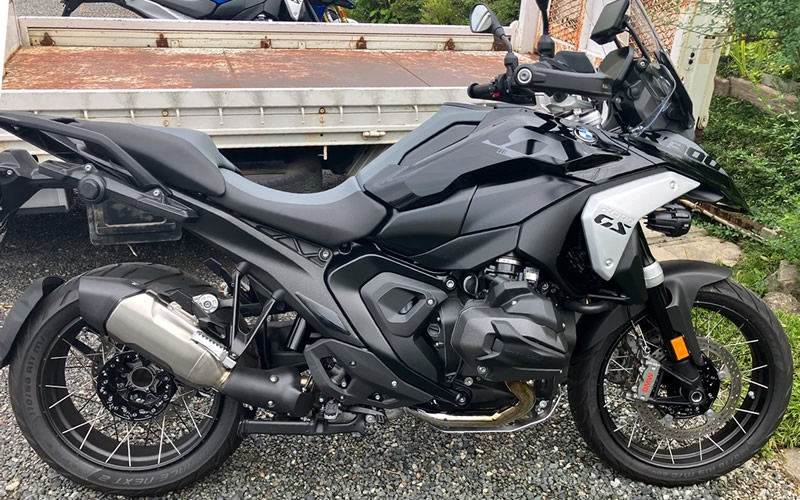
R 1300 GS, 2023 year, right view
The internal factory code is KA1. The abbreviation GS stands for Gelände/Straße. The KA1 is the sixth chassis generation of the GS series with a boxer engine, produced since 1980.
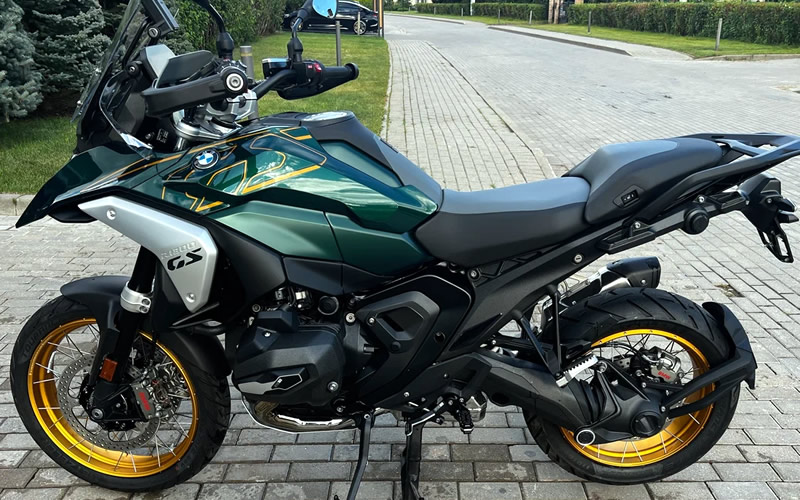
R 1300 GS, 2024 year, left view
The engine and chassis are a new design. Externally, the R1300 is slimmer compared to the R1250 and features a new headlight design. The turn signals have been integrated into the handguards. The inner diameter of the cylinder (bore) was increased by 4 mm, and the piston stroke was reduced by 3 mm, resulting in an increase in displacement to 1300 cm³. The maximum torque increased by 6 to 149 Newton meters at 6500 rpm, and the maximum power reached 107 kW (145 hp) at 7750 rpm. The transmission was positioned for better center of gravity under the engine. This placement shortens the drivetrain and also contributed to a 12 kg reduction in overall weight.
BMW R1100RS (1993-2001)
The BMW R1100RS is a fully-faired motorcycle from BMW. The tourer is powered by a two-cylinder boxer engine like all models in the R series and was produced 26,037 times at the BMW plant in Berlin-Spandau from 1993 to 2001.
The air- and oil-cooled two-cylinder engine generates a rated output of 66 kW (90 hp) from 1085 cm³ of displacement and a maximum torque of 95 Nm at an engine speed of 5500 rpm.
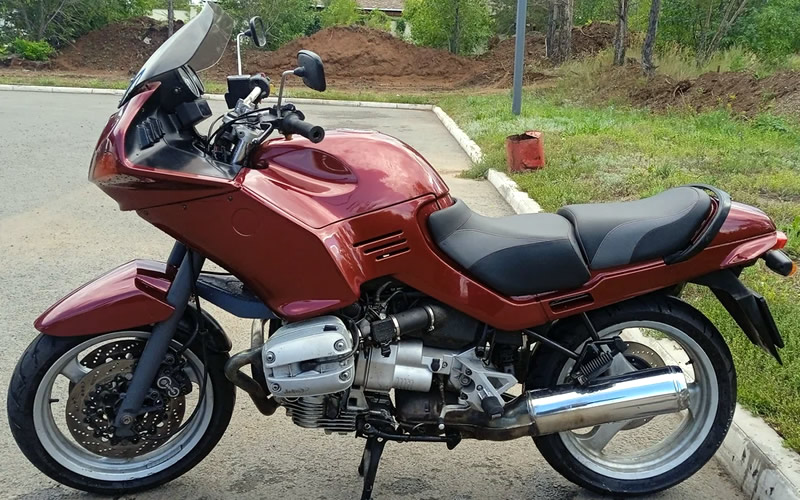
R 1100 RS, 1994 year, left view
The two cylinders of the longitudinally installed boxer engine have a bore of ⌀ 99 mm. The pistons have a stroke of 70.5 mm with a compression ratio of 10.7:1. Each cylinder head of the four-stroke engine has a chain-driven overhead camshaft that controls two intake and two exhaust valves via rocker arms. Fuel preparation is managed by a Bosch Motronic MA 2.2 with throttle cut-off. The fuel tank has a capacity of 23 liters.
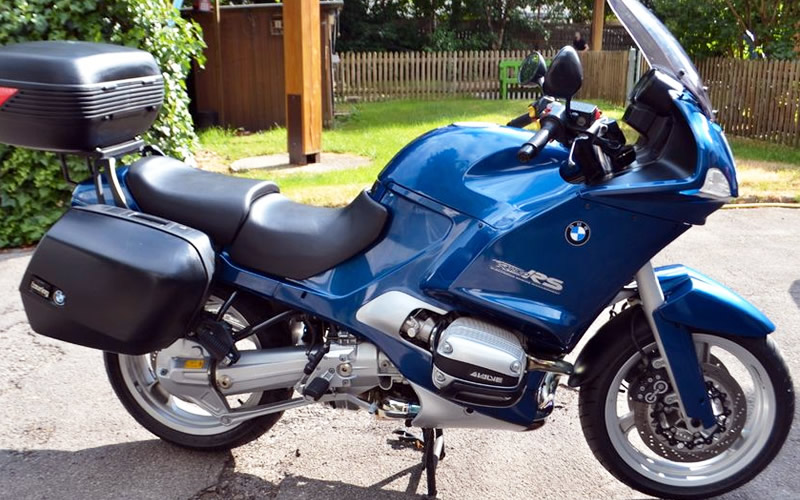
R 1100 RS, 1996 year, right view
The chassis consists of three parts: front frame, rear frame, and a load-bearing engine.
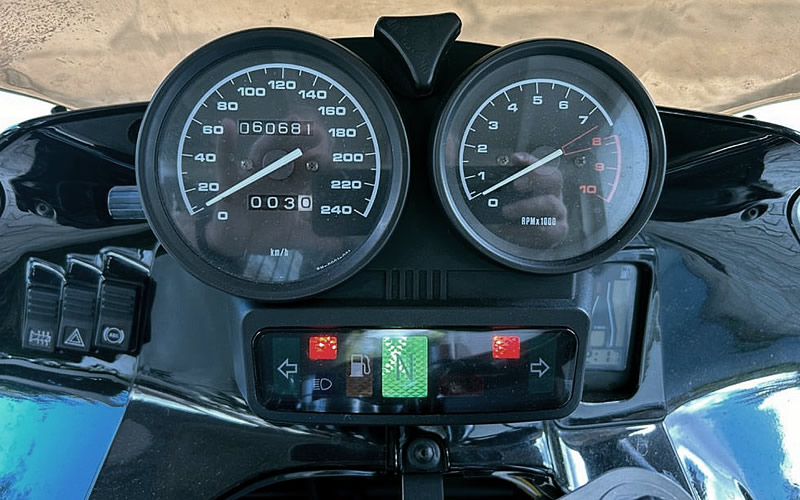
R 1100 RS, 1998 year, dashboard
The motorcycle accelerates from 0 to 100 km/h in 4.1 seconds and reaches a top speed of 215 km/h.
BMW R1150RS (2001-2005)
The BMW R1150RS is a sporty touring motorcycle from Bayerische Motoren Werke featuring the typical two-cylinder boxer engine. The suspension can be individually adjusted at the front and rear to suit the rider's preferences, whether for sporty or comfortable riding. The seat height, handlebar position, windscreen, and hand brake lever are also adjustable. The sport tourer has several mechanically similar sibling models with largely identical engines and different chassis designs and equipment: the naked bike R1150R, the touring bike R1150RT, and the adventure touring bike R1150GS/Adventure.
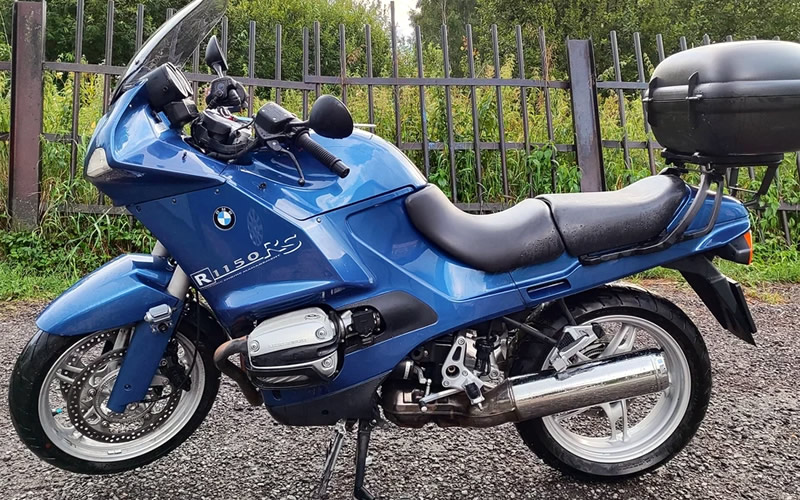
R 1150 RS, 2003 year, left view
The R1150RS replaced the R1100RS for the 2001 model year. Visually, there were hardly any changes apart from new color variants. The engine output was slightly increased from 66 to 70 kW (90 to 95 hp); the displacement was also marginally increased from 1085 cm³ to 1130 cm³.
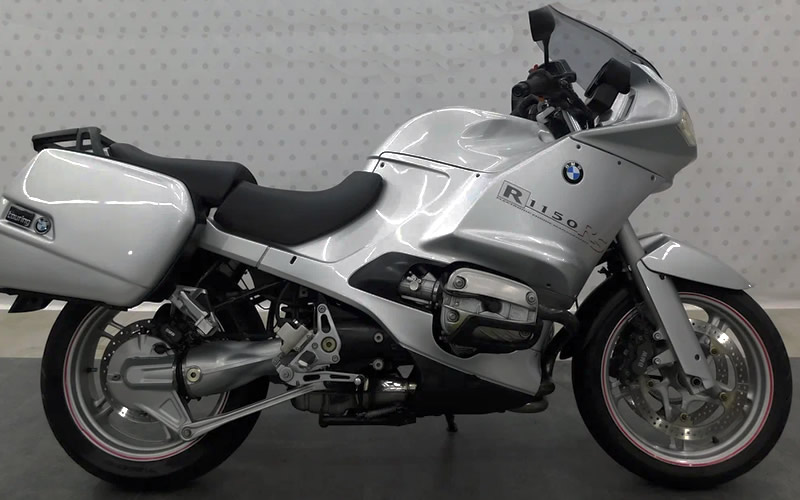
R 1150 RS, 2001 year, right view
Models from 2002 feature a dual ignition with two spark plugs per cylinder to improve running behavior and reduce emissions. The two-cylinder engine has electronic fuel injection, digital engine management, a regulated three-way catalytic converter, wet-sump pressure circulation lubrication, transistor ignition, a 12-volt starter battery with a capacity of 19 Ah, and an alternator with a power output of 700 watts.
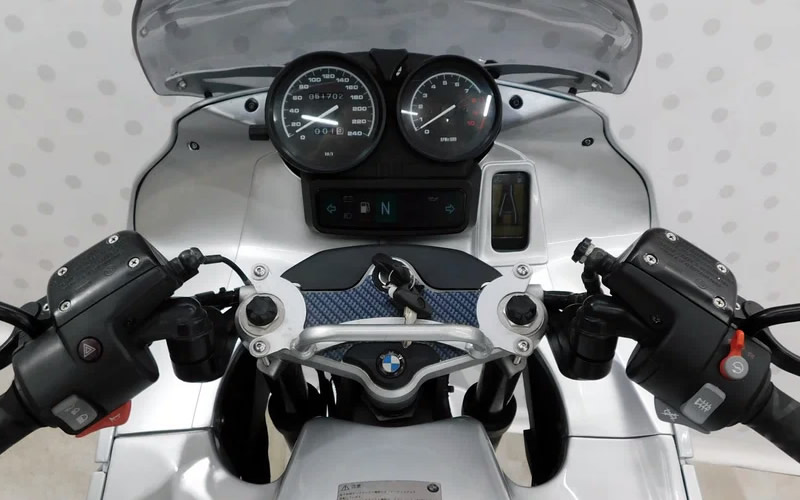
R 1150 RS, 2002 year, dashboard
The RS adopts the new braking technology from the R1150RT. The previously installed ABS II was replaced with integral ABS, which was available in two versions: partial and full integral ABS. The RS came from the factory with the partial integral variant, where both wheels are braked with the front brake, while only the rear wheel is braked with the foot brake.
BMW R1200RS (2015-2018)
The BMW R1200RS is a semi-faired motorcycle from the German vehicle manufacturer BMW. The sport tourer is based mainly on the liquid-cooled roadster R1200R (model series K53, VIN 0A04). The motorcycle was presented at the Intermot in September 2014. The road-oriented all-rounder is powered by a boxer engine like all models in the R series and is assembled at the BMW plant in Berlin-Spandau, with production starting on February 9, 2015. Sales began on May 12, 2015, at a base price of €13,500. The internal factory code is K54.
Following the BMW R100RS (including Classic), BMW R1100RS, BMW R1150RS, and BMW R1200ST, the K54 is the fifth generation of the RS series, with the suffix RS standing for Reise (touring) and Sport.
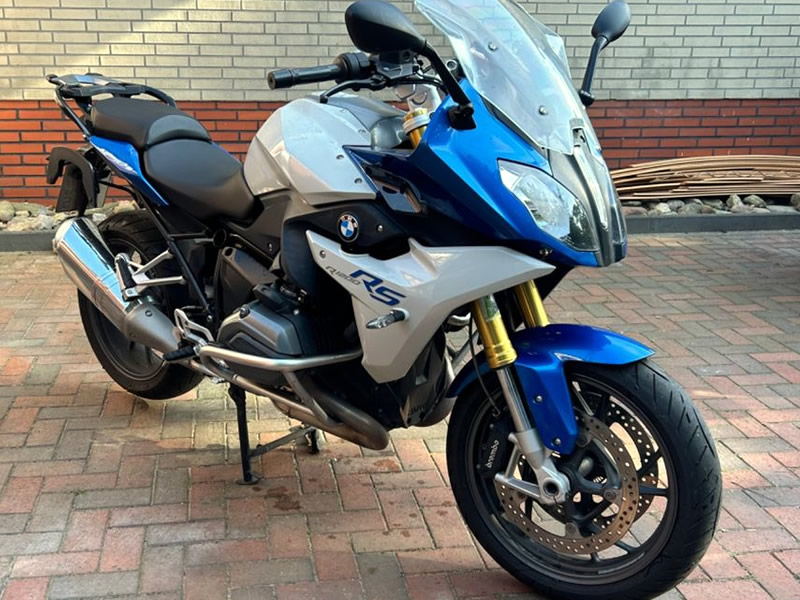
R 1200 RS, 2015 year, front view
The first RS appeared in 1976 with an aerodynamically optimized frame-mounted fairing, making the BMW R100RS the world's first fully-faired production motorcycle. The "cyclopean" BMW R1200ST was discontinued after just two years in 2007 due to insufficient sales figures. It wasn't until eight years later that BMW produced another sport tourer with the brand's characteristic boxer engine.
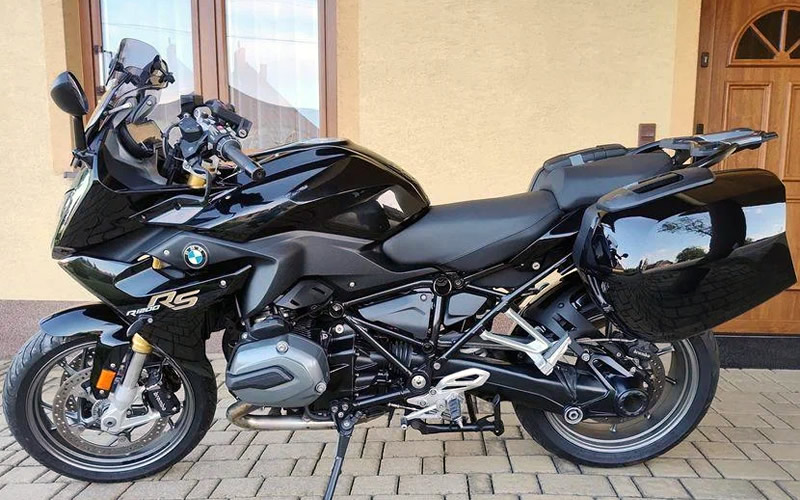
R 1200 RS, 2018 year, left view
The flat-twin engine generates a rated output of 92 kW (125 hp) from 1170 cm³ of displacement at an engine speed of 7750 rpm. The maximum torque of 125 Newton meters is reached at 6500 rpm. Compared to the unfaired R1200R, the vehicle geometry was slightly altered, and the trail was reduced to 114.8 mm. The seat height is 30 mm higher, increasing the knee angle, and the handlebars are positioned slightly lower. The steering head has an angle of 62.3 degrees. Fully fueled, the vehicle weighs 236 kg, with a permissible total weight of 450 kg. The motorcycle accelerates from 0 to 100 km/h in 3.3 seconds and reaches a top speed of 228 km/h. The motorcycle decelerates from 100 km/h to a standstill in under 37 meters.
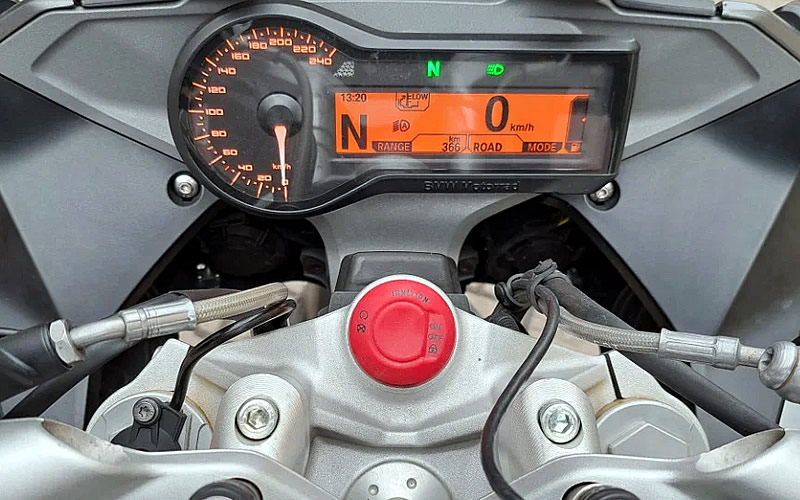
R 1200 RS, 2017 year, dashboard
The VDS of the vehicle identification number is 0A05. A competing model with comparable specifications is the sport tourer Kawasaki Z1000 SX.
BMW R1250RS (2018-current)
The BMW R1250RS is a faired BMW motorcycle from the R series, which was introduced at EICMA in November 2018. Like the other versions of the R series, including the R1250RT, R1250R (unfaired roadster), and R1250GS, the sport tourer is powered by a boxer engine.
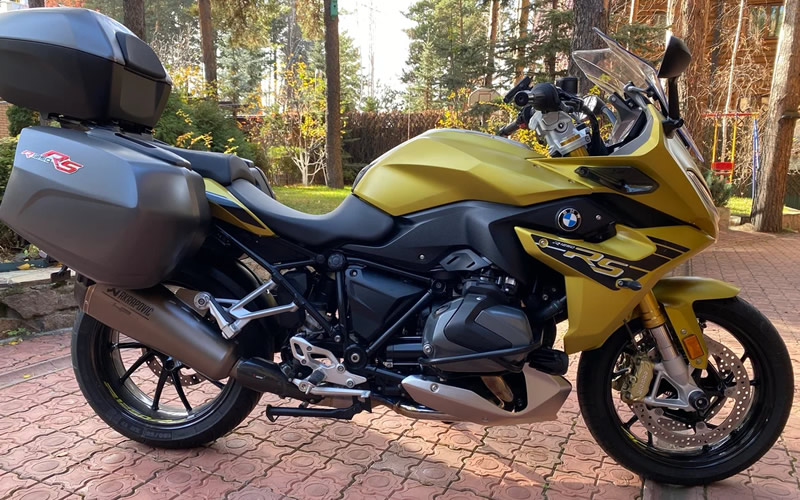
R 1250 RS, 2021 year, right view
The air- and water-cooled two-cylinder engine generates a rated output of 100 kW (136 hp) from 1254 cm³ of displacement at 7750 rpm and a maximum torque of 143 Nm at 6250 rpm. It features a variable camshaft (Shiftcam) that adjusts timing for the lower and middle as well as the upper engine speed ranges and alters valve lift. Depending on the position, either a partial load or full load cam operates the valves. A regulated three-way catalytic converter treats the exhaust gases. The engine meets the Euro 5 emission standard. Additionally, there is an engine drag torque control (MSR). Fuel consumption is rated at 4.75 l/100 km in the WMTC cycle (CO2 emissions of 110 g/km).
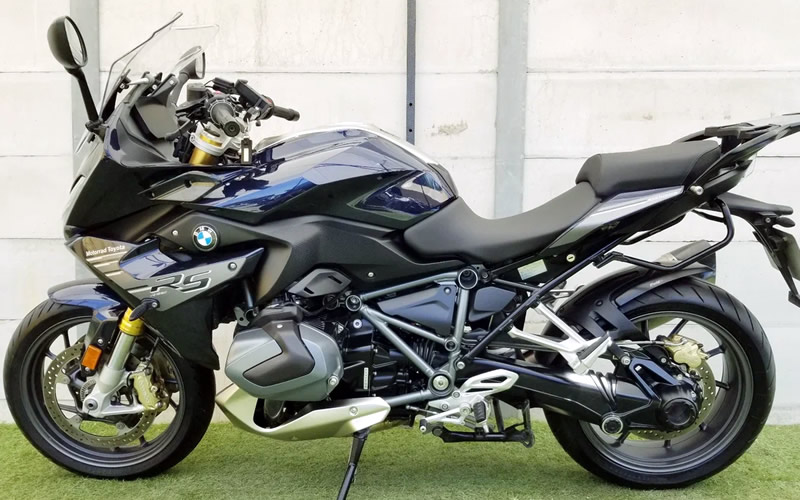
R 1250 RS, 2019 year, left view
The chassis consists of a steel tube main frame with a bolted rear frame; the engine serves as a load-bearing element. The R1250RS features an upside-down telescopic fork at the front and a single-sided swingarm made of aluminum at the rear. The chassis is complemented by dynamic traction control (DTC) and Pro riding modes with pre-selectable riding modes.
BMW R1200ST (2005-2007)
The BMW R1200ST is a semi-faired motorcycle from the BMW brand featuring a two-cylinder boxer engine. The sport tourer was unveiled on December 2, 2004, at the Bologna Motorshow and was produced at the BMW plant in Berlin until 2007. Sales began on March 12, 2005. The R1200ST was positioned between the touring bike R1200RT and the roadster R1200R. The abbreviation ST stands for Sport Touring.
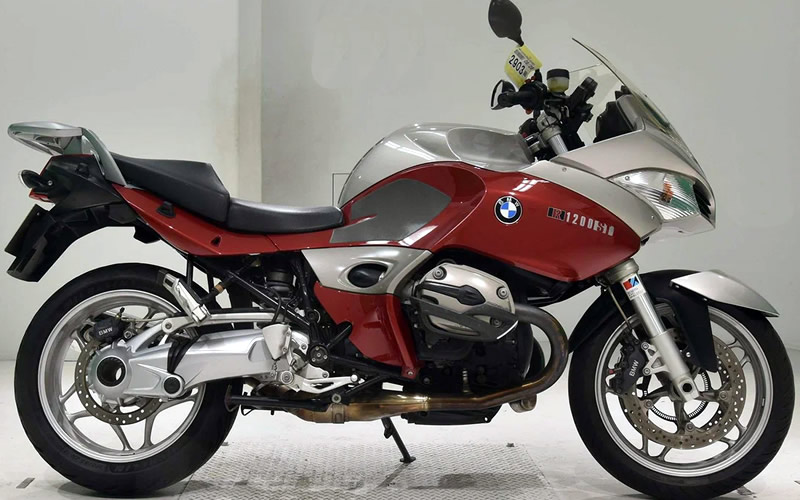
R 1200 ST, 2005 year, right view
The air- and oil-cooled boxer engine is longitudinally installed and generates a rated output of 81 kW (110 hp) from two cylinders with 1170 cm³ of displacement at 8,250 rpm and a torque of 112 Nm at 6,800 rpm. Each cylinder head has a chain-driven camshaft that controls two intake and two exhaust valves via rocker arms. The two cylinders have a bore of ⌀101 mm, and the pistons have a stroke of 73 mm with a compression ratio of 12:1. The four-stroke engine features digital engine management (BMS-K), for the first time with two lambda sensors and knock sensors, and a wet-sump pressure circulation lubrication system.
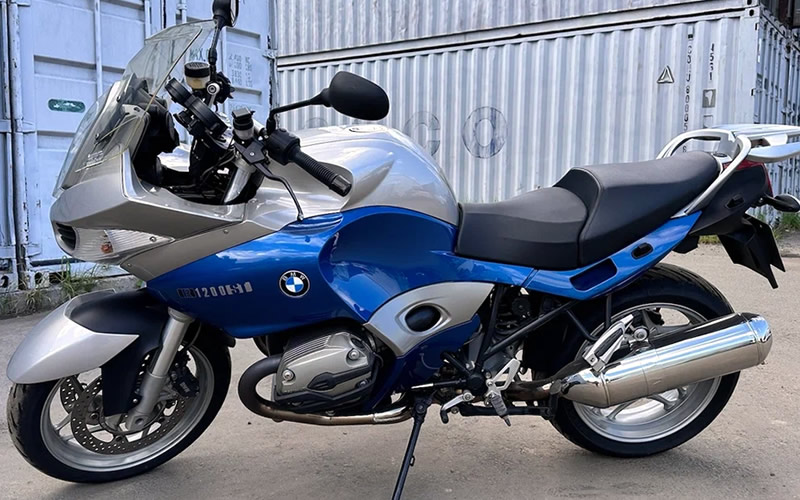
R 1200 ST, 2006 year, left view
The motorcycle accelerates from 0 to 100 km/h in 3.5 seconds and reaches a top speed of 230 km/h.
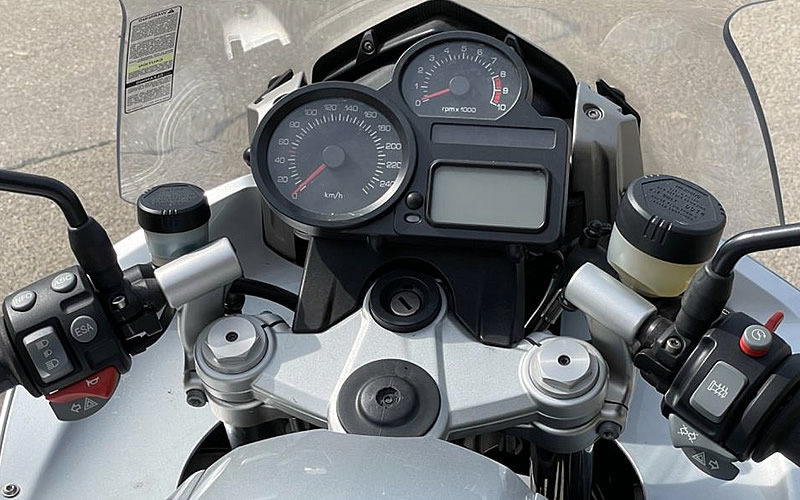
R 1200 ST, 2007 year, dashboard
BMW R nineT (2014-2023)
The BMW R nineT is an unfaired motorcycle from the vehicle manufacturer BMW. The naked bike, marketed under the English name "nineT", was presented on October 16, 2013, in celebration of the 90th anniversary of the motorcycle division at the BMW Museum in Munich. The motorcycle is assembled at the BMW plant in Berlin-Spandau. Production started on December 4, 2013, and sales began on March 8, 2014.
BMW categorized and marketed the motorcycle as a roadster. The internal model code is K21. Gradually, BMW introduced the variants Pure (K22), Scrambler (K23), Racer (K32), and Urban G/S (K33). To celebrate the 50th anniversary of the "Strich-Fünf" series, BMW sold the limited special model R nineT/5 in mid-2019. With the 2024 model year, two successor models were introduced, the R12 nineT and the R12.
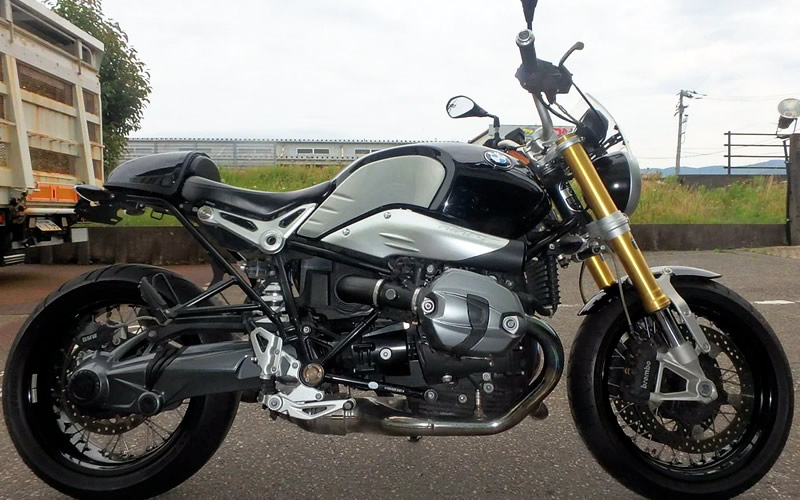
R nineT, 2015 year, right view
The air- and oil-cooled two-cylinder engine was taken almost unchanged from the R 1200 R and generates a rated output of 81 kW (110 hp). The boxer engine has a displacement of 1170 cm³, achieved from a bore of 101 mm and a stroke of 73 mm; the compression ratio is 12.0. The valves of the four-stroke engine are actuated by high-speed rocker arms from two chain-driven overhead camshafts. The crank pin offset of the two opposing pistons is 180°. A central balance shaft compensates for first-order mass moments that lead to engine vibrations and result from the design-related offset of the cylinders in the longitudinal direction. The six-speed gearbox features a claw-shift and has a shorter final drive ratio, derived from the former sport boxer R1200S.
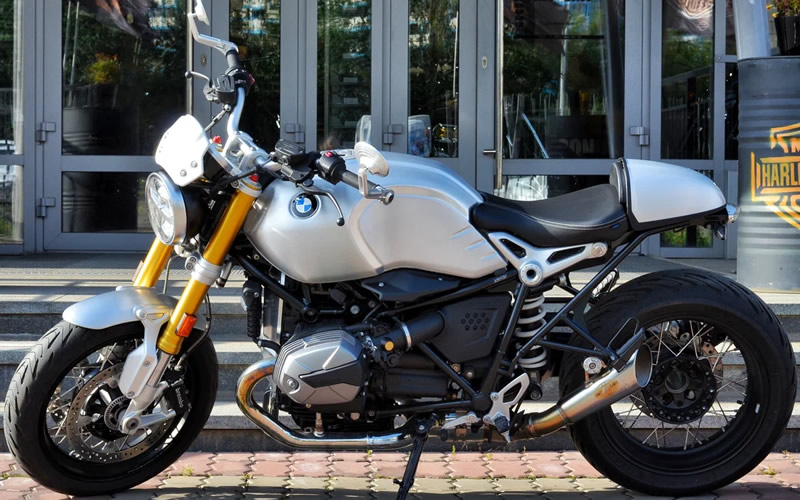
R nineT, 2021 year, left view
The motorcycle accelerates from 0 to 100 km/h in 3.6 seconds and reaches a top speed of 220 km/h. As of the 2021 model year, the R nineT meets the Euro 5 emission standard.
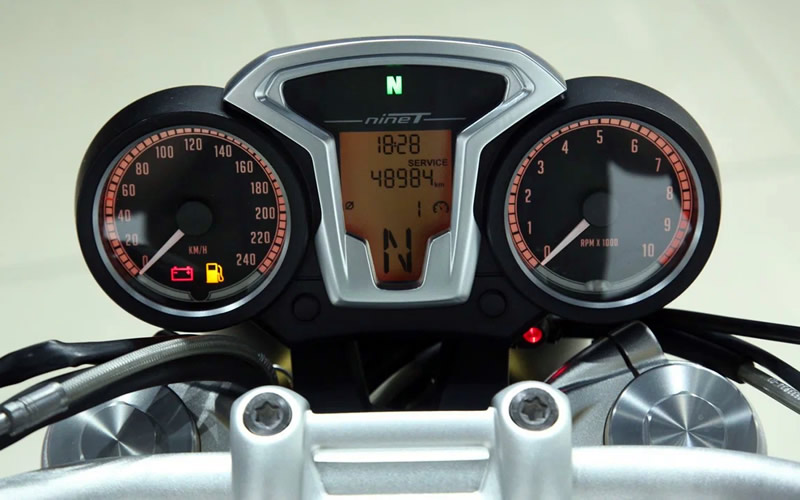
R nineT, 2016 year, dashboard
The four-part steel trellis frame consists of a front frame and a three-part rear frame with a load-bearing engine-transmission unit. The basic construction of the frame is based on a front frame section with an integrated steering head and a rear frame section with swingarm attachment. With the modular frame concept, the passenger footpeg assembly and the eight-bolt rear frame section can be disassembled and replaced.
- Information for owner
- Introduction to manual
- Maintenance
- Engine and systems
- Engine repair
- Fuel and exhaust systems
- Transmission
- Running gear and frame
- Frame and hinged elements
- Front suspension and handlebar
- Rear wheel drive
- Wheels and tires
- Brake system
- Electric equipment
- Equipment and devices
- Starting and charging system
Aprilia: RS-series Shiver (map) BMW: F-series R-series K-series (map) Ducati: ST series Monster (map) Harley: Street Sportster V-Rod (map) Honda: Africa Twin CB series VTX series (map) Kawasaki: ZX-6R Versys Vulcan (map) Suzuki: DR-Z V-Strom Boulevard (map) Triumph: Rocket Street Triple Tiger (map) Yamaha: Fazer DragStar R1 (map)