System description
The Rocket III is fitted with an electronic engine management system which encompasses control of both ignition and fuel delivery. The electronic control module (ECM) draws information from sensors positioned around the engine, cooling and air intake systems and precisely calculates ignition advance and fueling requirements for all engine speeds and loads.
In addition, the system has an on-board diagnostic function. This ensures that, should a malfunction occur in the engine management system, the malfunction type, and engine data at the time the malfunction occurred, are stored in the ECM memory. This stored data can then be recovered using a special service tool which is mandatory for all Triumph dealers. In this way, precise diagnosis of a fault can be made and the fault quickly rectified.
System sensors
Intake air temperature sensor - situated at the front of the intake duct, above the cam cover. As the density of the air (and therefore the amount of oxygen available to ignite the fuel) changes with temperature, an intake air temperature sensor is fitted. Changes in air temperature (and therefore air density) are compensated for by adjusting the amount of fuel injected to a level consistent with clean combustion and low emissions.
Barometric pressure sensor - situated beneath the motorcycle seat, in the top of the airbox. The barometric pressure sensor measures atmospheric air pressure. With this information, the amount of fuel per injection is adjusted to suit the prevailing conditions.
Manifold Absolute Pressure (MAP) sensor -situated at the front of the intake duct, above the cam cover, connected to each of the three throttle bodies by equal length tubes. The MAP sensor provides information to the ECM which is used at shallow throttle angles (very small throttle openings) to provide accurate engine load indications to the ECM. This degree of engine load accuracy allows the ECM to make very small adjustments to fuel and ignition which would otherwise not be possible from throttle angle data alone.
Clutch switch - situated on the clutch lever. The clutch must be pulled in for the starter motor to operate.
Crankshaft position sensor - situated in the alternator cover. The crankshaft position sensor detects movement of a toothed wheel attached to the alternator rotor.
The toothed wheel gives a reference point from which the actual crankshaft position is calculated. The crankshaft position sensor information is used by the ECM to determine engine speed and crankshaft position in relation to the point where fuel is injected and ignition of the fuel occurs.
Engine coolant temperature sensor - situated towards the front of the cylinder head, on the left hand side. Coolant temperature information, received by the ECM, is used to optimise fueling at all engine temperatures and to calculate hot and cold start fueling requirements.
Primary throttle position sensor - situated at the rear of the lower throttle spindle. Used to relay throttle position information to the ECM. Throttle opening angle is used by the ECM to determine fueling and ignition requirements for all throttle positions.
Secondary throttle position sensor - situated at the front of the upper throttle spindle. Used to relay secondary throttle position information to the ECM. Secondary throttle angle is used by the ECM to determine secondary throttle opening position under all engine running conditions.
Road speed sensor - situated in the lower crankcase, on the left hand side. The road speed sensor provides the ECM with data from which road speed is calculated and displayed on the speedometer. A vehicle speed limitation device also receives information from the road speed sensor.
Lambda sensor - situated in the exhaust header system upstream of the catalyst box. The lambda sensor constantly feeds in formation to the ECM on the content of the exhaust gases. Based on this information, adjustments to air/fuel ratio are made.
Side stand switch - situated at the top of the sidestand leg. If the sidestand is in the down position, the engine will not run unless the transmission is in neutral.
Sensor locations

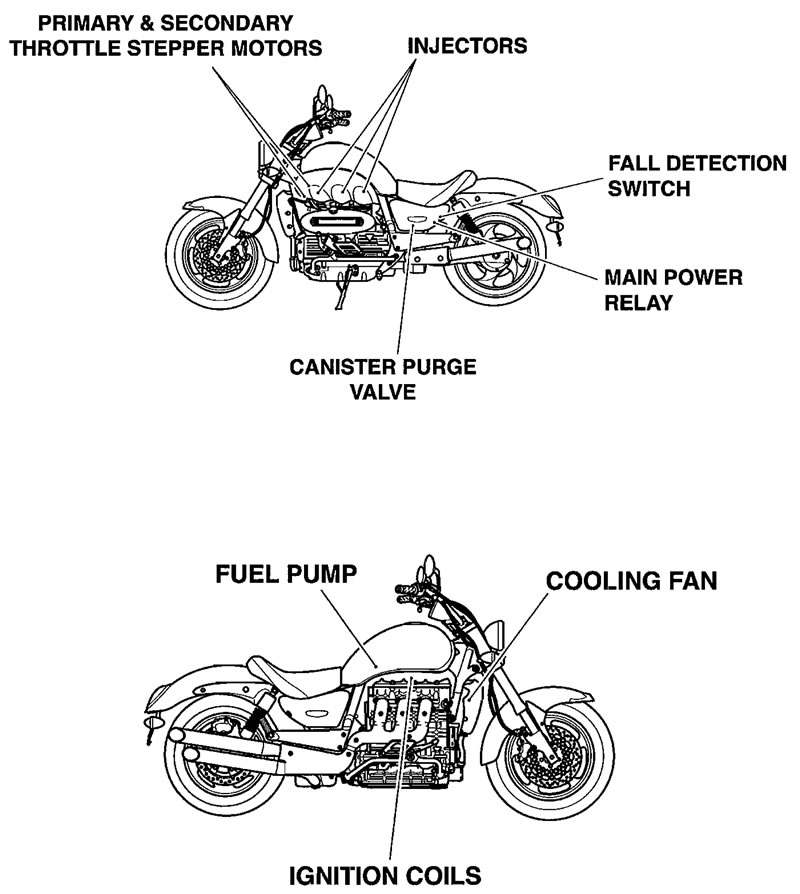
System actuators
In response to signals received from the sensors, the ECM controls and directs messages to a series of electronic and electro-mechanical actuators. The function and location of the actuators is given below.
Primary throttle stepper motor - situated at the front of the throttle bodies. The primary throttle stepper actuates a cam/lever which causes variations in the closed throttle position. Although used primarily to ensure target idle speed is maintained, it also increases throttle opening when the engine is cold.
Second throttle stepper motor - situated between the throttle bodies for numbers one and two cylinders. In response to direction from the ECM, the second throttle stepper motor moves the second throttle spindle to the position directed by the ECM. The second butterfly optimises engine torque by maintaining intake air flow speed. It does not act as a choke for cold start purposes.
Canister purge valve (California models only) - situated in the vapour return line between the carbon canister and the throttle bodies. The purge valve controls the return of vapour which has been stored in the carbon canister during the period when the engine is switched off. The valve is 'pulsed' by the ECM to give control over the rate at which the canister is purged.
Injectors - located in the throttle body assembly. The engine is fitted with three injectors. The spray pattern of the injectors is fixed but the length of time each injector can remain open is variable according to operating conditions. The duration of each injection is calculated by the ECM using data received from the various sensors in the system.
Ignition coils - mounted on a bracket, above the cam cover. There are three coils fitted, one for each pair of spark plugs. The ECM controls the point at which the coils are switched on and off. In calculating the switch-on time, the ECM allows sufficient time for the coils to charge to a level where a spark can be produced. The coils are switched off at the point of ignition, the timing of which is optimised for good engine performance.
Fall detection switch - situated behind the left hand side cover. The fall detection switch will detect if the motorcycle is on its side and will cut power to the ECM immediately. This prevents the engine from running and the fuel pump from delivering fuel. In the event of a fall, the switch is reset by returning the bike to an upright position and switching the ignition off then back on again.
Main power relay - situated behind the left hand side cover. When the ignition is switched on, the main power relay is powered up to provide a stable voltage supply for the ECM.
Fuel pump - located inside the fuel tank. The electric pump delivers fuel into the fuel system, via a pressure regulator, at a constant 3 bar pressure. The pump is run continuously when the engine is operating and is also run briefly when the ignition is first switched on to ensure that 3 bar is available to the system as soon as the engine is cranked. Fuel pressure is controlled by a regulator also situated inside the fuel tank.
Cooling fan - located behind the radiator. The ECM controls switching on and off of the cooling fan in response to a signal received from the coolant temperature sensor. When the coolant temperature rises to a level where the cooling effect of natural airflow is insufficient, the cooling fan is turned on by the ECM. When the coolant temperature falls sufficiently, the ECM turns the cooling fan off. The fan only becomes operational when the engine is running. It will not operate at any other time.
Note: In this system, the starter lockout system (clutch switch, neutral switch, sidestand switch) all operate through the engine management ECM.
Actuator locations