
Triumph:
Motorcycle engine repair Triumph Rocket III (Rocket, 2004-2018)
See this section in russian language

Exploded view — cam cover
Exploded view - cam cover
Exploded view - cam cover

Exploded view — camshaft and cam drive
Exploded view - camshaft and cam drive
Exploded view - camshaft and cam drive
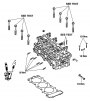
Exploded view — cylinder head
Exploded view - cylinder head
Exploded view - cylinder head

Cylinder head description
The engine is fitted with an aluminum alloy cylinder head, which carries the camshafts, valves and spark plugs. The cylinder head is cast as a single entity, to which various components are permanently added after machining. A silent-running cam...
The engine is fitted with an aluminum alloy cylinder head, which carries the camshafts, valves and spark plugs. The cylinder head is cast as a single entity, to which various components are permanently added after machining. A silent-running cam...

Cam cover — removal and installation
Warning! Before starting work, ensure the motorcycle is stabilised and adequately supported. This will help prevent it from falling and causing injury to the operator or damage to the motorcycle. Removal 1. Remove the rider's seat ( see page 17.9 )....
Warning! Before starting work, ensure the motorcycle is stabilised and adequately supported. This will help prevent it from falling and causing injury to the operator or damage to the motorcycle. Removal 1. Remove the rider's seat ( see page 17.9 )....

Cam chain tensioner — removal and installation
Warning! Before starting work, ensure the motorcycle is stabilised and adequately supported. This will help prevent it from falling and causing injury to the operator or damage to the motorcycle. Removal 1. Remove the cam cover ( see page 3.5 ). 2....
Warning! Before starting work, ensure the motorcycle is stabilised and adequately supported. This will help prevent it from falling and causing injury to the operator or damage to the motorcycle. Removal 1. Remove the cam cover ( see page 3.5 ). 2....

Camshafts — removal and installation
Warning! Before starting work, ensure the motorcycle is stabilised and adequately supported. This will help prevent it from falling and causing injury to the operator or damage to the motorcycle. Removal Note: Either camshaft can be removed from the...
Warning! Before starting work, ensure the motorcycle is stabilised and adequately supported. This will help prevent it from falling and causing injury to the operator or damage to the motorcycle. Removal Note: Either camshaft can be removed from the...
Valve clearances
Camshaft, valve, valve shim and valve seat wear affect the valve clearances. The effect of this wear is to change the clearance between the camshaft and the adjustment shim, causing engine noise and/or improper running. If the valve clearances are...
Camshaft, valve, valve shim and valve seat wear affect the valve clearances. The effect of this wear is to change the clearance between the camshaft and the adjustment shim, causing engine noise and/or improper running. If the valve clearances are...
Valve clearance adjustment
Note: Valve clearance checking and adjustment must be carried out with the engine cold. 1. Measure and record all valve clearances as described previously. 2. Remove the camshafts ( see page 3.9 ). 3. Remove a shim from one of the valves whose...
Note: Valve clearance checking and adjustment must be carried out with the engine cold. 1. Measure and record all valve clearances as described previously. 2. Remove the camshafts ( see page 3.9 ). 3. Remove a shim from one of the valves whose...

Cylinder head — removal and installation
Warning! Before starting work, ensure the motorcycle is stabilised and adequately supported. This will help prevent it from falling and causing injury to the operator or damage to the motorcycle. 1. Remove the fuel tank ( see page 11.100 ). 2. Drain...
Warning! Before starting work, ensure the motorcycle is stabilised and adequately supported. This will help prevent it from falling and causing injury to the operator or damage to the motorcycle. 1. Remove the fuel tank ( see page 11.100 ). 2. Drain...
Valves and valve stem seals — installation
Removal from the cylinder head 1. Remove each valve from the head using a valve spring compressor. The compressor must act on the top cup to allow removal of the valve collets. 2. Once the collets are released, remove the following items: collets...
Removal from the cylinder head 1. Remove each valve from the head using a valve spring compressor. The compressor must act on the top cup to allow removal of the valve collets. 2. Once the collets are released, remove the following items: collets...

Cam chain — inspection
An in-situ check can be made as follows: 1. Check for significant blue discolouration of the chain plates indicating excessive heat build-up. 2. Examine all pins for signs of rotation. 3. Check for cracking or deep scratching of the chain plates. 4....
An in-situ check can be made as follows: 1. Check for significant blue discolouration of the chain plates indicating excessive heat build-up. 2. Examine all pins for signs of rotation. 3. Check for cracking or deep scratching of the chain plates. 4....

Exploded view — crankshaft, connecting rod and piston
Exploded view - crankshaft, connecting rod and piston
Exploded view - crankshaft, connecting rod and piston

Exploded view — crankcase fixings
Exploded view - crankcase fixings
Exploded view - crankcase fixings
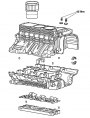
Exploded view — crankcase and liners
Exploded view - crankcase and liners
Exploded view - crankcase and liners

Crankcases — removal and installation
Warning! The following procedures often require lifting of heavy components. To avoid injury, always lift heavy components with a hoist or block and tackle and never attempt to manually lift items that are too heavy. Injury may result from failure...
Warning! The following procedures often require lifting of heavy components. To avoid injury, always lift heavy components with a hoist or block and tackle and never attempt to manually lift items that are too heavy. Injury may result from failure...

Crankshaft — removal and installation
Removal 1. Remove the engine from the frame ( see page 10.2 ). 2. Separate the lower and upper crankcases ( see page 5.5 ). 3. Lift the balancer out of the upper crankcase. Removing the balancer 4. Remove the connecting rod big end caps ( see page...
Removal 1. Remove the engine from the frame ( see page 10.2 ). 2. Separate the lower and upper crankcases ( see page 5.5 ). 3. Lift the balancer out of the upper crankcase. Removing the balancer 4. Remove the connecting rod big end caps ( see page...

Connecting rods — removal and installation
Removal Note: The connecting rods and cap are etch-marked on one side to identify their correct orientation. However, the cylinder from which they are individually removed should also be identified, using a laundry marker or similar. 1. Remove the...
Removal Note: The connecting rods and cap are etch-marked on one side to identify their correct orientation. However, the cylinder from which they are individually removed should also be identified, using a laundry marker or similar. 1. Remove the...

Connecting rod big end bearing selection/crankpin wear check
1. Measure the bearing and crankpin clearance as follows. Note: The crankpin clearances are measured using "Plastigage" (Triumph part number 3880150-T0301). Do not turn the connecting rod and crankshaft during the clearance measurement as this will...
1. Measure the bearing and crankpin clearance as follows. Note: The crankpin clearances are measured using "Plastigage" (Triumph part number 3880150-T0301). Do not turn the connecting rod and crankshaft during the clearance measurement as this will...
Crankshaft main bearing/journal wear
Using selective bearings compensates for minor differences in crankshaft main bearing journal and crankcase dimensions. For further information on bearing part number to colour cross-references, refer to the parts information system. 1. Measure the...
Using selective bearings compensates for minor differences in crankshaft main bearing journal and crankcase dimensions. For further information on bearing part number to colour cross-references, refer to the parts information system. 1. Measure the...

Pistons — disassembly and assembly
Disassembly 1. Remove the cylinder head and liners ( see page 3.5 ). Caution! The cylinder liners and pistons are made of aluminium alloy and can therefore be easily damaged. Handle the cylinder liner and piston with care, ensuring the internal bore...
Disassembly 1. Remove the cylinder head and liners ( see page 3.5 ). Caution! The cylinder liners and pistons are made of aluminium alloy and can therefore be easily damaged. Handle the cylinder liner and piston with care, ensuring the internal bore...

Cylinder liners — removal and installation
Removal 1. Mark each liner to identify correct orientation and the cylinder number from which it has been removed. 2. Turn the crankshaft until the piston in the liner to be removed is at the bottom of its stroke. 3. Check that the locking nut on...
Removal 1. Mark each liner to identify correct orientation and the cylinder number from which it has been removed. 2. Turn the crankshaft until the piston in the liner to be removed is at the bottom of its stroke. 3. Check that the locking nut on...

Exploded view — balancer
Exploded view - balancer Introduction In an engine with an even number of cylinders (i.e. 2, 4, 6 etc)., a piston on an upward stroke is always counter-balanced by one on a descending stroke. However, in an engine with an odd number of cylinders,...
Exploded view - balancer Introduction In an engine with an even number of cylinders (i.e. 2, 4, 6 etc)., a piston on an upward stroke is always counter-balanced by one on a descending stroke. However, in an engine with an odd number of cylinders,...

Balancer — removal and installation
Removal Warning! Before starting work, ensure the motorcycle is stabilised and adequately supported. This will help prevent it from falling and causing injury to the operator or damage to the motorcycle. 1. Remove the engine as described on page...
Removal Warning! Before starting work, ensure the motorcycle is stabilised and adequately supported. This will help prevent it from falling and causing injury to the operator or damage to the motorcycle. 1. Remove the engine as described on page...

Engine removal and refit
Removal Warning! Before starting work, ensure the motorcycie is stabilised and adequately supported. This will help prevent it from falling and causing injury to the operator or damage to the motorcycle. To gain access to the engine for removal: 1....
Removal Warning! Before starting work, ensure the motorcycie is stabilised and adequately supported. This will help prevent it from falling and causing injury to the operator or damage to the motorcycle. To gain access to the engine for removal: 1....
Similar subsections of other motorcycle models
Engine repair motorcycle Aprilia RS-series RS 125 (1998-2005, 3 generation)
Engine repair motorcycle Harley Sportster XL1200 (2012-2023)
Engine repair motorcycle Kawasaki Vulcan VN900 (2006-2024)
Engine repair motorcycle Yamaha Drag Star XVS 1100 (1998-2008)
- Information for owner
- Introduction to manual
- Engine and systems
- Engine repair
- Cooling system
- Lube system
- Fuel and control system
- Transmission
- Running gear and frame
- Frame and hinged elements
- Front suspension and handlebar
- Rear suspension
- Brake system
- Wheels and tires
- Electric equipment
- Equipment and devices
- Starting and charging system
- Electrical circuits
Aprilia: RS-series Shiver (map) BMW: F-series R-series K-series (map) Ducati: ST series Monster (map) Harley: Street Sportster V-Rod (map) Honda: Africa Twin CB series VTX series (map) Kawasaki: ZX-6R Versys Vulcan (map) Suzuki: DR-Z V-Strom Boulevard (map) Triumph: Rocket Street Triple Tiger (map) Yamaha: Fazer DragStar R1 (map)