
Note:
- A major cause of hidden electrical faults can be traced to faulty electrical connectors. For example:
- Dirty/corroded terminals.
- Damp terminals.
- Broken or bent cable pins within multi-plugs.
For example, the electronic control module (ECM) relies on the supply of accurate information to enable it to plan the correct fuelling and ignition timing. One dirty terminal will cause an excessive voltage drop resulting in an incorrect signal to the ECM.
If, when carrying out fault diagnosis, a fault appears to clear by simply disconnecting and reconnecting an electrical plug, examine each disconnected plug for the following.
Before disconnection:
- If testing with a voltmeter, the voltage across a connector should be virtually battery volts (unless a resistor is fitted in the circuit). If there is a noticeable change, suspect faulty/dirty connections.
When disconnecting a connector:
- Check for a security device that must be released before the connector can be separated. E.G. barb, hook and eye etc.
When inspecting a connector:
- Check that the individual pins have not been bent.
- Check for dampness/dirt/corrosion.
- Check cables for security.
- Check cable pin joints for damage.
When connecting a connector:
- Ensure there is no dirt around the connector/seal.
- Push together squarely to ensure
- terminals are not bent or incorrectly located.
- Push the two halves together positively.
Disconnection of ECM connectors
Note: Two different sized connectors are used in the ECM, which ensures correct connection is always made.
Caution! When disconnecting a connector, never pull directly on the wires as this may result in cable and connector damage.
Caution!
- Never disconnect an ECM when the ignition switch is in the ON position as this may cause multiple fault codes to be logged in the ECM memory.
- Always disconnect an ECM after disconnecting the battery negative (black) lead first.
1. Press down on the locking device and gently pull back on the connector to release it from the ECM.
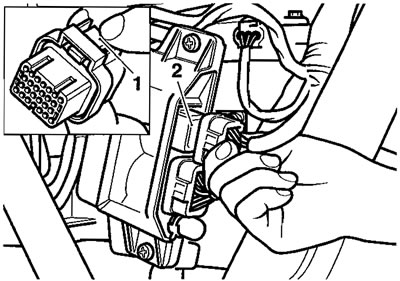
1. Locking device (inset); 2. Socket
Reconnection of ECM connectors
Caution! Damage to the connector pins may result if an attempt to fit the connectors incorrectly is made.
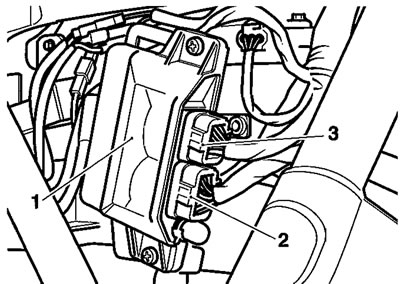
1. ECM; 2. Large connector; 3. Small connector
2. Fit the connector into its socket and, whilst holding the connector in place, insert it fully into the ECM until the locking device retains it.