MotoInstruction.ru
Mobile
version
Articles
& news
Site
map
Feed
back
Add to
bookmark
English Русский
Aprilia
BMW
Ducati
Harley
Honda
Kawasaki
Suzuki
Triumph
Yamaha
Honda:
Africa Twin▾
XRV750 (1989-2003) CRF1000L (2015-2020)
CB series▾
CB400SF [1] (1992-1999)
CBR series▾
CBR600RR (2007-2008)
VTX series▾
VTX1800C (2001-2008)
Gold Wing▾
GL1500 [4] (1987-2000)

Clutch — disassembly and assembly, replacement of discs and springs (Honda CB400SF/1)

  • Main
  • Honda
  • CB series
  • CB400SF [1]
  • Engine and systems
  • Transmission
  • Clutch — disassembly and assem…
0
Contents: Disassembly ↓ Clutch parts ↓ Assembly ↓
The motorcycle clutch is a multi-plate design and operates in an oil bath. The leading disks are made of a special friction material, the driven disks are made of steel. During operation of the motorcycle, the friction disks wear down, decreasing in thickness, the overall thickness of the disk pack decreases and the spring force is no longer enough for the clutch to transmit torque from the engine. The clutch begins to slip. At first, slippage appears only at high engine speeds and when the "gas" is opened sharply, but over time this effect begins to manifest itself at lower and lower speeds and as a result leads to the fact that the motorcycle is not able to move on its own at all. The clutch kit is subject to replacement at the first signs of slippage.

Disassembly


I. Drain the oil from the engine (see "Changing engine oil and oil filter").

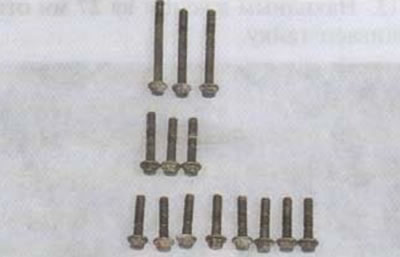
2. Using an 8 mm socket wrench, unscrew the 14 bolts securing the left engine cover.

2. Using an 8 mm socket wrench, unscrew the 14 bolts securing the left engine cover.


Attention! The crankcase cover bolts have different lengths. It is important to remember their location in order to install them in their proper places during assembly.


Attention! The crankcase cover bolts have different lengths. It is important to remember their…


3. Remove the cover.

3. Remove the cover.


4. To completely disconnect the cover, disconnect the generator wiring harness (the connector is located under the seat) or using a 5 mm Allen key, unscrew the four screws securing the generator stator to the cover.

4. To completely disconnect the cover, disconnect the generator wiring harness (the connector is…


5. Using a 10 mm open-end wrench, loosen the bolt securing the generator wiring harness retaining bracket.


5. Using a 10 mm open-end wrench, loosen the bolt securing the generator wiring harness retaining…


6. If the cover gasket has stuck to the surfaces and torn, remove the remains of the old gasket from the mating surfaces of the crankcase and cover.

7. To secure the rotating parts of the power unit, engage 1st gear and secure the rear brake pedal in the pressed position, for example, using a piece of rope.

8. Using a 10 mm open-end or socket wrench, unscrew the four bolts securing the release plate.
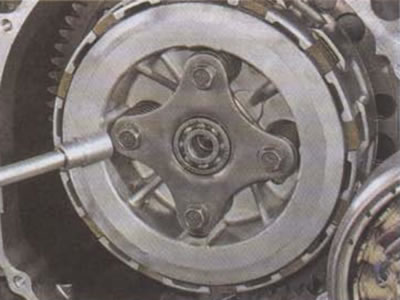
8. Using a 10 mm open-end or socket wrench, unscrew the four bolts securing the release plate.


9. Remove the plate assembly with the release bearing.

9. Remove the plate assembly with the release bearing.


10. Remove the clutch springs.


10. Remove the clutch springs.


11. Inspect the springs. If at least one of the springs is deformed or broken, the entire set must be replaced. Measure the height of the springs with a caliper.
  • The nominal height of the spring in a free state is 45.6 mm.
  • The minimum height of the spring in a free state is 41.7 mm.

If the height of at least one spring is less than specified or the springs have a difference in height of more than 1 mm, the entire set must be replaced.

Attention!
  • It is not allowed to replace springs one by one. Springs of different stiffness (old and new), installed in one package will cause the disks to become skewed during operation, which can lead to slippage, uneven wear of the disks and even their breakage.
  • The springs are color-coded according to their stiffness. When replacing, it is important to ensure that all springs are color-coded according to their stiffness.


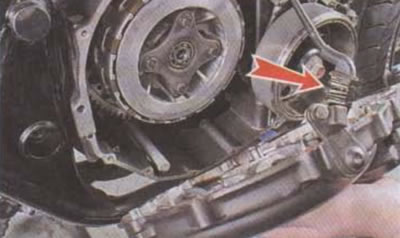
12. Bend back the punching hole of the central nut of the clutch basket (indicated by the arrow).

12. Bend back the punching hole of the central nut of the clutch basket (indicated by the arrow).


13. Using a 27 mm open-end wrench, unscrew the nut.

13. Using a 27 mm open-end wrench, unscrew the nut.


14. Remove the clutch thrust disc assembly with two spacer washers (installed on the gear side).

14. Remove the clutch thrust disc assembly with two spacer washers (installed on the gear side).
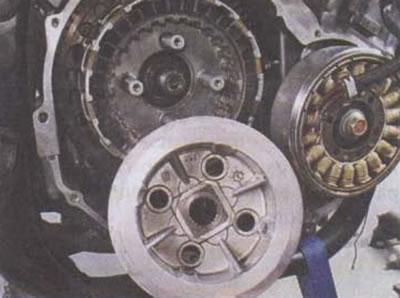

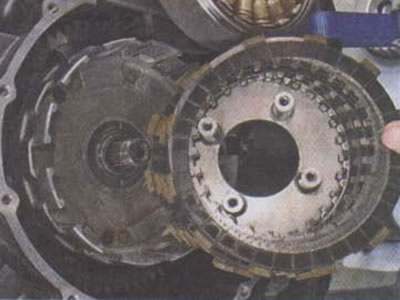
15. Remove the disc pack assembled with the pressure plate from the outer drum.

15. Remove the disc pack assembled with the pressure plate from the outer drum.


Attention! If the disks are installed back after inspection, it is important not to mix up their mutual arrangement and installation order. The disks rub against each other during operation and if installed incorrectly, the clutch may start slipping.


16. Inspect the set. Steel disks should not have deformations, traces of overheating, especially in the area of the teeth, and other mechanical damage. Friction disks should not have chips, cracks, or nicks. The thickness of the disk should be the same throughout the entire working part.

We measure the thickness of the discs.
  • Nominal disc thickness: 3.22-3.38 mm.
  • Nominal thickness of the thrust disc (narrow) - 3.42-3.58 mm.
  • Minimum disc thickness is 2.90 mm.
  • Minimum thickness of the thrust disc (narrow) - 3.10 mm.

If the thickness of at least one of the disks is less than the minimum permissible value, the entire set of disks must be replaced.

Attention! The clutch friction discs are replaced only as a set. It is not allowed to replace individual discs.


17. Check the condition of the clutch basket bearing. If the basket has play on the shaft, rotates with sticking, clicks or strong extraneous noise, the needle bearing must be replaced.
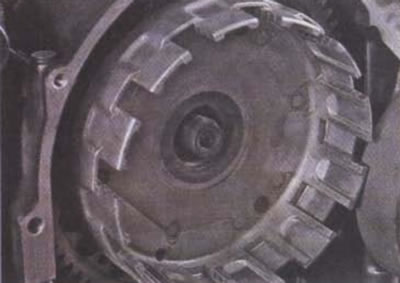
17. Check the condition of the clutch basket bearing. If the basket has play on the shaft, rotates…


18. Remove the basket from the shaft and replace the needle bearing (the bearing is mounted on the shaft without interference).

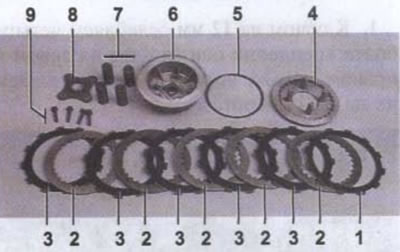
Clutch parts


1 - thrust (narrow) friction disc; 2 - steel disk; 3 - friction disc; 4 - pressure plate; 5 -…

1 - thrust (narrow) friction disc; 2 - steel disk; 3 - friction disc; 4 - pressure plate; 5 - thrust disc spacer washer; 6 - thrust disc; 7 - springs; 8 - release plate assembly with release bearing; 9 - mounting bolts


Assembly


We assemble the clutch in the reverse order.

We tighten the central nut to a torque of 80-85 Nm and punch its edge so that it fits into the groove of the shaft.

Tighten the release plate bolts to a torque of 25-30 Nm. The bolts should be tightened crosswise.

After assembly, adjust the clutch drive (see "Clutch cable - removal and installation, adjustment").
See this article in russian language
This article has been reviewed: Timofey Alexandrov
◀ Previous
Honda CB400SF 1: Transmission
 

Driven sprocket of the main transmission — inspection, removal…
Drive chain sprocket — inspection, removal and installation
Drive chain — replacement
Wheel drive chain flushing
 
Similar articles about motorcycles of other brands
Clutch — disassembly and assembly Suzuki V-Strom DL-650 (2004-2011)
Clutch assembly — exploded view Triumph Street Triple 765 (2017-2024)
Checking the clutch springs Yamaha FZ1 Fazer (2006-2015)
Clutch plate assembly — inspection Kawasaki ZX6R/ZX600J (2000-2002)
Clutch master cylinder and reservoir — removal,… Harley-Davidson V-Rod (2002-2006)
Link to this article in different formats
TEXTHTMLBB Code
Comments and feedback from visitors
No comments yet, you will be the first!


Add up two numbers: 14 + 37


CB400SF 1 (1992-1999) 
  • Information for owner
  • Operation manual
  • Maintenance
  • Engine and systems
  • Engine repair
  • Lube system
  • Cooling system
  • Fuel and exhaust system
  • Transmission
  • Running gear and frame
  • Wheels and tires
  • Front suspension and handlebar
  • Rear suspension
  • Brake system
  • Frame and hinged elements
  • Electric equipment
  • Equipment and devices
  • Ignition system
  • Starting and charging system
  • Lighting and alarm
  • Electrical circuits
Aprilia BMW Ducati Harley Honda Kawasaki Suzuki Triumph Yamaha
MotoInstruction.ru © 2021–2025 | Sitemap | Articles | Contacts | Site search | Add to bookmarks | Mobile version